Why Did OpenAI's Windsurf Acquisition Fall Apart?
TL;DR
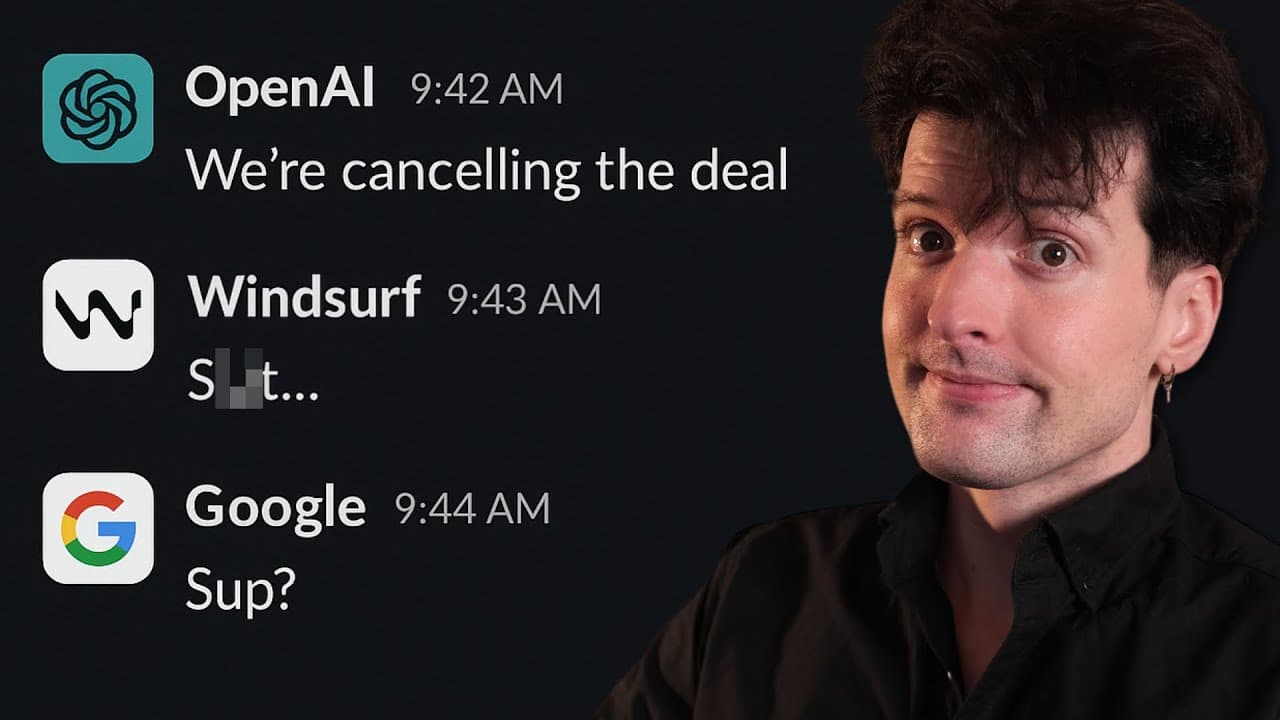
OpenAI's planned Windsurf acquisition did not happen, while Windsurf's CEO and other team members instead joined Google DeepMind without Google acquiring the company. The situation reflects an intense AI talent market where major companies use large investments, partial purchases, and direct recruiting to secure experienced researchers and product builders, sometimes leaving the original startup operating independently.
Transcript
Remember Windsurf, the $3 billion VS Code fork that was about to be purchased by OpenAI two months ago? I do and I've been waiting for the update on that for a while and today we got that update. The deals finally went through and now they are working. Huh? Big welcome to Verun and others from the Windsurf team joining Deep Mind. Deepmind's the Goo... Read More
Key Insights
- OpenAI's anticipated Windsurf acquisition did not close, despite Windsurf being described as a $3 billion VS Code fork that was about to be purchased two months earlier. The failed transaction set the stage for Google to recruit several prominent Windsurf team members.
- Google did not acquire Windsurf, according to the account presented. Windsurf's CEO and other employees left to join DeepMind, while the original company continued to exist separately, making the arrangement fundamentally different from purchasing the startup and all of its assets.
- AI talent is unusually difficult to replace because advanced model research, agent development, and training-data operations require specialized experience. The transcript argues that these capabilities cannot be acquired as quickly as engineers can learn a different application framework.
- Poaching is a central competitive strategy in the current AI market. Large companies are reportedly offering exceptional compensation and substantial equity to recruit researchers and builders from rivals rather than waiting to develop equivalent expertise internally.
- Meta's Scale AI transaction involved a $14.3 billion purchase of a 49% stake rather than a conventional full acquisition. Scale remained independent at an implied valuation of roughly $28.6 billion to $30 billion, while founder Alexander Wang joined Meta's leadership.
- Partial purchases can give startup stakeholders liquidity without transferring the entire company. In the Scale AI example, employees, founders, and investors reportedly received an opportunity to sell ownership, unlike equity holders who ordinarily must wait for an acquisition, an IPO, or another liquidity event.
- Similar talent-focused arrangements involved Character AI and Google, Inflection AI and Microsoft, Adept and Amazon, and Covariant. These examples support the video's argument that major technology companies increasingly pursue teams or leaders without completing standard acquisitions.
- The original Windsurf organization may face uncertainty because key leaders moved to DeepMind while the company stayed independent. The transcript raises concern that employees, investors, or other stakeholders could lose the expected benefits that a completed acquisition might have provided.
Install to Summarize YouTube Videos and Get Transcripts
Explore YouTube Video Summarizer or Get YouTube Transcript Extractor
Questions & Answers
Q: Why did OpenAI's Windsurf acquisition fall apart?
The provided transcript establishes that OpenAI's anticipated acquisition of Windsurf did not happen, but it does not give a confirmed, detailed cause for the transaction's failure. It instead focuses on the unexpected outcome: Windsurf's CEO and other team members joined Google DeepMind, while Windsurf remained independent. Any more specific explanation for why OpenAI withdrew or failed to close would go beyond the supplied material.
Q: Did Google acquire Windsurf after the OpenAI deal failed?
Google did not acquire Windsurf, according to the transcript. Instead, Windsurf's CEO and several other members of its team left the company to join Google DeepMind. Windsurf continued to exist as a separate organization and did not become part of Google. The distinction matters because recruiting a company's leaders does not automatically transfer its business, assets, employees, or investor obligations.
Q: What happened to Windsurf's CEO and team members?
Windsurf's CEO and an unspecified number of other team members joined Google DeepMind after the expected OpenAI transaction failed to materialize. The transcript emphasizes that these personnel moves were not an acquisition of Windsurf itself. Consequently, the departing individuals moved to Google, while Windsurf remained independent and other employees, investors, and stakeholders were left connected to the original company.
Q: Why are AI companies aggressively recruiting rival talent?
AI companies are recruiting rival talent because experienced researchers and product builders are portrayed as scarce and difficult to replace. Developing models, agent-based tools, and training-data operations requires knowledge accumulated through extended research and practical work. Large companies therefore spend heavily on compensation and equity to improve their chances of catching competitors or maintaining a lead in the AI market.
Q: How does the Scale AI transaction explain the Windsurf situation?
The Scale AI transaction provides an example of a company obtaining strategic talent without executing a standard full acquisition. Meta purchased 49% of Scale AI for $14.3 billion, Scale remained independent, and founder Alexander Wang moved into Meta's leadership to head a superintelligence research lab. The comparison shows how technology companies can prioritize founders and teams while leaving the underlying business legally separate.
Q: What was unusual about Meta's investment in Scale AI?
Meta's arrangement was unusual because it purchased a 49% stake for $14.3 billion rather than buying all of Scale AI. The transaction left Scale independent at an implied valuation of approximately $28.6 billion to $30 billion, while bringing founder Alexander Wang into Meta's leadership. It also reportedly allowed employees, founders, and investors to sell some ownership and obtain liquidity.
Q: Why does liquidity matter to startup employees and investors?
Startup equity usually cannot be readily converted into cash until a liquidity event occurs, such as an acquisition or IPO. The Scale AI transaction reportedly let employees, founders, and investors sell some of their ownership when Meta purchased its stake. That opportunity can be significant for early stakeholders whose shares have increased substantially in value but otherwise remain difficult or impossible to sell.
Q: What does the Windsurf outcome reveal about the AI market?
The Windsurf outcome suggests that major AI companies may value specialized teams and leaders as much as, or more than, entire businesses. Google recruited prominent Windsurf personnel without acquiring the company, while other firms have pursued comparable talent-focused arrangements. The trend creates intense competition for experienced people and can leave original companies and their remaining stakeholders facing operational and financial uncertainty.
Summary & Key Takeaways
-
OpenAI was reportedly preparing to purchase Windsurf, a VS Code fork valued at $3 billion, but the anticipated transaction did not happen. Google then recruited Windsurf's CEO and other team members into DeepMind. Windsurf remained an independent company rather than becoming part of Google, creating uncertainty about stakeholders left behind.
-
The broader context is an aggressive market for specialized AI talent. Meta, Google, Microsoft, Amazon, Cursor, and other organizations have used recruiting or unconventional transactions to obtain experienced founders, researchers, and product builders. Such people are difficult to replace because their expertise often comes from years of research and practical development.
-
Meta's Scale AI transaction illustrates how these arrangements can differ from ordinary acquisitions. Meta paid $14.3 billion for a 49% stake, while Scale remained independent and founder Alexander Wang moved into Meta's leadership. The transaction also reportedly offered employees, founders, and investors an opportunity to sell some of their ownership.
Read in Other Languages (beta)
Share This Summary 📚
Summarize YouTube Videos and Get Video Transcripts with 1-Click
Try YouTube Summary with ChatGPT & Claude or YouTube Transcript Generator
Explore More Summaries from Theo - t3․gg 📚






Summarize YouTube Videos and Get Video Transcripts with 1-Click
Try YouTube Summary with ChatGPT & Claude or YouTube Transcript Generator