Which Vibe Coding Tool Fits Your Skill Level?
TL;DR
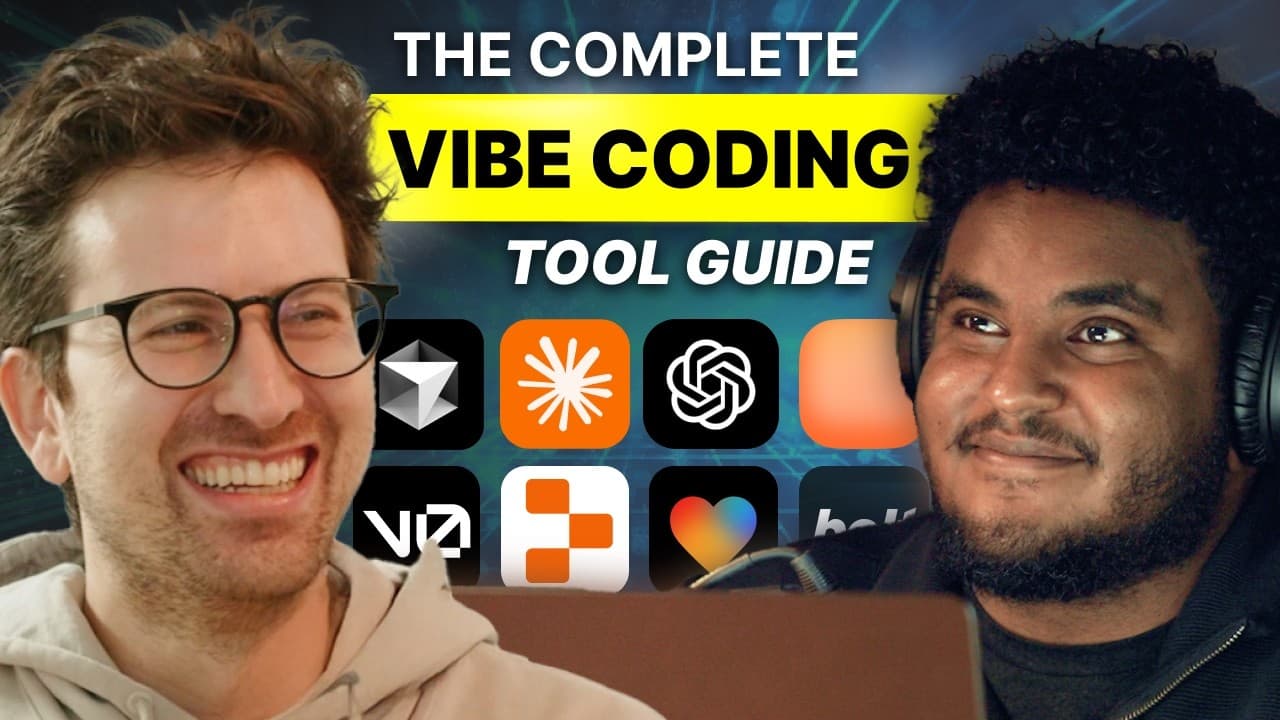
Choose a vibe coding tool according to your technical ability, target platform, and confidence in the team behind it. Cursor and Claude Code stand out for technical developers, while V0 offers non-technical builders a strong balance of accessibility and capability. Community support, integrations, platform stability, testing, and patient iteration can matter as much as raw technical performance.
Transcript
Mickey, by the end of this episode, what are we going to learn? >> We're going to know what's the best, what's the worst, what to use, what not to use. [music] And this is just our non-professional professional opinion. >> Okay. So, this is the definitive guide to vibe coding apps, right? >> Yes. This is the [music] ultimate tier list. And if this ... Read More
Key Insights
- Cursor is a developer-first tool that can cause friction for non-technical users. Working with repositories, installation commands, and development workflows requires knowledge that beginners may lack, although extensive tutorials and a large community make Cursor more approachable than similarly technical alternatives.
- Community support is a major factor in choosing a coding platform. The hosts argue that tutorials, documentation, external packages, and a large user base can matter alongside technical quality because they make problems easier to understand and resolve.
- Windsurf is technically stronger than its D-tier placement suggests. One host says its technology might otherwise merit a position between A-tier and B-tier, but team and founder developments reduced trust enough that he would not personally use it again.
- V0 is the preferred option among V0, Bolt, and Lovable for a non-technical vibe coder. Its templates, reusable components, Vercel integration, and marketplace choices give builders more options, while a real RSVP website project continued working in V0 after alternatives became unusable.
- Lovable Cloud reduces integration work for non-developers by abstracting backend setup and API-key handling. This addresses tasks that developers may consider trivial but beginners often find difficult, although the hosts still place Lovable around the boundary between A-tier and B-tier.
- Backend flexibility distinguishes V0 from Lovable. The discussion says Lovable selects Supabase as its backend, while Vercel's marketplace presents multiple backend options, creating different tradeoffs depending on the application a builder wants to create.
- Mobile vibe coding is becoming a distinct product category represented by Rork, Vibe Code App, and Anything. Vibe Code App is described as comparable to Lovable for mobile applications, and the hosts identify mobile consumer products as an area with meaningful opportunity.
- Successful vibe coding requires time, testing, and iteration rather than a handful of prompts. The hosts emphasize a mindset shift for non-technical builders because creating real software remains an involved process even when AI makes coding more accessible.
Install to Summarize YouTube Videos and Get Transcripts
Explore YouTube Video Summarizer or Get YouTube Transcript Extractor
Questions & Answers
Q: Which vibe coding tool is best for non-technical builders?
V0 receives the strongest recommendation for a non-technical vibe coder among the discussed web application builders. The hosts value its templates, reusable components, marketplace integrations, and close connection with Vercel. One host also reports that V0 was the only option that did not become unusable while he was creating an RSVP website with several AI tools.
Q: Is Cursor suitable for someone who cannot code?
Cursor can be used by a determined non-technical builder, but the hosts expect that person to experience friction. Opening the tool, forking a repository, installing packages, and running package commands all assume familiarity with development workflows. Cursor is still more approachable than some technical alternatives because it has numerous tutorials and a large supporting community.
Q: Why does community size matter when choosing an AI coding tool?
A large community provides tutorials, documentation, support, and external packages that help users solve problems beyond the tool's core capabilities. The hosts compare this advantage to the broad adoption of React and Next.js. Their point is that technical merit alone does not determine usefulness, because accessible guidance can make a platform substantially easier to adopt and maintain.
Q: Why was Windsurf placed in D-tier despite its technology?
Windsurf's D-tier placement reflects concerns about trust rather than a judgment that its technology is poor. One host says the tool might otherwise belong between A-tier and B-tier based on earlier use. However, developments involving the founder and team reduced his confidence in the platform, and he also considers Windsurf highly technical and primarily suited to developers.
Q: How do Lovable Cloud integrations help non-developers?
Lovable Cloud addresses the difficult integration work that previously affected tools such as Lovable and Bolt. Non-developers could struggle with selecting a backend, creating accounts, connecting services, and copying API keys. According to the discussion, Lovable Cloud abstracts much of that setup and fetches the required information when a project starts, making initial development less burdensome.
Q: Why do the hosts prefer V0 over Lovable and Bolt?
The preference for V0 comes from its wider integration choices, templates, reusable components, Vercel connection, and demonstrated reliability in one host's project. Lovable chooses Supabase as its backend, while Vercel's marketplace offers multiple backend options. The hosts place Lovable and Bolt near the A-tier and B-tier boundary, but position V0 above both for non-technical builders.
Q: What tools can be used for mobile vibe coding?
Rork, Vibe Code App, and Anything are identified as part of a newer category focused on creating mobile applications. The hosts have not used every option extensively, so they avoid making equally firm rankings for all of them. They describe Vibe Code App as similar to Lovable for mobile development and see opportunity in consumer mobile applications discovered through TikTok.
Q: What mindset should non-technical vibe coders adopt?
Non-technical builders should expect software creation to require time, repeated testing, troubleshooting, and iteration. AI assistance does not mean a dependable product will appear after five prompts. The hosts recommend treating vibe coding as real software development, while also evaluating the platform's community, integrations, team stability, founder vision, and suitability for the builder's technical level.
Summary & Key Takeaways
-
The rankings separate developer-focused tools from platforms designed for non-technical builders. Cursor receives an A-tier placement, with one host considering it closer to S-tier, because of its capabilities, tutorials, and large community. However, basic development tasks such as handling repositories and package commands can create substantial friction for beginners.
-
Among accessible web application builders, V0 receives the strongest endorsement. The hosts place Lovable and Bolt around the boundary between A-tier and B-tier, while V0 ranks higher because of its templates, reusable components, marketplace integrations, Vercel connection, and its success when other tested tools failed during an RSVP website project.
-
Tool selection involves more than technical output. The hosts consider founder commitment, team stability, documentation, ecosystem breadth, backend integration, and long-term platform direction. They also argue that successful AI-assisted software development requires realistic expectations, repeated testing, and iteration rather than assuming a useful product will emerge after only five prompts.
Read in Other Languages (beta)
Share This Summary 📚
Summarize YouTube Videos and Get Video Transcripts with 1-Click
Try YouTube Summary with ChatGPT & Claude or YouTube Transcript Generator
Explore More Summaries from Greg Isenberg 📚




Summarize YouTube Videos and Get Video Transcripts with 1-Click
Try YouTube Summary with ChatGPT & Claude or YouTube Transcript Generator