AI News: Infinite Video, 4K Images, DeepSeek & Quantum Leap
TL;DR
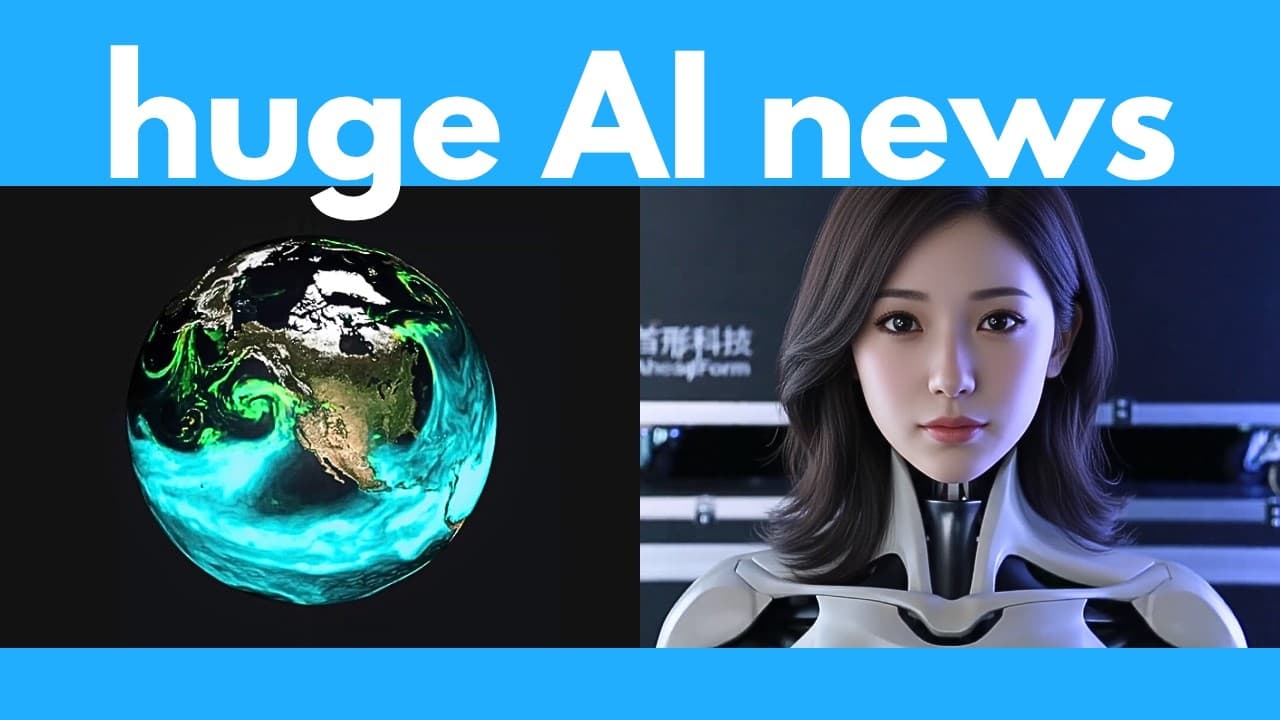
This week's open-source AI releases include Hunyuan World Mirror for flexible 3D world generation, HoloCine for coherent multi-shot long videos, DyPE for native 4K image generation, and Krea Realtime 14B for real-time video. Google achieved a quantum computing breakthrough, OpenAI launched the ChatGPT Atlas browser, and DeepSeek released a new model.
Transcript
AI never sleeps and this week has been absolutely insane. This AI can generate extremely highresolution images natively. And instead of images, we have another AI that can create 4K videos, and these are all free and open- source. Deepseek releases a banger that might change how we design future AI models. Google achieves a huge breakthrough in qua... Read More
Key Insights
- Hunyuan World Mirror is Tencent's open-source 3D world generator that accepts an image, camera intrinsics, depth maps, or poses, and can output camera parameters, depth maps, and normal estimation. The models are on HuggingFace and total only 5 GB.
- HoloCine, from Ant Group, generates entire multi-shot long videos from a single text prompt using a global caption plus numbered shot captions, keeping background, colors, and character appearance consistent across shots.
- Traditional video models can only generate isolated clips of about 5 to 10 seconds, which is the problem HoloCine solves by producing longer coherent videos; its default is 10 seconds at 24 frames per second.
- HoloCine is based on Wan 2.2 14B, the latest and best open-source version of Wan, and works best for cinematic shots rather than high-action or physically challenging scenes like gymnastics.
- DyPE is an open-source AI that generates native high-resolution 4K images, adding sharper detail than Flux alone, which often gets parts wrong at very high resolution.
- Inpaint4Drag lets users paint over image areas to mask them, then draw arrows to move objects, roughly repositioning them before AI stitches everything together seamlessly.
- Krea Realtime 14B is based on Alibaba's Wan 2.1 14B with a self-forcing technique, achieving text-to-video inference at 11 frames per second on a single Nvidia B200 GPU.
- Google achieved a quantum computing breakthrough and released updates for Google Earth AI, while OpenAI launched the ChatGPT Atlas web browser to challenge Google Chrome.
Install to Summarize YouTube Videos and Get Transcripts
Explore YouTube Video Summarizer or Get YouTube Transcript Extractor
Questions & Answers
Q: What is Hunyuan World Mirror and how does it work?
Hunyuan World Mirror is Tencent's open-source 3D world generator, described as the most flexible one available. You can input an image as a reference, and also add camera intrinsics, depth maps, or poses in any combination to control the output. It maps all your controls together to generate the 3D world, and can also generate camera parameters, depth maps, and normal estimation. It reconstructs rooms from multiple photos and estimates camera positions, producing either 3D point maps or complete Gaussian scenes.
Q: How do you generate long multi-shot videos with HoloCine?
HoloCine, from Ant Group, generates entire multi-shot long videos from a text prompt. You format the prompt with a global caption defining the overall scene, then denote each character with a number like character one and character two. You specify how many shots the scene contains and list each shot, for example a wide shot, then a medium shot, then a closeup. The default is 10 seconds at 24 frames per second, but you can make it longer. It keeps the background, colors, and characters consistent across shots.
Q: What is DyPE and how does it compare to Flux?
DyPE is an open-source AI that natively generates super high-resolution 4K images with sharp, detailed results across faces, grass, fingers, buildings, and armor. You could use an existing open-source model like Flux to generate a 4K image, but the result is worse and Flux often gets some parts wrong at such high resolution. Plugging in DyPE adds much more detail and produces a truly 4K image. The code has been released on GitHub for local use.
Q: How does Inpaint4Drag edit images?
Inpaint4Drag edits images through a drag-based workflow. First, you paint over the areas of the image you want to edit, and it automatically selects or masks those areas. Second, you draw arrows that control how you want to move the objects. It then roughly moves the objects and uses AI to stitch everything together seamlessly, producing the final result. Examples include moving a wing up, shifting a panda left, or raising an arm. Unlike Nano Banana, which uses text prompts, you draw directly over the image to dictate movement. The code and a Colab demo are available.
Q: What GPU does Krea Realtime 14B need for real-time video?
Krea Realtime 14B is an open-source video model based on Alibaba's Wan 2.1 14B, with a new self-forcing technique added. It can achieve text-to-video inference at a speed of 11 frames per second on a single Nvidia B200. The caveat is that you still need a beast of a GPU to actually generate real-time videos, so you will not be able to do real time on a typical consumer machine. It represents progress toward generating videos in real time.
Q: What breakthroughs did Google announce this week?
Google achieved a huge breakthrough in quantum computing, referenced in the video and linked in the description as a quantum echoes and verifiable quantum advantage announcement. Google also released powerful updates for Google Earth AI, giving more access to the platform. These were highlighted alongside other major weekly AI developments, though the transcript focuses more detail on the open-source 3D, image, and video tools than on the specifics of the Google announcements.
Q: What are the hardware requirements to run Hunyuan World Mirror locally?
To run Hunyuan World Mirror locally, you need a CUDA GPU. The GitHub repo contains instructions on how to download and run it on your computer. The developers did not specify the minimum VRAM requirements on the main page. However, the HuggingFace repo shows that all the models total only 5 GB in size, so you should be able to run it using most consumer-grade GPUs, making it accessible to a wide range of users.
Q: What other AI tools and products were announced in this week's news?
Beyond the 3D and video tools, OpenAI launched ChatGPT Atlas, a new web browser that plans to challenge Google Chrome. DeepSeek released a model, referenced as DeepSeek OCR in the description, described as a banger that might change how future AI models are designed. There was also a new semantic 3D model editor for editing 3D models with a text prompt, two new open-source long-video models generating consistent video, new humanoid robot demos, and Google Earth AI updates.
Summary & Key Takeaways
-
Tencent's Hunyuan World Mirror is a flexible open-source 3D world generator accepting images, camera intrinsics, depth maps, or poses in any combination. It reconstructs rooms from multiple photos, estimates camera positions, and generates point maps or complete Gaussian 3D scenes. The 5 GB models are on HuggingFace and run on most consumer GPUs with CUDA.
-
Ant Group's HoloCine generates coherent multi-shot long videos from a single text prompt using a global caption and numbered shot captions. Examples with five or six shots follow the prompt exactly while keeping the scene, colors, and characters consistent. Based on Wan 2.2 14B, it excels at cinematic shots but struggles with high-action scenes.
-
DyPE generates native 4K images with far more detail than Flux alone, while Inpaint4Drag enables drag-based image editing, and Krea Realtime 14B reaches 11 fps on an Nvidia B200. Google made a quantum computing breakthrough, updated Google Earth AI, OpenAI launched ChatGPT Atlas, and DeepSeek released a new model.
Read in Other Languages (beta)
Share This Summary 📚
Summarize YouTube Videos and Get Video Transcripts with 1-Click
Try YouTube Summary with ChatGPT & Claude or YouTube Transcript Generator
Explore More Summaries from AI Search 📚




Summarize YouTube Videos and Get Video Transcripts with 1-Click
Try YouTube Summary with ChatGPT & Claude or YouTube Transcript Generator