How to Synthesize Luminol for Chemiluminescence
TL;DR
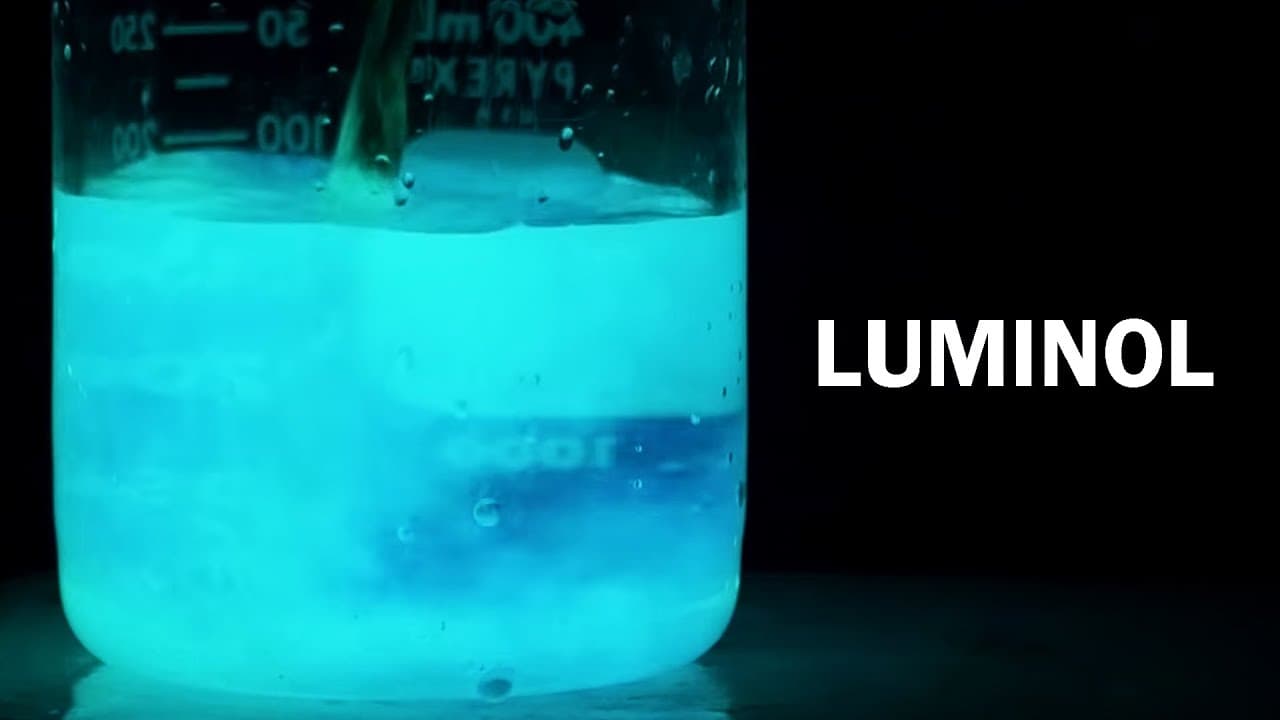
To synthesize luminol, react 3-nitrophthalic acid with hydrazine sulfate, followed by reduction of the nitro group to an amine using sodium dithionite in basic conditions. Luminol is known for its use in forensics to detect blood traces, emitting a blue glow when oxidized.
Transcript
luminol is a pretty interesting molecule that displays something called chemiluminescence this is just a fancy word which means that light is emitted due to a chemical reaction so in luminol is mixed with an appropriate oxidizer it will glow a very nice blue color although the glow is relatively brief it's still pretty impressive to see the final s... Read More
Key Insights
- 🙂 Luminol is a molecule with chemiluminescent properties, producing light through a chemical reaction.
- 😒 The synthesis of luminol involves the use of precursors such as phthalic anhydride and urea.
- 🕵️ Luminol has practical applications in forensics, particularly for detecting blood traces in crime scene investigation.
- ❓ Chemiluminescence demonstrations using luminol can be found in educational settings and chemical experiments.
- 💄 Luminol can be synthesized using readily available chemicals and equipment, making it accessible for experimentation.
- 🛩️ The yield of luminol synthesis can vary, but even a small amount of luminol is sufficient for many applications.
- 👻 The addition of a base increases the solubility of luminol, allowing for the creation of luminol solutions.
Install to Summarize YouTube Videos and Get Transcripts
Explore YouTube Video Summarizer or Get YouTube Transcript Extractor
Questions & Answers
Q: What is chemiluminescence and how does luminol exhibit this property?
Chemiluminescence is the emission of light resulting from a chemical reaction. Luminol, when mixed with an appropriate oxidizer, glows blue due to chemiluminescence.
Q: What are the main precursors used in the synthesis of luminol?
The synthesis of luminol involves two main precursors: phthalic anhydride, extracted from gloves, and urea, obtained from cold packs.
Q: How is luminol used in forensics to detect blood?
Luminol solution can be sprayed on surfaces, and when it comes into contact with blood, it lights up. This allows investigators to detect traces of blood that may not be visible to the naked eye.
Q: What are some other potential applications of luminol?
Besides forensics, luminol can also be used in chemistry experiments, educational demonstrations, and other fields where chemiluminescence properties are of interest.
Summary & Key Takeaways
-
Luminol is a molecule that exhibits chemiluminescence, meaning it produces light through a chemical reaction.
-
The synthesis of luminol involves two convergent pathways using precursors such as phthalic anhydride and urea.
-
Luminol has applications in forensics, specifically for detecting blood traces that are otherwise invisible to the naked eye.
Read in Other Languages (beta)
Share This Summary 📚
Summarize YouTube Videos and Get Video Transcripts with 1-Click
Try YouTube Summary with ChatGPT & Claude or YouTube Transcript Generator
Explore More Summaries from NileRed 📚




Summarize YouTube Videos and Get Video Transcripts with 1-Click
Try YouTube Summary with ChatGPT & Claude or YouTube Transcript Generator