How Zapier Central AI Bots Automate Your Workflows
TL;DR
Zapier Central introduces AI Bots that turn natural-language prompts into automated workflows across Zapier's 7,000+ integrations. Users describe a task in plain English, equip the bot with actions like Google Calendar or Slack, then test and correct it with feedback the bot saves into its own instructions. The bots run tasks autonomously and can self-heal broken automations.
Transcript
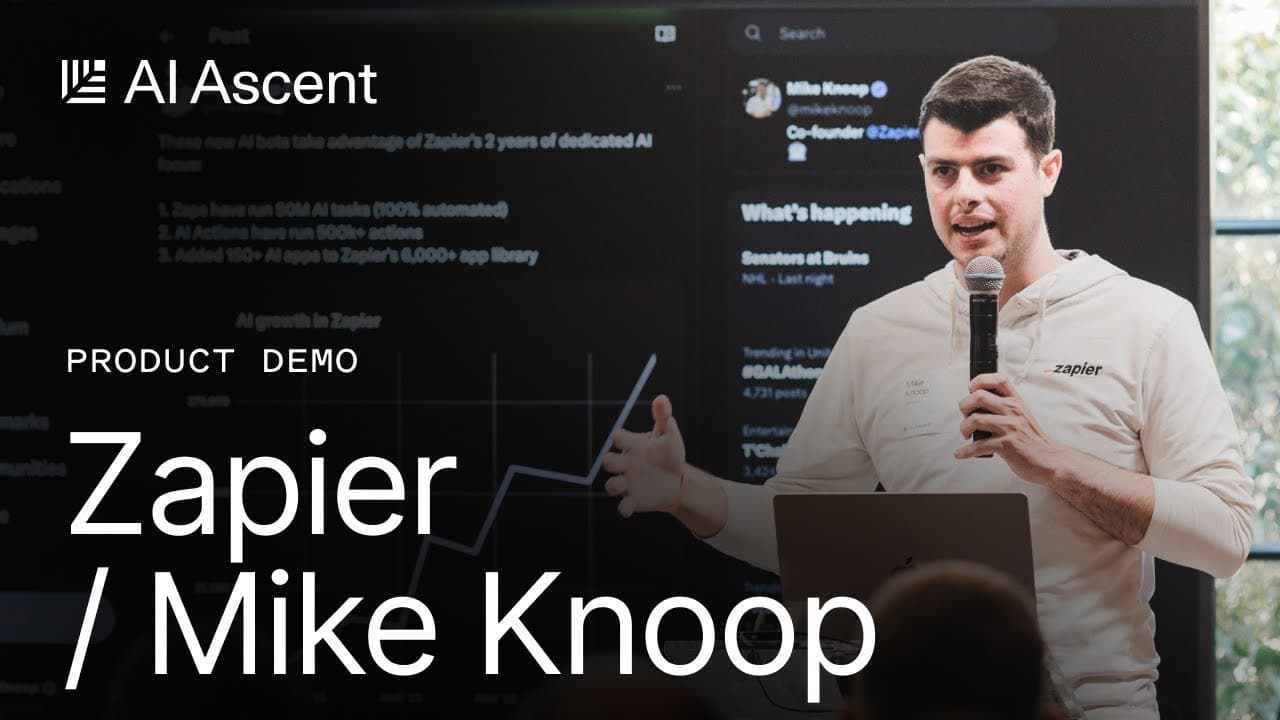
okay up next we have found our demos Mike from zappier which rhymes with happier is uh is gonna show us a little bit of what they've been working on over at zapier hey everyone I'm Mike uh one of the co-founders of zapier uh thank you Sonia and Pat for inviting me back this year to uh show something new uh one year ago I was here we were launching ... Read More
Key Insights
- Zapier Central AI Bots are a ground-up reimagining of automation designed so more people can discover, figure out, and adopt automation using AI, removing the steep learning curve of Zapier Classic's structured canvas view.
- Zapier has run over 50 million fully automated AI tasks on behalf of users, where a task is something completely hands-off and 100 percent automated, reflecting how much agentic activity already happens on the platform.
- Behaviors are how users customize what AI Bots do, including running tasks in the background on a schedule even when the user is away from their computer, such as summarizing daily calendar meetings each morning.
- AI Bots can guess and infer values completely zero-shot and unprompted using Zapier's AI actions technology, but real users often want deterministic control over decisions to expand the range of supported use cases.
- The bots have self-healing capabilities inside agentic loops, so when a spreadsheet column is renamed and would classically break a rigid Zap, the natural-language system can debug, loop, and fix the automation automatically.
- AI Bots learn from user feedback by using an update-instructions tool, feeding corrections like proper Slack message formatting back into their instructions so future autonomous runs apply the fix.
- Zapier named the product Bots because usage data over 10 years showed over a million people already named their Zaps with the word bot, making it a natural and colloquial term for these systems.
- Zapier Central works with all of Zapier's over 7,000 integrations, so although the demo used just two apps, the same natural-language automation extends across the entire integration catalog.
Install to Summarize YouTube Videos and Get Transcripts
Explore YouTube Video Summarizer or Get YouTube Transcript Extractor
Questions & Answers
Q: What is Zapier Central and what problem does it solve?
Zapier Central is a new product containing AI Bots, described as a ground-up reimagining of AI automation. Its entire goal is to help more people successfully use, figure out, discover, and adopt automation using AI. It solves the problem that Zapier Classic's canvas view requires lots of structure, configuration, and nitty-gritty detail, creating a big learning curve that depresses the number of people who can successfully adopt Zapier.
Q: How do you set up an AI Bot to automate a workflow?
You start with a blank-slate bot that behaves like a standard chat interface, then customize it by building a behavior. In the demo, Mike typed a prompt to schedule every morning, get the list of today's meetings from Google Calendar, summarize them into short bullets with emojis, and send the summary to himself on Slack with a fun automation-inspired quote. The bot then suggests a schedule trigger and relevant actions to equip.
Q: How many AI tasks has Zapier run and what counts as a task?
Zapier has run over 50 million AI tasks. A task is basically something that is completely automated on a user's behalf, entirely hands-off and 100 percent automated. Additionally, over the prior year Zapier executed over half a million AI actions, an API that translates natural language into executed API calls, which was launched as V1 one year before this demo.
Q: What does it mean that AI Bots have self-healing capabilities?
Self-healing means the bots, hooked up in agentic loops, can recover from situations that would classically break a rigid Zap. For example, if a workflow is connected to a Google spreadsheet and a teammate changes a column name, a classic Zap would break and get stuck, sending an error email and requiring manual debugging. These natural-language systems can instead debug automatically, loop, and fix the problem for the user.
Q: How do AI Bots learn from user feedback?
Users can give bots feedback in natural language, telling them what they did well or badly and how to fix it. In the demo, Mike told the bot to use Slack message formatting after noticing the links were not formatted correctly. The bot used a tool called updating instructions to feed that feedback back into its own instructions, so the next time it runs live and autonomously it applies the correction.
Q: Why did Zapier name the product AI Bots?
Zapier chose the name after reviewing usage data of Zapier Classic over the previous 10 years. A major theme was that people tend to call their Zaps bots. Over a million people had named their Zaps with the word bot in them. Zapier decided to adopt that name because it seemed like a good, colloquial way to refer to what these automated systems actually are.
Q: How many integrations does Zapier Central work with?
Zapier Central works with all of Zapier's integrations, which number over 7,000. Although Mike's demo used only two apps, Google Calendar and Slack, he emphasized that the magic of Zapier is its support for over 7,000 integrations, and Zapier Central works with all of them, extending natural-language AI automation across the entire catalog rather than being limited to a few connected apps.
Q: Do AI Bots require you to manually configure every value?
No. Out of the box the bots will guess everything, taking advantage of the AI actions technology built over the prior year. They try to infer and act completely unprompted and zero-shot, so selecting specific calendar or Slack values is not required. However, Zapier learned from real users that guessing does not always work, and many use cases benefit from giving users more deterministic control over how the bot makes decisions.
Summary & Key Takeaways
-
One year after launching V1 of AI actions, an API translating natural language into executed API calls, Zapier executed over half a million such calls and ran over 50 million fully automated AI tasks, all completely hands-off on behalf of users.
-
Zapier Central's AI Bots let users type a plain-English prompt, such as scheduling a 5 am daily summary of Google Calendar meetings sent to Slack with emojis and a quote. The bot suggests triggers and actions and can run in the background.
-
The bots test behaviors using threaded context, guess values zero-shot, self-heal broken automations, and learn from natural-language feedback by updating their own instructions. They work across all 7,000-plus Zapier integrations, with reliability and consistency as key roadmap priorities.
Read in Other Languages (beta)
Share This Summary 📚
Summarize YouTube Videos and Get Video Transcripts with 1-Click
Try YouTube Summary with ChatGPT & Claude or YouTube Transcript Generator
Explore More Summaries from Sequoia Capital 📚




Summarize YouTube Videos and Get Video Transcripts with 1-Click
Try YouTube Summary with ChatGPT & Claude or YouTube Transcript Generator