How to learn quantum computing basics from scratch
TL;DR
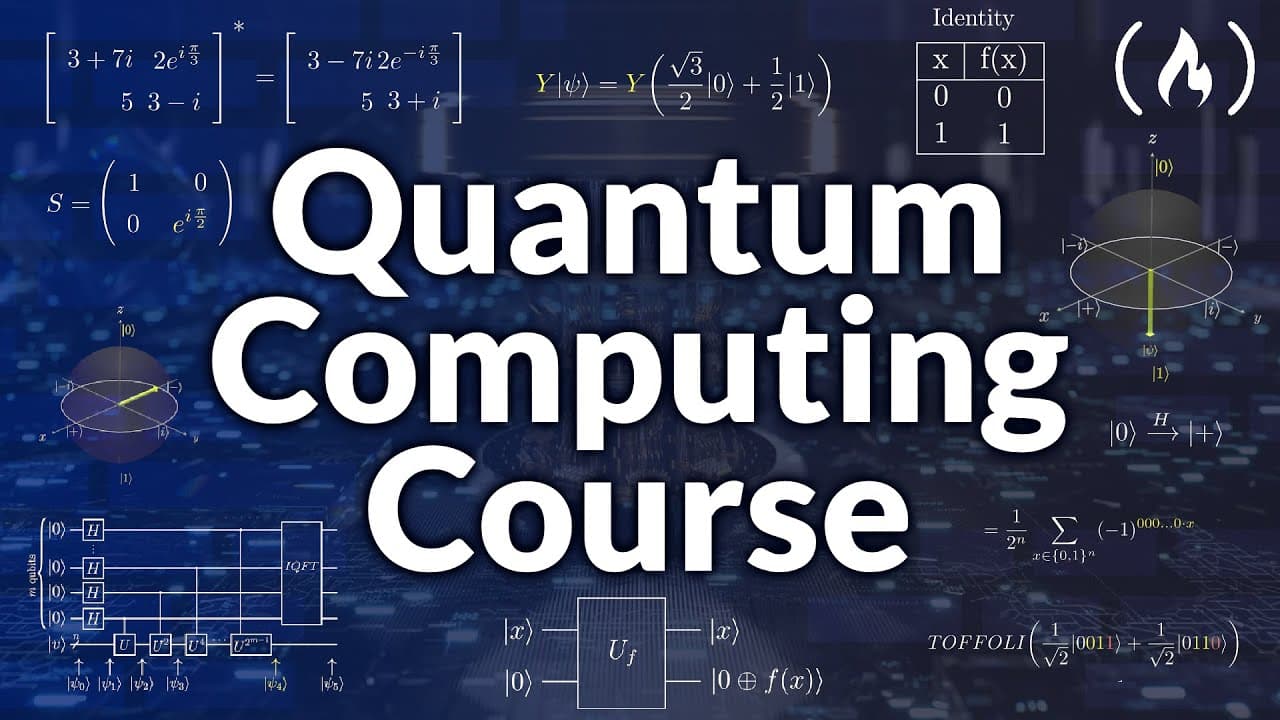
The course builds a solid foundation in quantum computing starting with complex numbers and matrices and then moving to qubits gates and entanglement. It emphasizes mathematics over analogies and shows how quantum states transform with unitary operations and measurements guiding the way to understanding quantum algorithms.
Transcript
Quantum Computing leverages the principles of quantum mechanics to process information at incredible speeds this course provides a solid foundation in Quantum Computing from the ground up taking you from the basics to a thorough understanding of how popular Quantum algorithms work the first section covers all the essential mathematics and the secon... Read More
Key Insights
- Complex numbers and their operations extend to complex numbers on the number plane and are essential for representing quantum states.
- Matrices and vectors form the backbone of quantum transformations, with matrix multiplication acting as state changes when applied to column vectors.
- Unitary matrices preserve the length of quantum state vectors, a property critical for maintaining valid probability amplitudes after transformations.
- Hermitian matrices and their properties relate to observable quantities in quantum systems, influencing measurement outcomes.
- Qubits enable superposition, allowing quantum states to encode multiple classical states simultaneously for computation.
- Quantum gates manipulate qubits, with single qubit gates and phase operations forming the basic building blocks of circuits.
- Entanglement links multiple qubits so that the state of one cannot be described independently of the others, enabling nonlocal correlations.
- Phase kickback and measurement play pivotal roles in quantum algorithms by translating control information into phase changes and observable results.
Install to Summarize YouTube Videos and Get Transcripts
Explore YouTube Video Summarizer or Get YouTube Transcript Extractor
Questions & Answers
Q: How to start learning quantum computing from mathematics to quantum states
Begin with the mathematics that underpins quantum theory, starting from complex numbers and moving to vector spaces and matrices. Learn how to represent a quantum state as a column vector and how matrix operations transform that vector. Understand unitary transformations and preservation of state length before introducing qubits and superposition.
Q: What is a qubit and how is it represented
A qubit is the basic unit of quantum information that can be in a superposition of zero and one. It is represented mathematically as a state vector in a two dimensional complex vector space. The state can be expressed in Dirac notation as alpha times |0> plus beta times |1>, with alpha and beta complex amplitudes whose squared magnitudes sum to one.
Q: Why are unitary matrices important in quantum computing
Unitary matrices are essential because they preserve the total probability when they act on quantum states. This means the length of the state vector remains one after transformation, ensuring valid probability amplitudes. In quantum circuits, all gate operations are modeled as unitary transformations to maintain coherence and enable accurate measurements.
Q: How does entanglement affect multi-qubit systems
Entanglement creates correlations between qubits that cannot be described independently. In a multi-qubit system, the state cannot be factored into individual qubit states, which enables powerful computational capabilities. Entangled states enable phenomena like nonlocal correlations and are exploited in various quantum algorithms and protocols.
Q: What is the Bloch sphere and how is it used
The Bloch sphere provides a geometric representation of a single qubit state. Any pure qubit state corresponds to a point on the surface of the sphere, described by angles that relate to the amplitudes of the basis states. This visualization helps understand rotations and the effects of quantum gates on qubit states.
Q: What is the difference between a matrix transpose and a conjugate
The transpose of a matrix swaps its rows and columns, while the complex conjugate changes the sign of the imaginary parts of all its elements. The combination of both operations yields the conjugate transpose, used to define unitary and Hermitian properties that are central to quantum operations and measurements.
Q: How are quantum measurements described mathematically
Measurements collapse a quantum state to a definite classical outcome with probabilities given by the squared magnitudes of the amplitudes. The mathematical framework uses projection operators and post-measurement state update rules, ensuring probabilistic outcomes while preserving the overall formalism of quantum theory.
Q: What is the purpose of phase in quantum gates
Phase in quantum gates encodes information in the relative phase between basis states. While the probabilities depend on amplitudes, the phase affects interference patterns that drive how quantum algorithms converge to solutions. Phase gates manipulate this aspect to steer quantum evolution toward desired results.
Summary & Key Takeaways
-
This summary outlines the mathematical foundations used in quantum computing, including complex numbers matrices and their operations. It explains how a quantum state is represented as a vector and how transformations preserve vector length when unitary operations are applied. It highlights the transition from theory to quantum algorithms.
-
The summary covers qubits superposition and single and multi qubit gates, as well as the representation of quantum information with Dirac notation and Bloch sphere concepts. It shows why matrix representations are central and how entanglement and phase kickback become essential in circuits.
-
The summary also notes that the course progresses through representations of multiple qubits quantum circuits and measurement, and ends with practical questions about how quantum algorithms harness these ideas to solve problems.
Read in Other Languages (beta)
Share This Summary 📚
Summarize YouTube Videos and Get Video Transcripts with 1-Click
Try YouTube Summary with ChatGPT & Claude or YouTube Transcript Generator
Explore More Summaries from freeCodeCamp.org 📚





Summarize YouTube Videos and Get Video Transcripts with 1-Click
Try YouTube Summary with ChatGPT & Claude or YouTube Transcript Generator