What Are the Benefits of Stretching for Flexibility?
TL;DR
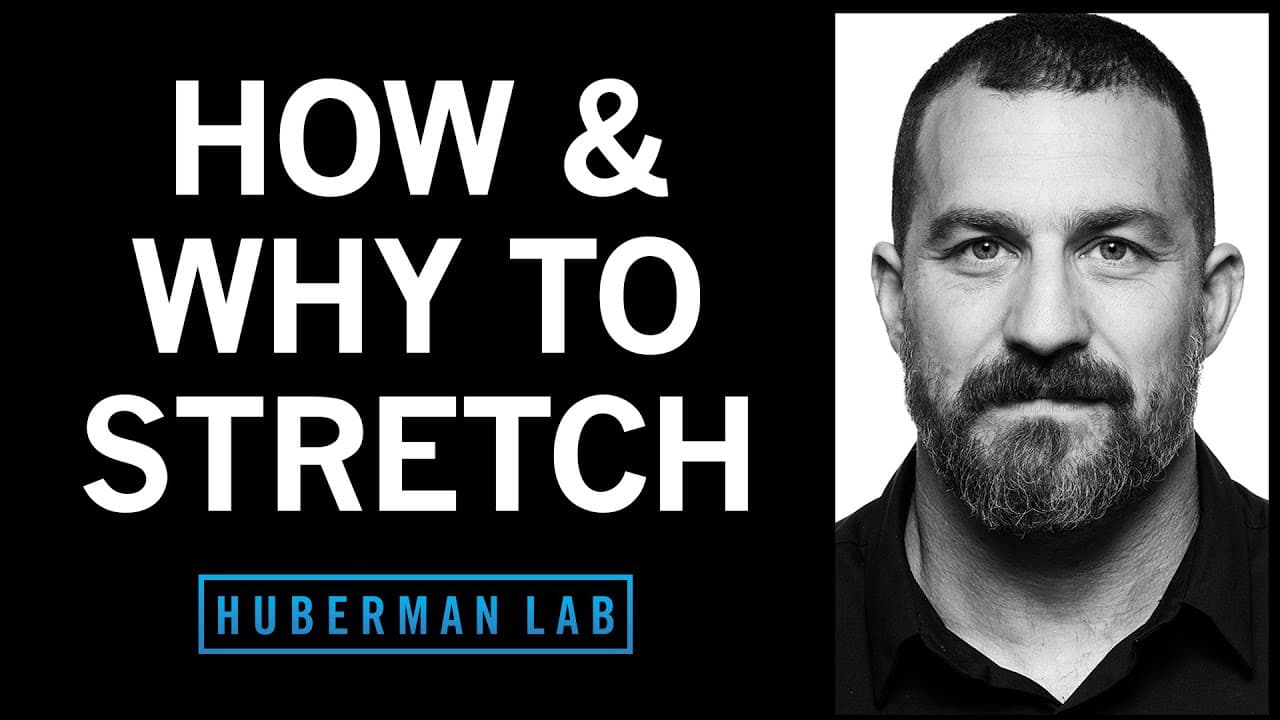
Stretching significantly enhances flexibility, which is essential for movement, injury prevention, and reducing inflammation. It involves various mechanisms, including motor neurons and sensory receptors, that can improve range of motion. Regular stretching not only boosts physical performance but also positively affects emotional well-being and pain tolerance.
Transcript
- Welcome to the Huberman Lab Podcast, where we discuss science and science-based tools for everyday life. [upbeat music] I'm Andrew Huberman, and I'm a Professor of Neurobiology and Ophthalmology at Stanford School of Medicine. Today, we are going to discuss the science and practice of flexibility and stretching. Flexibility and stretching are top... Read More
Key Insights
- 🖐️ Flexibility and stretching play crucial roles in movement, learning, injury prevention, and inflammation reduction.
- 🅰️ Different types of stretching, such as dynamic, ballistic, static, and PNF stretching, offer unique benefits and applications.
- ☠️ Stretching can impact tumor growth rates and be used as a complementary approach in cancer treatment.
- 👨🎨 Stretching exercises influence pain perception and can help individuals better tolerate physical and emotional pain.
Install to Summarize YouTube Videos and Get Transcripts
Explore YouTube Video Summarizer or Get YouTube Transcript Extractor
Questions & Answers
Q: What are the key components involved in flexibility and stretching?
Flexibility and stretching involve motor neurons, spindle neurons, and Golgi tendon organs. Motor neurons control muscle contraction, spindle neurons sense stretch in the muscles, and Golgi tendon organs sense muscle tension to prevent overloading.
Q: How can stretching adjust tumor growth?
Studies have shown that stretching can influence tumor growth. Specific stretching protocols can create mechanical forces that affect tumor cell signaling pathways and alter tumor growth rates.
Q: What are the different types of stretching?
There are various types of stretching, including dynamic stretching (controlled movement without momentum), ballistic stretching (movement involving momentum), static stretching (holding a stretch), and PNF stretching (combining contraction and relaxation of muscles).
Q: How can stretching improve pain tolerance?
Stretching exercises can serve as a tool to modulate pain tolerance. Through neural and physiological mechanisms, stretching can help alleviate both physical and emotional pain.
Summary & Key Takeaways
-
Flexibility and stretching are often overlooked topics but are essential for our body's basic functions.
-
Flexibility and stretching involve mechanisms such as motor neurons, spindle neurons, and Golgi tendon organs.
-
Regular stretching practice can increase range of motion, prevent injury, and positively impact physiological and emotional states.
Read in Other Languages (beta)
Share This Summary 📚
Summarize YouTube Videos and Get Video Transcripts with 1-Click
Try YouTube Summary with ChatGPT & Claude or YouTube Transcript Generator
Explore More Summaries from Andrew Huberman 📚


Summarize YouTube Videos and Get Video Transcripts with 1-Click
Try YouTube Summary with ChatGPT & Claude or YouTube Transcript Generator