How to Build an AI Chatbot with Langchain and RAG
TL;DR
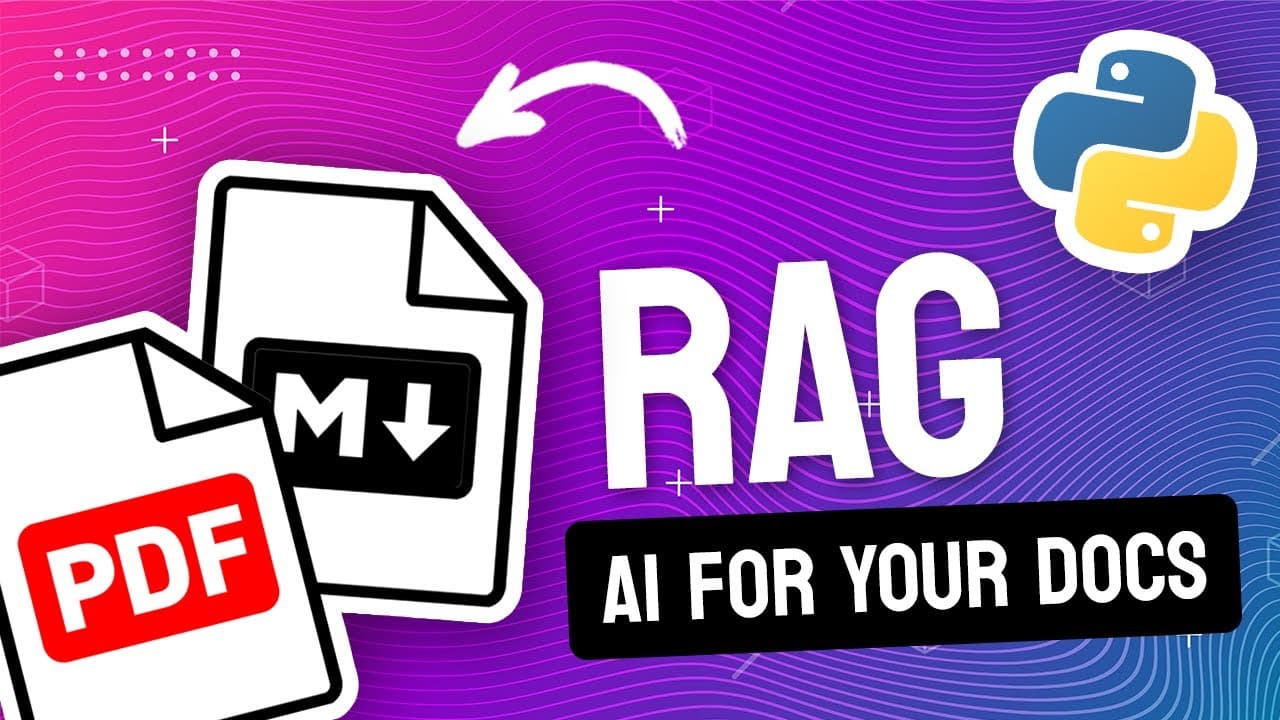
Build a retrieval augmented generation (RAG) app using Langchain and OpenAI in Python to interact with large text data sources such as books or documents. This approach allows for creating chatbots or AI applications that can answer questions based on specific data, ensuring responses are grounded in provided materials rather than fabricated.
Transcript
Hey everyone, welcome to this video where I'm going to show you how to build a retrieval augmented generation app using Langchain and OpenAI. You can then use this app to interact with your own documents or your own data source. This type of application is great for when you have a lot of text data to work with. For example, a collection of books, ... Read More
Key Insights
- RAG is a technique for creating AI applications that interact with large text data sources.
- Langchain and OpenAI can be used in Python to build RAG applications.
- The process involves preparing data, creating a vector database, and querying it for relevant information.
- Data is split into manageable chunks using a text splitter to improve search relevance.
- Vector embeddings represent text as numerical vectors, allowing similarity comparisons.
- ChromaDB is used to store data chunks as vectors for efficient querying.
- The AI generates responses by combining relevant data chunks, ensuring accuracy and source referencing.
- Understanding vector embeddings is crucial for optimizing data retrieval and AI response quality.
Install to Summarize YouTube Videos and Get Transcripts
Explore YouTube Video Summarizer or Get YouTube Transcript Extractor
Questions & Answers
Q: How to build an AI chatbot using Langchain and OpenAI?
To build an AI chatbot using Langchain and OpenAI, start by preparing your data source, such as documents or books. Use Langchain to load the data into Python, split it into manageable chunks, and create a vector database using ChromaDB. Generate vector embeddings for each chunk with OpenAI, allowing for similarity comparisons. Query the database to find relevant data chunks and use OpenAI to generate responses based on this data, ensuring responses are accurate and grounded in the provided materials.
Q: What is retrieval augmented generation (RAG)?
Retrieval augmented generation (RAG) is a technique used in AI applications to interact with large text data sources by retrieving relevant information and generating responses based on that data. It combines retrieval of data chunks from a database with the generation of text responses using AI models like OpenAI. This ensures that the responses are based on actual data rather than being fabricated, making it ideal for applications like chatbots and interactive AI systems.
Q: Why use vector embeddings in AI applications?
Vector embeddings are used in AI applications to represent text as numerical vectors, capturing the semantic meaning of the text. This allows for similarity comparisons between different pieces of text, enabling efficient retrieval of relevant information from large datasets. By using embeddings, AI applications can accurately determine the closeness of different texts in meaning, which is crucial for tasks like information retrieval, recommendation systems, and natural language processing.
Q: How does ChromaDB work in the context of RAG?
In the context of RAG, ChromaDB is used to store data chunks as vector embeddings, allowing for efficient querying and retrieval of relevant information. Data is split into smaller chunks, each represented as a vector, and stored in ChromaDB. When a query is made, the database is searched for chunks with embeddings closest in meaning to the query, ensuring that the most relevant information is retrieved for generating responses.
Q: What are the steps to prepare data for a RAG application?
To prepare data for a RAG application, first identify and gather the text data sources you want to use, such as documents or books. Load the data into Python using Langchain and split it into smaller, manageable chunks to improve search relevance. Create metadata for each chunk, including source information. Generate vector embeddings for each chunk using OpenAI, which will be used for querying and retrieving relevant information during the RAG process.
Q: How to ensure AI responses are grounded in provided data?
To ensure AI responses are grounded in provided data, use the RAG approach, which involves retrieving relevant data chunks from a vector database and using them as a basis for generating responses. By querying the database for chunks with embeddings similar to the query, you can ensure that the AI's responses are based on actual data rather than being fabricated. Additionally, referencing the source of the data chunks in the response further grounds the AI's answers in the provided materials.
Q: What are vector embeddings and why are they important?
Vector embeddings are numerical representations of text that capture the semantic meaning of the text. They are important because they allow for similarity comparisons between different pieces of text, enabling efficient retrieval of relevant information in AI applications. By representing text as vectors, AI systems can determine the closeness of different texts in meaning, which is crucial for tasks like information retrieval, recommendation systems, and natural language processing.
Q: How does Langchain facilitate the creation of RAG applications?
Langchain facilitates the creation of RAG applications by providing tools to load, process, and manage large text data sources in Python. It enables data to be split into smaller chunks, which are then converted into vector embeddings for efficient querying and retrieval. Langchain also integrates with OpenAI to generate text responses based on retrieved data, making it easier to build AI applications that interact with and generate responses from large datasets.
Summary & Key Takeaways
-
The video explains how to build a retrieval augmented generation (RAG) app using Langchain and OpenAI in Python. This approach enables interaction with large text data sources, like documents or books, to create AI chatbots that provide responses based on the provided data. The process involves preparing data, creating a vector database with ChromaDB, and querying it for relevant information.
-
Vector embeddings are used to represent text as numerical vectors, allowing for similarity comparisons between different pieces of data. By splitting data into smaller chunks, the application can more accurately retrieve relevant information and generate responses. The AI ensures responses are grounded in the provided materials, reducing the risk of fabricated answers.
-
The video provides a step-by-step guide, including data preparation, database creation, and crafting AI responses. It emphasizes the importance of understanding vector embeddings and provides code examples to illustrate the process. The tutorial encourages viewers to experiment with their own datasets to create custom AI applications.
Read in Other Languages (beta)
Share This Summary 📚
Summarize YouTube Videos and Get Video Transcripts with 1-Click
Try YouTube Summary with ChatGPT & Claude or YouTube Transcript Generator
Explore More Summaries from pixegami 📚
Summarize YouTube Videos and Get Video Transcripts with 1-Click
Try YouTube Summary with ChatGPT & Claude or YouTube Transcript Generator