What Is Google DeepMind's Genie 3 World Model?
TL;DR
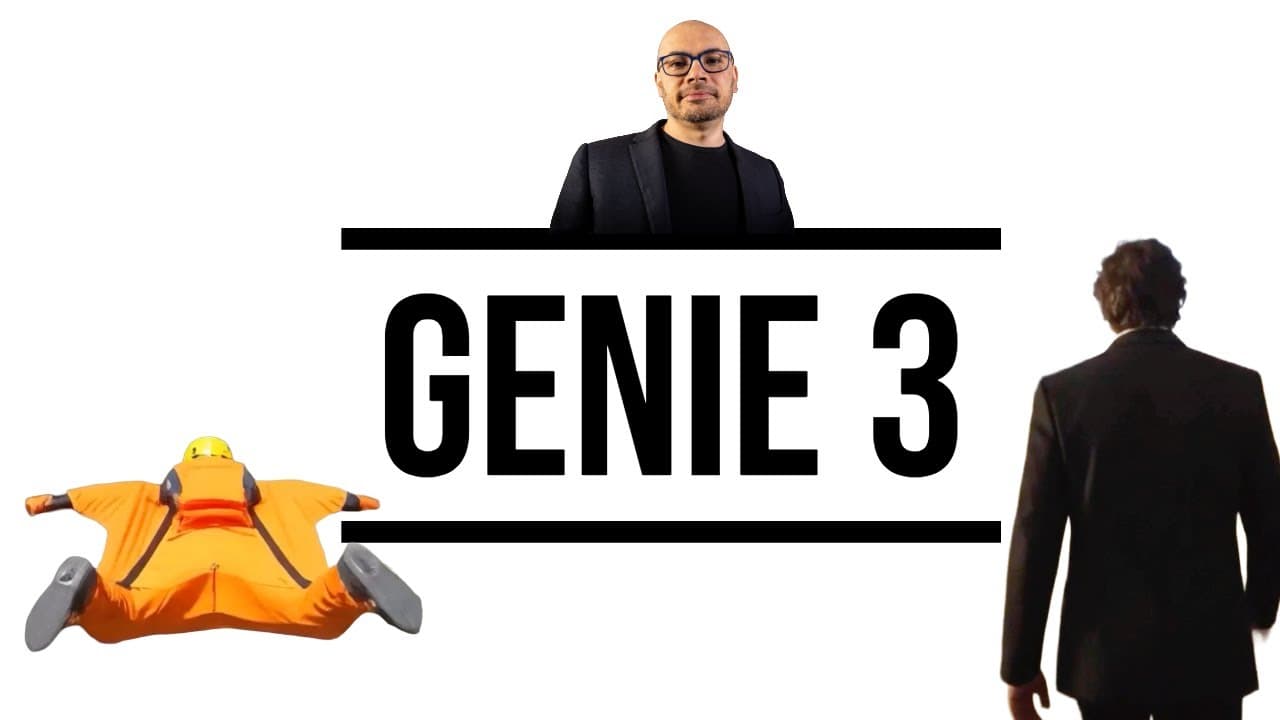
Google DeepMind’s Genie 3 is a world model that turns a starting image into a playable environment you can explore and modify with prompts. It generates interactions in real time at 720p and 24 frames per second, while world memory preserves actions such as painting a wall for minutes rather than hours. Read on to understand its capabilities, robotics ambitions, availability, and current limitations.
Transcript
In the week that we are set to get GPT5, it might be easy to miss this announcement of Google Deep Minds Genie 3. To cut a long story short, it makes the world playable. Start with an image, which could be one of your photos, and then enter that world and modify it with prompts. By entering, I mean you can move around, take actions that last and st... Read More
Key Insights
- Genie 3 is a world model that generates interactive environments from a single text prompt or starting image, letting users move around, take lasting actions, and modify the world live rather than walking through a pre-built simulation.
- Real-time interactivity means the environment reacts to your movements as it is generated, running at 720p resolution and 24 frames per second, a scaling improvement over the earlier Genie 2 which was said to scale gracefully with more compute.
- World memory keeps environments consistent, so actions persist: the lead demonstrator paints a wall, looks away to generate other parts of the world, and the paint is still there on returning, though this memory is measured in minutes not hours.
- The stated goal, per lead author Jack Parker Holder, was a 'move 37 moment' for embodied AI and robots, using simulated worlds to produce novel breakthroughs since there isn't enough real data to train robots for innumerable scenarios.
- Simulators like Genie 3 cannot guarantee agent reliability because of physics inaccuracies, but the authors argued they can demonstrate unreliability: an agent that goes off the rails in simulation is also liable to fail in the real world.
- Promptable events let users add new elements into a world on the fly, such as another person, transportation, or something unexpected, alongside distinct geographies, historical settings, and fictional environments.
- Genie 3 has documented caveats: no complex actions beyond moving and jumping, no talking to other characters, no accurate real-world locations, and no high-fidelity text rendering unless text is added to the prompt.
- Genie 3 is a research preview with no announced general release date, but the creator compares it to Google's Imagen, which went from being unfit for public release to the public, API-available Imagen 4, suggesting a Genie release could come sooner than expected.
Install to Summarize YouTube Videos and Get Transcripts
Explore YouTube Video Summarizer or Get YouTube Transcript Extractor
Questions & Answers
Q: What is Google DeepMind's Genie 3 world model?
Genie 3 turns a starting image, including one of your own photos, into an interactive world. You can enter that world, move around, perform actions that persist, and modify the environment with prompts.
Q: How does Genie 3 create playable worlds?
Genie 3 generates the environment live as the user explores it rather than relying on a pre-built simulation. Users can move around, take actions, and change the world through prompts.
Q: What resolution and frame rate does Genie 3 support?
Genie 3 provides real-time interaction at 720p and 24 frames per second. This means user inputs can produce changes on screen at the same time at a fairly high resolution.
Q: How does Genie 3's world memory work?
World memory allows changes to remain when the user looks away and returns. For example, paint applied to a wall is still visible after exploring another part of the world, but the memory lasts minutes rather than hours.
Q: Can the public use Genie 3 now?
No, Genie 3 is currently a research preview that the public cannot access. Google gave no date or even a hint about when it might receive a general release.
Q: What are Genie 3's main limitations?
Genie 3 supports common actions such as moving and jumping but not complex actions or conversations with other characters. It also cannot accurately reproduce real-world locations, and high-fidelity text rendering is not built into its environments, although text can appear when added to the prompt.
Q: Why was Genie 3 designed for AI agents and robots?
Lead author Jack Parker Holder said the goal was a “move 37 moment” for embodied AI. Because there is not enough data to train robots for innumerable scenarios, simulated worlds could let agents practice actions and potentially produce breakthroughs beyond what their training data explicitly covered.
Q: Can Genie 3 simulations guarantee reliable AI agents?
No, physics inaccuracies in generated worlds prevent Genie 3 from guaranteeing that an agent will be reliable. However, the researchers argued that simulations can expose unreliability because an agent that goes off the rails in simulation may also fail in the real world.
Summary & Key Takeaways
-
Google DeepMind's Genie 3 makes worlds playable: start from an image, such as one of your own photos, enter that world, move around, take actions that persist, and modify it with prompts. It delivers real-time interaction at 720p and 24 frames per second, a step up from Genie 2.
-
The creator argues Genie 3 is marketed to let AI agents act out scenarios and self-improve for embodied AI and robotics, aiming for a 'move 37 moment.' He pushed back that physics inaccuracies prevent guaranteed reliability, though the authors noted simulation can still reveal unreliability in agents.
-
Genie 3 remains a research preview with no release date and several caveats: world memory lasts minutes not hours, no complex actions, no character conversations, no accurate real-world locations, and limited text rendering. The creator predicts it will be used mostly for gamifying reality and entertainment.
Read in Other Languages (beta)
Share This Summary 📚
Summarize YouTube Videos and Get Video Transcripts with 1-Click
Try YouTube Summary with ChatGPT & Claude or YouTube Transcript Generator
Explore More Summaries from AI Explained 📚

Summarize YouTube Videos and Get Video Transcripts with 1-Click
Try YouTube Summary with ChatGPT & Claude or YouTube Transcript Generator