How to Convert Acetyl Salicylic Acid to Salicylic Acid
TL;DR
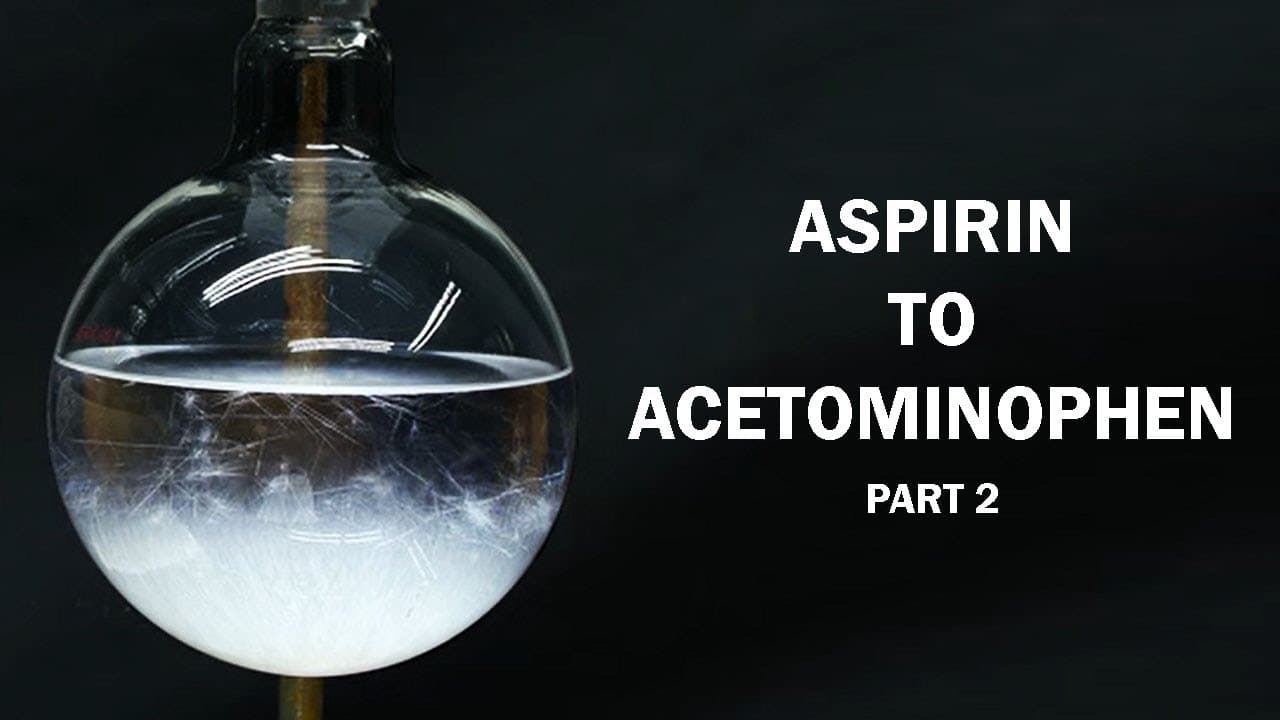
To convert acetyl salicylic acid (aspirin) to salicylic acid, perform an acid-catalyzed ester hydrolysis by refluxing the solution with hydrochloric acid and distilled water for about 30 minutes. This process leads to the crystallization of salicylic acid, typically yielding around 86% of the expected product.
Transcript
today we're continuing the journey from aspirin to acetaminophen in the previous video I extracted acetyl salicylic acid from aspirin pills and now I'm going to hydrolyze everything that I recovered to salicylic acid also from this point on I'm going to refer to acetyl salicylic acid by its abbreviated form a sa to carry out the conversion from a s... Read More
Key Insights
- 💨 Acid hydrolysis is a faster and easier method for converting acetyl salicylic acid to salicylic acid compared to base hydrolysis.
- ☠️ Refluxing the solution for approximately 30 minutes helps to reach equilibrium and enhance the reaction rate.
- 🧑🏭 The yield of salicylic acid obtained through this process is dependent on several factors, including the quality and amount of starting acetyl salicylic acid.
- 😘 The next step in the process involves converting salicylic acid to phenol, which is expected to have a lower yield efficiency.
- ❓ The overall yield of the process is slowly whittled down with each subsequent step.
- 🧡 The final yield of salicylic acid obtained through this process is approximately 86%, which falls within the expected range of 85-90% yield.
- ❓ The yield can be further improved through optimization of the process parameters and techniques.
Install to Summarize YouTube Videos and Get Transcripts
Explore YouTube Video Summarizer or Get YouTube Transcript Extractor
Questions & Answers
Q: What is the purpose of converting acetyl salicylic acid to salicylic acid?
The conversion is done to isolate salicylic acid, which has several applications in the pharmaceutical industry, including as an anti-inflammatory and pain medication.
Q: How does ester hydrolysis occur in this process?
Ester hydrolysis is a reaction where the ester group in acetyl salicylic acid is cleaved by water, resulting in the formation of salicylic acid and acetic acid. This reaction requires acidic conditions and is catalyzed by hydrochloric acid.
Q: Why is refluxing necessary in this process?
Refluxing is used to maintain a constant temperature and ensure thorough mixing, allowing the reaction to reach equilibrium faster. In this case, refluxing the solution for approximately 30 minutes is sufficient to achieve the desired conversion.
Q: What factors affect the direction of the ester hydrolysis reaction?
One major factor is the concentration of water. By including a high amount of water, hydrolysis is favored. In contrast, minimizing water content would favor the formation of an ester.
Summary & Key Takeaways
-
The video demonstrates the process of converting acetyl salicylic acid (aspirin) to salicylic acid through ester hydrolysis.
-
Acid hydrolysis is chosen as it is faster and easier compared to base hydrolysis.
-
The procedure involves refluxing the solution for approximately 30 minutes to ensure equilibrium is reached, followed by crystallization of salicylic acid.
Read in Other Languages (beta)
Share This Summary 📚
Summarize YouTube Videos and Get Video Transcripts with 1-Click
Try YouTube Summary with ChatGPT & Claude or YouTube Transcript Generator
Explore More Summaries from NileRed 📚
Summarize YouTube Videos and Get Video Transcripts with 1-Click
Try YouTube Summary with ChatGPT & Claude or YouTube Transcript Generator