How to become a Backend Developer: Complete Roadmap
TL;DR
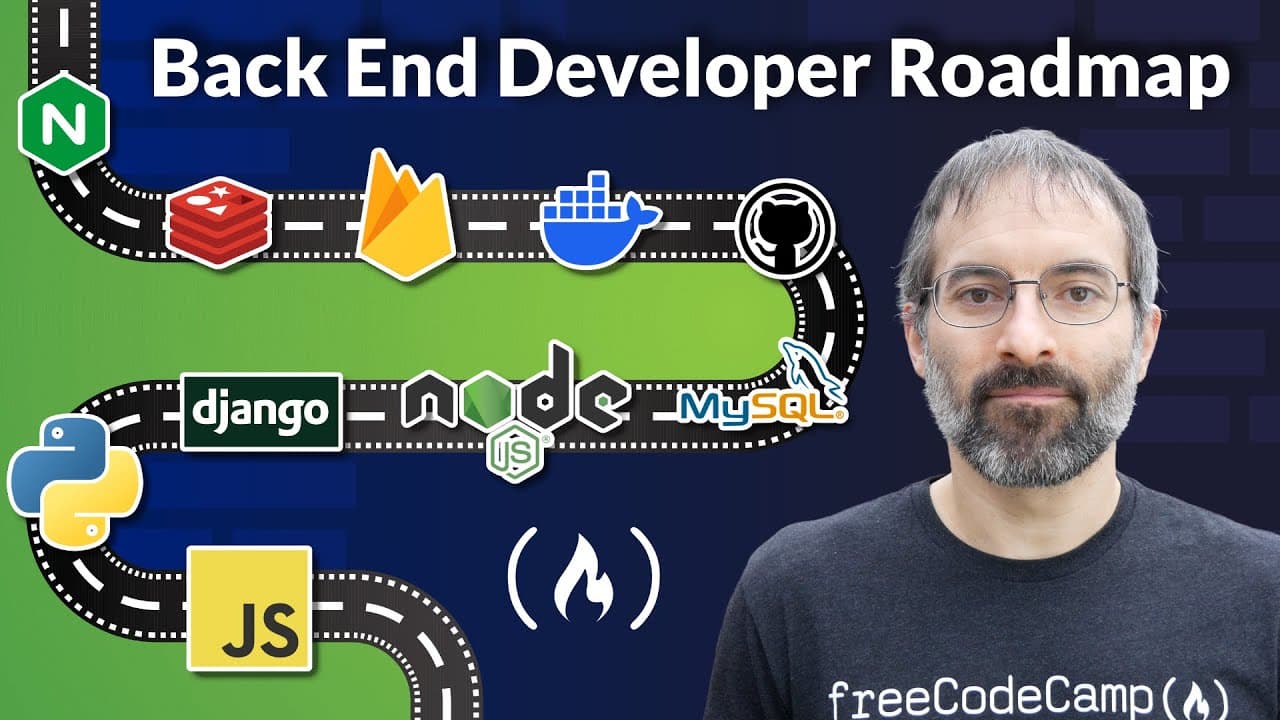
Master the core server side languages, databases, and APIs to start. The video outlines a comprehensive backend roadmap with languages like Python, JavaScript, Java, and frameworks, plus tools like Git, databases, APIs, caching, security, testing, and deployment. It also emphasizes understanding servers, cloud services, containers, and how to design scalable, secure backend systems.
Transcript
in this video I'm going to explain all the core Technologies you need to learn to become a back-end developer my name is Bo KS and I've created many courses about backend development for the freeco camp.org YouTube channel you can learn a lot from this video on its own but it also serves as an introduction to a massive curriculum that will teach yo... Read More
Key Insights
- Backend development focuses on server side logic, databases, APIs, and server management
- A solid backend developer foundation includes Python, Java, JavaScript, Node.js, and .NET
- Relational databases like MySQL and PostgreSQL are essential, along with NoSQL options like MongoDB
- APIs enable communication between systems, with REST and GraphQL as key approaches
- Caching and security are critical for performance and protection of data
- Testing, design patterns, and architecture knowledge support scalable, maintainable systems
- Message brokers and containerization tools support distributed, reliable apps
- Understanding infrastructure and cloud providers helps optimize deployment and scalability
Install to Summarize YouTube Videos and Get Transcripts
Explore YouTube Video Summarizer or Get YouTube Transcript Extractor
Questions & Answers
Q: A real search query question about the video: How to start learning backend development effectively?
To start learning backend development effectively, focus on building a strong foundation in server side programming languages such as Python, JavaScript with Node.js, Java, and .NET. Learn about databases like MySQL, PostgreSQL, and MongoDB, and gain hands on experience designing and consuming APIs. Start with small projects that expose you to server logic, data modeling, and basic API development, then progressively incorporate cloud services, containers, and security practices as you grow.
Q: What is a backend developer responsible for in simple terms?
A backend developer is responsible for the server side of applications. This includes writing the code that runs on web servers to process user requests, manage data flow between the server and front end, design and maintain databases, create APIs for system communication, manage servers, and implement security and testing to ensure reliability and performance.
Q: Why are APIs important in backend development?
APIs are important because they let different software systems communicate with each other. Backend developers create, manage, and document APIs so the front end can access server side data and functions. They enable data exchange, enable integrations with other services, and support scalable architectures by decoupling front end from backend logic.
Q: What technologies should a beginner backend developer learn first?
A beginner should start with programming languages commonly used on the backend such as Python, JavaScript with Node.js, Java, and possibly .NET. Then learn relational databases like MySQL or PostgreSQL, a NoSQL option like MongoDB, and version control with Git. Understanding REST or GraphQL APIs, basic security practices, and introductory containerization with Docker is also recommended.
Q: How do caching and security fit into backend development?
Caching helps reduce load on the backend and decreases latency by storing copies of data in fast storage. Security involves protecting data and APIs through authentication, authorization, encryption, rate limiting, and regular audits. Implementing these correctly is essential for performance and protecting user information in backend systems.
Q: What role do containers and cloud services play in this roadmap?
Containers, via Docker and orchestration with Kubernetes, enable consistent deployment across environments. Cloud services from providers like AWS, Azure, and Google Cloud allow scalable hosting, server management, and managed databases. Mastery of these tools helps build reliable, scalable applications and simplifies deployment and resource management.
Q: What is the learning path recommended by the video for backend developers?
The video recommends following a structured learning path that covers core languages, databases, APIs, and infrastructure. It emphasizes practical projects, internships, or open source contributions to gain real world experience, while staying engaged with the developer community to keep up to date with evolving technologies.
Q: How does the video suggest evaluating progress in backend learning?
Progress evaluation should focus on building progressively complex projects, understanding core concepts like server side logic, database design, API development, and security. Regularly review and refactor code, test across unit, integration, and end to end levels, and measure performance improvements from caching, indexing, and scalable architecture choices.
Summary & Key Takeaways
-
The video defines backend development as creating server side logic and data flows that power web apps, including databases, APIs, and server management, along with security considerations and continuous learning.
-
It presents a structured learning path covering languages, databases, APIs, tools, and modern infrastructure concepts like containers and cloud services to build scalable backend systems.
-
It stresses practical experience through projects and community involvement, and notes the field is constantly evolving with new technologies and best practices.
Read in Other Languages (beta)
Share This Summary 📚
Summarize YouTube Videos and Get Video Transcripts with 1-Click
Try YouTube Summary with ChatGPT & Claude or YouTube Transcript Generator
Explore More Summaries from freeCodeCamp.org 📚


Summarize YouTube Videos and Get Video Transcripts with 1-Click
Try YouTube Summary with ChatGPT & Claude or YouTube Transcript Generator