Is Claude Opus 5 Better and Cheaper Than Fable?
TL;DR
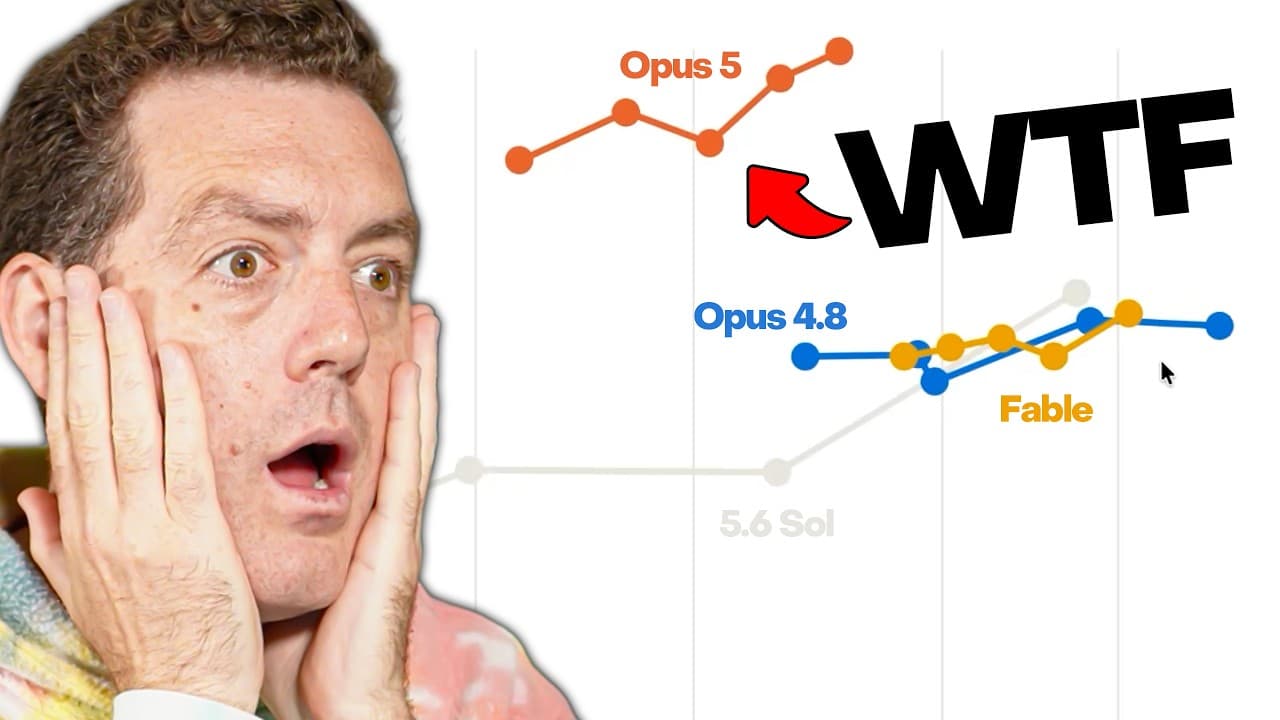
Claude Opus 5 reportedly beats Fable 5 on most presented benchmarks while costing half as much at $5 per million input tokens and $25 per million output tokens. Its strongest gains appear in coding, computer use, automation, enterprise analysis, and ARC AGI 3, although legal, health, and some cybersecurity results are weaker.
Transcript
better than Fable, half the price. This is Opus 5. We have a new model, Claude Opus 5. Now, if you remember, Opus was their kind of top tier in their family model. There was Haiku, Sonnet, and Opus. Then, of course, Fable came out. Fable is their biggest best model they make. And now, we have a version five of Opus. I tested it again. I didn't have... Read More
Key Insights
- Claude Opus 5 outperforms Fable 5 on most benchmarks presented in the comparison, despite being positioned below Fable in the model family. The displayed advantages include agentic terminal coding, Frontier Bench, GDPval, browsing, computer use, automation, and novel problem solving.
- Cost per task is more informative than token price alone because models can consume different numbers of tokens to finish the same assignment. The transcript argues that a model with cheaper tokens may offer no savings if it requires twice as many tokens to produce a successful result.
- Claude Opus 5 costs $5 per million input tokens and $25 per million output tokens. That is the same stated price as Opus 4.8, half the price of Fable, and described as comparable to GPT 5.6 Soul.
- ARC AGI 3 tests novel problem solving by placing a model in an unnamed game without instructions about its rules or objective. Opus 5 reaches 30% in the displayed results, compared with roughly 8% for the previous leading model shown.
- Computer-use efficiency is a major Opus 5 strength in the presented OS World chart. The model achieves a higher score at a lower cost per task than Fable 5 and Opus 4.8, while GPT 5.6 Soul costs more than twice as much at one comparable performance point.
- Enterprise knowledge work improves most on exhaustive, multistep analysis. Box's benchmark across 12 industries shows an overall rise from 63 to 78, due diligence improving from 65 to 76, report drafting moving from 67 to 69, and data analysis gaining six points.
- Opus 5 does not improve every measured capability. Deep Sui declines slightly, the legal benchmark drops from 13.3 to 11.7, Healthbench Professional decreases, and the highest thinking level on Frontier Bench reportedly costs more while producing a lower score than another setting.
- Cybersecurity capability is stronger than Opus 4.8 but remains substantially behind Mythos 5 for exploit development. The presented exploitation-success figures are 13 for Mythos, zero for Opus 4.8, and four for Opus 5, which the reviewer connects speculatively to guardrails or deliberate capability limits. Opus 5 also uses automatic safety fallbacks.
Install to Summarize YouTube Videos and Get Transcripts
Explore YouTube Video Summarizer or Get YouTube Transcript Extractor
Questions & Answers
Q: How much does Claude Opus 5 cost?
Claude Opus 5 is priced at $5 per million input tokens and $25 per million output tokens across the platforms described in the transcript. That is the same stated price as Opus 4.8 and half the price of Fable. The reviewer also describes the pricing as comparable to GPT 5.6 Soul, while emphasizing that cost per completed task matters more than token price alone.
Q: Is Claude Opus 5 better than Fable 5?
Claude Opus 5 outperforms Fable 5 on most of the benchmarks presented in the transcript, including several evaluations of coding, practical tasks, browsing, computer use, automation, and novel problem solving. Humanity's Last Exam is approximately tied, and Deep Sui shows a slight decline. Cybersecurity is the important exception, where Opus 5 remains substantially behind the more capable Mythos 5 model for developing exploits.
Q: Why is cost per task more useful than price per token?
Cost per task accounts for both token price and the amount of work a model must perform to complete an assignment successfully. A model can charge less for each token but consume many more tokens, eliminating the apparent savings. The transcript cites Kimmy K3 as an example: it was cheaper per token than GPT 5.6 Soul and Fable 5 but used twice as many tokens for the same task, making the total cost comparable.
Q: What does the ARC AGI 3 benchmark test?
ARC AGI 3 tests novel problem solving by placing a model into a game without providing the game's name, rules, objective, or completion instructions. The model must explore within limited moves and infer what actions are required. The games are described as solvable by humans but difficult for AI. Opus 5 scores 30% in the presented results, while the prior best model shown was around 8%.
Q: How does Claude Opus 5 perform on computer-use tasks?
Claude Opus 5 performs strongly on OS World, a benchmark measuring whether a model can interpret on-screen information, click interface elements, and complete computer tasks. The transcript reports a four-point improvement and shows Opus 5 achieving better performance at a lower cost per task than Fable 5 and Opus 4.8. At one comparison point, GPT 5.6 Soul costs more than twice as much to match Opus 5's lowest-setting performance.
Q: How does Claude Opus 5 handle enterprise document work?
Box tested Claude Opus 5 on realistic, document-grounded work across 12 industries, including reading sources, reconciling figures, conducting due diligence, drafting reports, and checking expert output for errors. Compared with Opus 4.8, the overall score rises from 63 to 78, due diligence rises from 65 to 76, report drafting moves from 67 to 69, and data analysis gains six points. Expert review remains approximately unchanged.
Q: Which Claude Opus 5 benchmarks show weaker results?
Claude Opus 5 has several weaker or mixed results in the presented evaluations. Deep Sui declines slightly, although the reviewer describes it as essentially similar. The legal benchmark falls from 13.3 to 11.7, and Healthbench Professional also decreases. On Frontier Bench, the highest thinking level reportedly becomes more expensive while scoring lower than another setting, showing that maximum reasoning effort does not always produce the best result.
Q: Does Claude Opus 5 have safety fallbacks and cybersecurity limits?
Claude Opus 5 supports automatic API fallbacks when safety classifiers flag a request. Such requests can be routed to another model, and users pay the fallback model's price. Its cybersecurity performance is stronger than Opus 4.8 but substantially behind Mythos 5 for exploit development. The presented exploitation-success scores are four for Opus 5, zero for Opus 4.8, and 13 for Mythos. The reviewer speculates that guardrails may explain part of this gap.
Summary & Key Takeaways
-
Claude Opus 5 is presented as a more efficient alternative to Fable 5 and Opus 4.8. It reportedly leads or matches them across most displayed evaluations, including coding, practical work, browsing, computer use, and automation, while retaining the same token pricing as Opus 4.8 and costing half as much as Fable.
-
The standout result is a 30% score on ARC AGI 3, where the previous best model shown scored roughly 8%. The benchmark gives models unfamiliar games without instructions, requiring them to infer objectives and mechanics. Opus 5 also demonstrates strong cost-adjusted performance relative to GPT 5.6 Soul in the presented comparisons.
-
Performance is not uniformly higher across every domain. Deep Sui shows a slight decline, the legal score falls from 13.3 to 11.7, and Healthbench Professional also decreases. Cybersecurity improves over Opus 4.8 but remains behind Mythos 5 for exploit development, while safety classifiers can automatically route flagged Opus 5 requests to another model.
Read in Other Languages (beta)
Share This Summary 📚
Summarize YouTube Videos and Get Video Transcripts with 1-Click
Try YouTube Summary with ChatGPT & Claude or YouTube Transcript Generator
Explore More Summaries from Matthew Berman 📚





Summarize YouTube Videos and Get Video Transcripts with 1-Click
Try YouTube Summary with ChatGPT & Claude or YouTube Transcript Generator