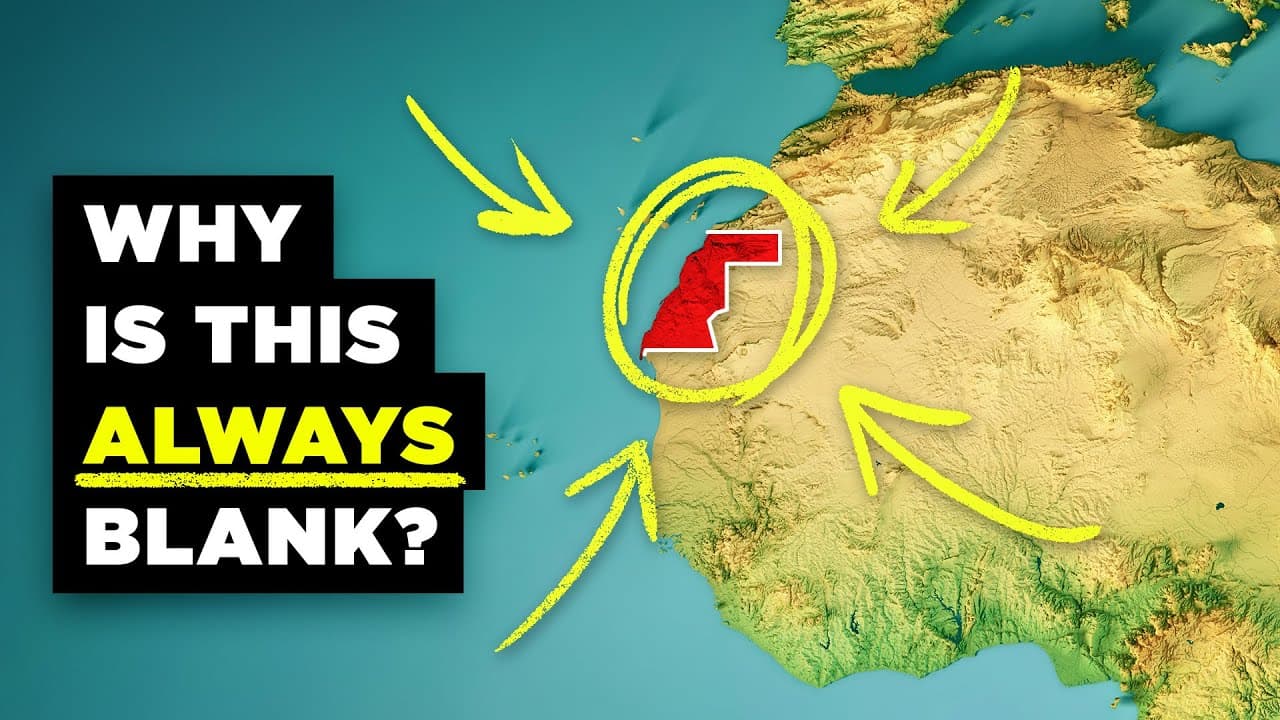
Why Is Western Sahara Missing From World Maps?
TL;DR
Western Sahara often appears blank on global data maps because its political status remains disputed and it is not listed as a United Nations member country. Morocco controls about 80% of the territory, while the Polisario Front theoretically controls the remaining 20% and claims an independent Sahrawi state. Their unresolved conflict complicates standardized national statistics and threatens wider regional instability.
Transcript
throughout your life youve probably seen a lot of these kinds of worldwide Maps display different kinds of global data and if you paid close enough attention to all of them you would have noticed a peculiar pattern emerging in this corner of Northwestern Africa time and time again that might seem rather strange to you at first because it seems that... Read More
Key Insights
- Western Sahara is often marked as having no data because its political status remains disputed, making it difficult to classify consistently within country-based datasets covering economic output, population, electricity, emissions, development, migration, prison populations, travel advisories, and food consumption.
- Western Sahara is a geographic designation rather than a United Nations member country, even though Google Maps labels the territory by that name and uses a dashed northern boundary to indicate the unresolved dispute between Morocco and the Sahrawi independence movement.
- Morocco controls about 80% of Western Sahara and describes the disputed lands as its southern provinces, including areas outside its actual control. The Polisario Front theoretically controls the remaining 20%, which is characterized as largely empty desert.
- The Polisario Front is a Sahrawi nationalist movement that claims all of Western Sahara as the Sahrawi Arab Democratic Republic. It considers Morocco's presence an illegal foreign occupation, while Morocco asserts sovereignty over the entire territory, including Polisario-controlled areas.
- The opposing territories are separated by a roughly 2,700-kilometer wall of sand and stone containing millions of landmines. The barrier cuts through the desert and forms the active dividing line between Moroccan-controlled territory and land theoretically administered by the Polisario Front.
- The ceasefire between Morocco and the Polisario Front collapsed in 2020, allowing armed conflict to resume along the front line. The United States, Israel, and much of the Western world lean toward Morocco, while Algeria especially supports the Polisario Front.
- The Western Sahara dispute has severely damaged relations between Morocco and Algeria. Their land border has been closed since 1994, Algeria severed diplomatic relations in 2021, and both countries have pursued an escalating arms race involving different foreign weapons suppliers.
- Western Sahara has strategic value because it contains major phosphate reserves important to synthetic fertilizer and global agriculture. The territory may also possess offshore natural gas and could serve as a crossroads for future oil and gas pipelines connecting sub-Saharan Africa with Europe.
Install to Summarize YouTube Videos and Get Transcripts
Explore YouTube Video Summarizer or Get YouTube Transcript Extractor
Questions & Answers
Q: Why does Western Sahara appear blank on world maps?
Western Sahara appears blank on many world data maps because its political status remains unresolved. It is labeled geographically but is not listed as a United Nations member country, while Morocco and the Polisario Front claim the same territory. This dispute complicates the assignment of standardized national statistics, so datasets frequently display the area as blank or simply mark it as having no data.
Q: Who controls Western Sahara today?
Morocco exercises de facto control over about 80% of Western Sahara and calls the territory its southern provinces. The Polisario Front theoretically controls the remaining 20%, described as a largely empty desert, and claims the entire region for the Sahrawi Arab Democratic Republic. Both parties claim sovereignty over all of Western Sahara, including the areas held by the opposing side.
Q: What is the Polisario Front fighting for?
The Polisario Front is a nationalist movement formed among Western Sahara's indigenous Sahrawi community. It was founded in Spanish Sahara in 1973 to wage an armed insurgency against Spanish colonial rule and seek independence. It now claims the whole territory as the Sahrawi Arab Democratic Republic and rejects Morocco's presence as an illegal foreign occupation of the Sahrawi homeland.
Q: What separates Morocco and the Polisario Front in Western Sahara?
A massive wall constructed from sand and stone separates the territories controlled by Morocco and the Polisario Front. It extends for roughly 2,700 kilometers across the desert and contains millions of landmines. The barrier marks the practical division of Western Sahara and serves as the front line in a conflict that resumed after the longstanding ceasefire collapsed in 2020.
Q: Why are Morocco and Algeria divided over Western Sahara?
Algeria strongly supports the Polisario Front and its claim to an independent Sahrawi Arab Democratic Republic, while Morocco claims Western Sahara as sovereign Moroccan territory. This disagreement compounds tensions dating to the 1963 Sand War and the contrasting political systems that emerged after independence. Their land border has remained closed since 1994, and Algeria severed diplomatic relations with Morocco in 2021.
Q: How did Spanish colonial rule shape the Western Sahara dispute?
Spain acquired the territory during the 1884 Berlin Conference and governed it for nearly a century as Spanish Sahara. After Morocco gained independence in 1956, its monarchy claimed nearby Spanish possessions on the basis that they had historically been Moroccan. Morocco invaded Spanish Sahara in 1957, but Spain expelled Moroccan forces and retained colonial control while international pressure for decolonization continued to grow.
Q: Why is Western Sahara strategically important?
Western Sahara contains enormous phosphate reserves that are important for synthetic fertilizer and global agricultural supply chains. It may also possess rich offshore natural gas reserves. Its location gives it potential importance as a crossroads for oil and gas pipelines carrying energy from sub-Saharan Africa toward the European Union, adding economic and geopolitical stakes to the unresolved territorial conflict.
Q: Could the Western Sahara conflict become a wider war?
The dispute carries a risk of wider regional escalation because the ceasefire collapsed in 2020, armed conflict resumed, and Morocco and Algeria entered an intensifying arms race. Morocco has acquired American and Israeli weapon systems, while Algeria has obtained Russian and Chinese arms. Although an all-out shooting war between Morocco and Algeria has been avoided, the unresolved dispute continues to create danger.
Summary & Key Takeaways
-
Western Sahara is frequently excluded from maps covering GDP, electricity access, population, emissions, development, migration, and other statistics. The omission reflects its unresolved political status. Morocco claims the whole territory and controls most of it, while the Polisario Front claims an independent Sahrawi Arab Democratic Republic and theoretically controls the remainder.
-
The dispute grew from Spanish colonial rule, Moroccan territorial claims, and Sahrawi demands for independence. Spain acquired the territory during the 1884 Berlin Conference and governed it as Spanish Sahara. After Morocco regained independence in 1956, its monarchy pursued surrounding Spanish possessions that it regarded as historically Moroccan lands.
-
The conflict now affects relations between Morocco and Algeria, whose land border has remained closed since 1994. Their diplomatic rupture, arms buildup, and opposing international partnerships increase the regional danger. Phosphate deposits, possible offshore natural gas, and proposed energy routes toward Europe give the disputed territory broader strategic importance.
Read in Other Languages (beta)
Share This Summary 📚
Summarize YouTube Videos and Get Video Transcripts with 1-Click
Try YouTube Summary with ChatGPT & Claude or YouTube Transcript Generator
Explore More Summaries from RealLifeLore 📚
Summarize YouTube Videos and Get Video Transcripts with 1-Click
Try YouTube Summary with ChatGPT & Claude or YouTube Transcript Generator