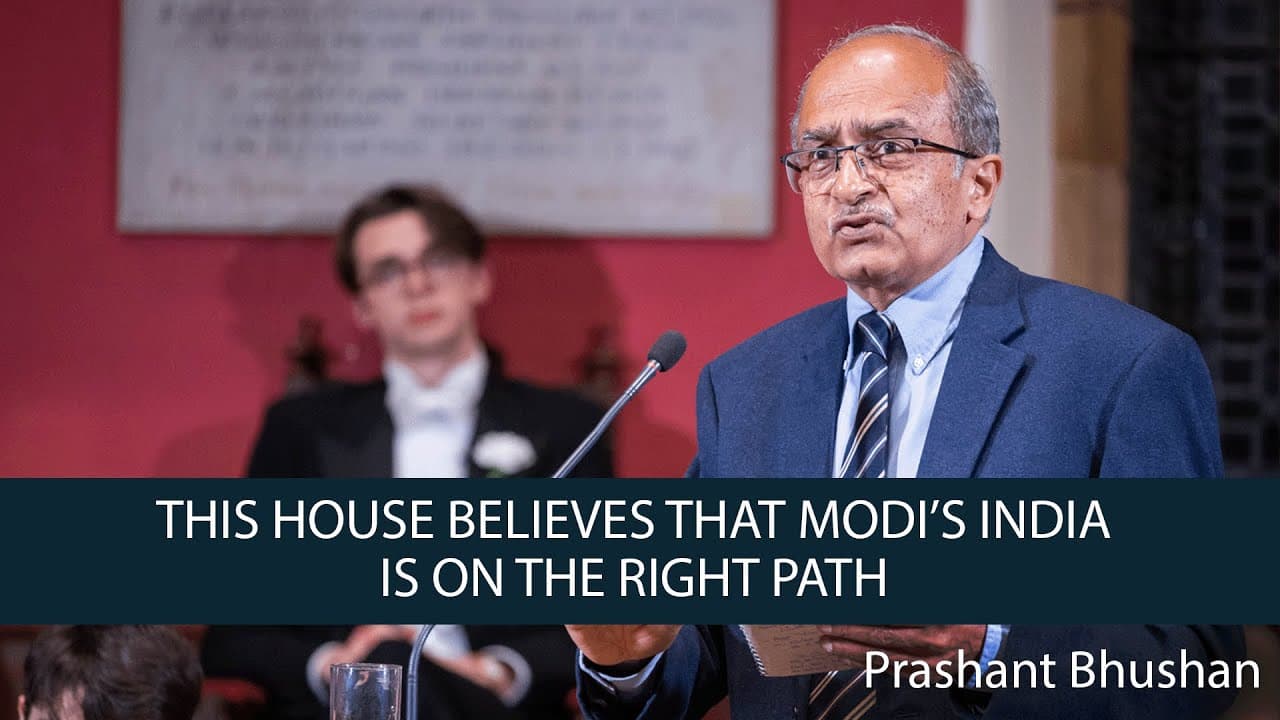
Why Does Prashant Bhushan Oppose Modi's Path?
TL;DR
Prashant Bhushan argues that India is on the wrong path because economic hardship, weakening civil liberties, communal violence, attacks on scientific education, and institutional decline outweigh claims of growth and reduced corruption. He maintains that unemployment, poverty, media pressure, arbitrary punishment, and compromised oversight have harmed ordinary people while concentrating power and undermining democracy and the rule of law.
Transcript
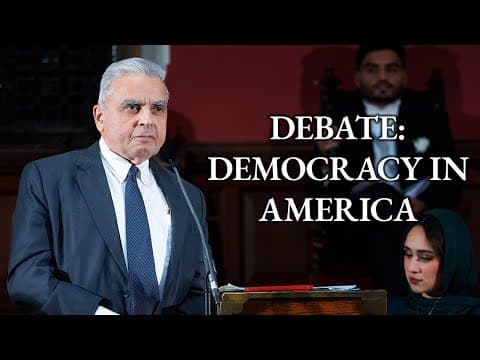
thank you Mr President ladies and gentlemen I Rise here to oppose this motion because of the war that the Modi government has declared on the poor and on the livelihoods of the people I Rise Against the motion because of the war that it has declared on minorities on truth on decency on civility on democracy and the rule of law I Rise Against the mo... Read More
Key Insights
- Bhushan’s central claim is that the Modi government has harmed livelihoods, minorities, truth, science, history, democracy, and independent institutions. He presents these problems as interconnected consequences of concentrated political power rather than as separate failures in individual policy areas.
- Reported unemployment is a central part of Bhushan’s economic criticism. He says a 2018 government survey found unemployment at 6.2 percent, its highest level in more than 40 years, while an independent organization measured it at 8.3 percent in April 2023 despite declining labor participation.
- Economic growth is inadequate, according to Bhushan, when its benefits do not reach poorer citizens. He cites India’s position of 107 out of 121 countries on the hunger index and says the annual incomes of the poorest 20 percent fell 53 percent between 2015–2016 and 2021.
- Anti-corruption institutions are ineffective, Bhushan argues, because the Lokpal was delayed and ultimately established without sufficient credibility. He also cites India’s Transparency International corruption ranking, which he says declined from 76 in 2015 to 85, as evidence against claims that corruption was reduced.
- The rule of law is being weakened, according to Bhushan, through lynchings, alleged extrajudicial killings, politically celebrated violence, and demolitions of accused people’s homes. He stresses that an accusation is not proof and that punishing a suspect’s family violates basic legal principles.
- Civil liberties are deteriorating, Bhushan claims, because activists, journalists, and human rights defenders face arrests on fabricated charges and remain imprisoned without timely trials. He cites the Bhima Koregaon case and allegations that incriminating emails were inserted using Pegasus-related digital intrusion.
- Media freedom is under pressure, according to Bhushan, through advertising inducements, investigative agencies, propaganda, disinformation, and communal programming. He cites India’s position of 150 out of 161 in a press freedom index and argues that mainstream media increasingly amplifies government narratives.
- Institutional independence is being compromised, Bhushan argues, across Parliament, investigative agencies, the Election Commission, the CAG, the NHRC, the Law Commission, and academic bodies. He says reduced parliamentary sittings, limited debate, and fewer committee referrals weaken scrutiny and democratic accountability.
Install to Summarize YouTube Videos and Get Transcripts
Explore YouTube Video Summarizer or Get YouTube Transcript Extractor
Questions & Answers
Q: Why does Prashant Bhushan argue that India is on the wrong path?
Prashant Bhushan argues that India is on the wrong path because the government has damaged livelihoods, civil liberties, scientific temper, historical understanding, democracy, and institutional independence. He says worsening unemployment and poverty coexist with communal violence, media pressure, arbitrary arrests, weakened parliamentary scrutiny, and compromised regulatory bodies. In his assessment, these developments promote inequality, falsehood, hatred, lawlessness, and concentrated political power.
Q: What evidence does Bhushan cite about unemployment in India?
Bhushan says the National Statistical Commission’s 2018 survey found unemployment had risen to 6.2 percent, which he describes as unprecedented in more than 40 years. He claims publication was delayed until after the 2019 elections, prompting two independent commission members to resign. He also cites an independent organization’s April 2023 estimate of 8.3 percent and notes that labor participation had fallen because many people stopped seeking work.
Q: How does Bhushan connect economic growth with poverty and inequality?
Bhushan argues that headline GDP growth is not meaningful when poorer people experience hunger, reduced income, and limited employment. He cites India’s hunger index position of 107 out of 121 countries and says the annual incomes of the poorest 20 percent declined 53 percent from 2015–2016 to 2021. He contends that growth primarily benefiting wealthy business interests does not improve conditions for the majority.
Q: What does Bhushan claim about corruption and the Lokpal?
Bhushan claims that the Lokpal, created as an anti-corruption institution, was delayed for four years and established only after repeated approaches to the Supreme Court. He argues that the institution was designed without enough credibility for citizens to use it effectively. He also cites India’s corruption index ranking as 85, compared with 76 in 2015, to challenge claims that corruption declined under the government.
Q: Why does Bhushan say the rule of law has weakened?
Bhushan says the rule of law has weakened because minorities are attacked, police sometimes fail to intervene, alleged extrajudicial killings are celebrated, and governments demolish homes belonging to people merely accused of crimes. He emphasizes that accusations do not establish guilt and that even a convicted person’s family cannot legally be punished through demolition. For him, these practices replace judicial process with public and administrative retaliation.
Q: How does Bhushan describe the treatment of activists and journalists?
Bhushan says political activists, journalists, and human rights defenders are increasingly arrested on fabricated or exaggerated charges and detained without timely trials. He points to the Bhima Koregaon case, where he claims digital evidence was fabricated by inserting emails through Pegasus-related intrusion. He says some detainees remained in jail for more than five years without bail or the start of a trial, illustrating weakened personal liberty.
Q: What is Bhushan’s criticism of media freedom and propaganda?
Bhushan argues that mainstream media has been pressured through government advertising, investigative agencies, and other inducements, turning many outlets into channels for official propaganda. He says evening news frequently promotes communal hostility and distracts audiences from substantive issues. He also alleges that an information technology cell spreads false and hateful material, and cites India’s press freedom position of 150 out of 161 as evidence of decline.
Q: How does Bhushan argue that democratic institutions have been compromised?
Bhushan argues that Parliament holds fewer sittings, conducts little debate, passes laws rapidly, and rarely sends bills to committees for expert feedback. He also says investigative agencies, the Election Commission, the judiciary, the CAG, the NHRC, and the Law Commission have lost independence. He cites a Supreme Court judgment questioning government control over Election Commission appointments as support for his broader concern about institutional capture.
Summary & Key Takeaways
-
Bhushan challenges positive assessments of India’s economy by citing reported unemployment, declining labor participation, hunger, and falling incomes among the poorest 20 percent. He argues that economic growth offers little public benefit when livelihoods deteriorate and alleges that favorable arrangements with politically connected companies divert public resources away from ordinary citizens.
-
Bhushan argues that minorities, activists, journalists, and human rights defenders face violence, arbitrary arrests, prolonged detention, and collective punishment. He says lynchings, alleged extrajudicial killings, home demolitions, fabricated evidence, propaganda, and pressure on mainstream media have weakened civil liberties, public truth, social decency, and the rule of law.
-
Bhushan contends that changes to textbooks and academic leadership undermine scientific temper and historical understanding. He also alleges that Parliament, investigative agencies, the Election Commission, the judiciary, and other oversight bodies have lost independence. His conclusion is that concentrated power, propaganda, hatred, and institutional subversion are degrading Indian democracy.
Read in Other Languages (beta)
Share This Summary 📚
Summarize YouTube Videos and Get Video Transcripts with 1-Click
Try YouTube Summary with ChatGPT & Claude or YouTube Transcript Generator
Explore More Summaries from OxfordUnion 📚


Summarize YouTube Videos and Get Video Transcripts with 1-Click
Try YouTube Summary with ChatGPT & Claude or YouTube Transcript Generator