How to Build Generative AI Apps with LangChain
TL;DR
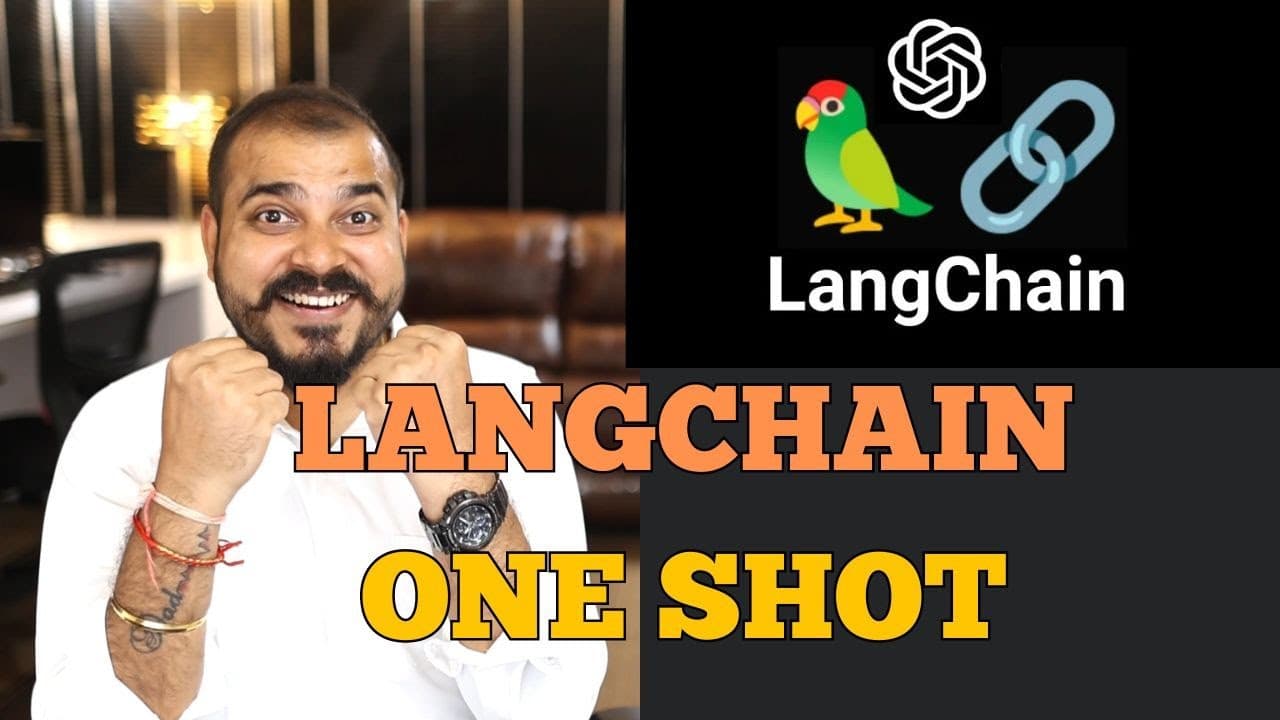
LangChain provides reusable components for building chatbots, retrieval-augmented generation systems, and other LLM applications with paid or open-source models. Its ecosystem covers application development, LangSmith-based debugging and monitoring, and LangServe API deployment, while LangChain Expression Language supports composition, parallelization, fallbacks, batching, streaming, asynchronous execution, and tracing.
Transcript
hello all my name is krishak and welcome to my YouTube channel so guys here is one amazing one short video on Lang chain in order to learn generative AI so if you are interested in creating amazing llm application or gen AI power uh application then this specific video is definitely for you if you don't know about Lang chain it is a complete framew... Read More
Key Insights
- LangChain is a framework for building applications powered by large language models, including question-answering chatbots and retrieval-augmented generation systems. Its reusable components let developers focus on application behavior while integrating either paid model APIs or open-source models hosted through services such as Hugging Face.
- The LangChain ecosystem covers development, productionization, and deployment. Open-source building blocks, integrations, and templates support development, LangSmith supports inspection and continuous optimization, and LangServe exposes completed chains as APIs that can be called by client-side applications.
- LangSmith is the observability and LLM operations component of the ecosystem. It supports debugging, playground experimentation, evaluation, annotation, tracing, testing, and monitoring, with reports and analytics available through the LangChain ecosystem's dashboard.
- LangServe turns chains and other LLM application services into REST APIs using FastAPI. It reduces the need to create an API layer from scratch and provides a practical bridge between application development, client-side access, and eventual deployment.
- Chains, agents, and retrieval strategies are central LangChain application concepts. Chains organize processing steps, agents work with available tools, and retrieval strategies connect applications to information loaded from different data sources and represented through vector embeddings.
- Model input and output components include models, prompts, example selectors, chains, and output parsers. These components structure how an application prepares requests for a language model and converts model responses into forms that downstream application logic can use.
- LangChain Expression Language is a protocol for composing generative AI application workflows. Its covered capabilities include parallelization, fallbacks, tracing, batching, streaming, asynchronous execution, and composition, which can be combined when developing end-to-end projects.
- Model independence is a central reason for using LangChain. The application integration layer can remain broadly generic as newer models appear, allowing developers to select models based on their needs without rebuilding the complete application workflow around one provider.
Install to Summarize YouTube Videos and Get Transcripts
Explore YouTube Video Summarizer or Get YouTube Transcript Extractor
Questions & Answers
Q: What is LangChain used for in generative AI?
LangChain is used to develop applications powered by large language models. The examples covered include question-answering chatbots, basic and advanced retrieval-augmented generation pipelines, systems that retrieve information from multiple data sources, and end-to-end generative AI projects. Its components provide a common application framework that can integrate paid model APIs as well as open-source models.
Q: How does the LangChain ecosystem support an LLM application lifecycle?
The ecosystem supports three broad stages: development, productionization, and deployment. During development, applications use open-source building blocks, integrations, templates, chains, agents, and retrieval strategies. LangSmith supports inspection, debugging, evaluation, testing, and monitoring during productionization. LangServe then converts chains into REST APIs, allowing client-side programs to access the completed application services.
Q: What is LangSmith used for in LangChain applications?
LangSmith provides observability and LLM operations capabilities for LangChain applications. It can be used for debugging, playground experimentation, evaluation, annotation, testing, tracing, and monitoring. Annotation also supports the creation of custom datasets needed for fine-tuning or application development. Reports and analytics can be viewed within the broader LangChain ecosystem through its dashboard.
Q: How does LangServe deploy a LangChain application as an API?
LangServe exposes chains and application services as REST APIs and uses FastAPI for API creation. This approach reduces the amount of code required compared with building the service layer from scratch with another web framework. After creating the API services, developers can write client-side code that calls those endpoints and prepare the resulting application for deployment.
Q: What are chains, agents, and retrieval strategies in LangChain?
Chains, agents, and retrieval strategies are core concepts used to construct LangChain applications. Chains connect application processing steps, agents operate with tools, and retrieval strategies bring relevant information into an application. Retrieval can include reading datasets from different data sources and creating vector embeddings, allowing these concepts to work together in chatbot and retrieval-augmented generation projects.
Q: What capabilities does LangChain Expression Language provide?
LangChain Expression Language provides a protocol for composing application workflows from LangChain components. The course identifies parallelization, fallbacks, tracing, batching, streaming, asynchronous execution, and composition as important capabilities. These features help organize how application steps run, how failures can be handled, how execution can be observed, and how multiple components can be combined into end-to-end projects.
Q: Can LangChain work with both paid and open-source LLMs?
LangChain can integrate both paid language model APIs and open-source language models. The course demonstrates chatbot development through both approaches and identifies Hugging Face as one route for integrating open-source models. It also includes an end-to-end project using the Groq inference engine, emphasizing that developers should understand multiple integration paths instead of depending on one model provider.
Q: How does retrieval-augmented generation progress in the LangChain course?
The course develops retrieval-augmented generation in stages. It first presents a complete basic RAG pipeline, then moves to an advanced RAG pipeline, and later covers an advanced pipeline that works with multiple data sources. The wider ecosystem discussion connects retrieval with data ingestion, data transformation, reading datasets from different sources, and creating vector embeddings for application use.
Summary & Key Takeaways
-
LangChain is presented as a model-independent framework for developing generative AI applications. The course applies its components to chatbots, basic and advanced retrieval-augmented generation pipelines, multiple data sources, Groq inference, and Hugging Face integrations, showing how paid APIs and open-source language models can support comparable application workflows.
-
The LangChain ecosystem addresses development, productionization, and deployment. Developers assemble applications from chains, agents, retrieval strategies, templates, prompts, models, output parsers, and tools. LangSmith adds debugging, evaluation, annotation, tracing, and monitoring, while LangServe turns completed chains and application services into REST APIs that client-side code can access.
-
LangChain Expression Language provides a protocol for composing application behavior. The covered capabilities include parallelization, fallbacks, tracing, batching, streaming, asynchronous execution, and composition. These concepts are intended to work together in end-to-end projects, allowing developers to change models while preserving a broadly reusable application structure and integration approach.
Read in Other Languages (beta)
Share This Summary 📚
Summarize YouTube Videos and Get Video Transcripts with 1-Click
Try YouTube Summary with ChatGPT & Claude or YouTube Transcript Generator
Explore More Summaries from Krish Naik 📚
Summarize YouTube Videos and Get Video Transcripts with 1-Click
Try YouTube Summary with ChatGPT & Claude or YouTube Transcript Generator