How Do Compiled and Interpreted Languages Differ?
TL;DR
Compiled languages produce machine-specific executables that run quickly, keep source code private, and are optimized for the target CPU, but they require compilation after changes and provide limited portability. Interpreted languages run portable source code through an interpreter and simplify debugging, but execute more slowly and expose the source. A hybrid approach compiles source into portable bytecode that an interpreter runs on each machine.
Transcript
foreign tations we saw what is a compiler and what is an interpreter now we are ready to understand the differences between compiled and interpreted languages so without any further delay let's get started and let's see all the topics of this presentation one by one there are only three topics we need to cover in this presentation the first topic i... Read More
Key Insights
- A compiled language converts source code into an executable that can be distributed and run multiple times. Because users receive the executable rather than the original source, the source remains private, and no interpreter is required each time the program runs.
- Compiled executables run faster because they contain machine code and do not require translation during every execution. The compiler also optimizes the resulting executable for the target CPU, providing performance benefits when the program runs on its intended type of machine.
- A compiled executable is designed for a specific type of machine. An executable built for Windows cannot automatically run on Mac or Linux, so compiled programs provide no direct portability at the executable level described in the presentation.
- Compilation adds an extra development step because changes to the source code require the program to be compiled again before it runs. This differs from the interpreted approach, where source code is submitted directly to an interpreter whenever execution is needed.
- An interpreted language is portable because its source code can run on any machine that has the required interpreter installed. The same source can therefore be given to users of different machines without first creating a separate machine-specific executable.
- Interpreted code supports easier debugging because the interpreter translates it line by line and reports an error immediately when it encounters a problematic line. It does not wait until the complete program has been interpreted before identifying that error.
- Interpreted execution is slower because the source code must be submitted to the interpreter whenever the program runs. It also makes the source public to recipients because there is no separately distributed executable that conceals the original code.
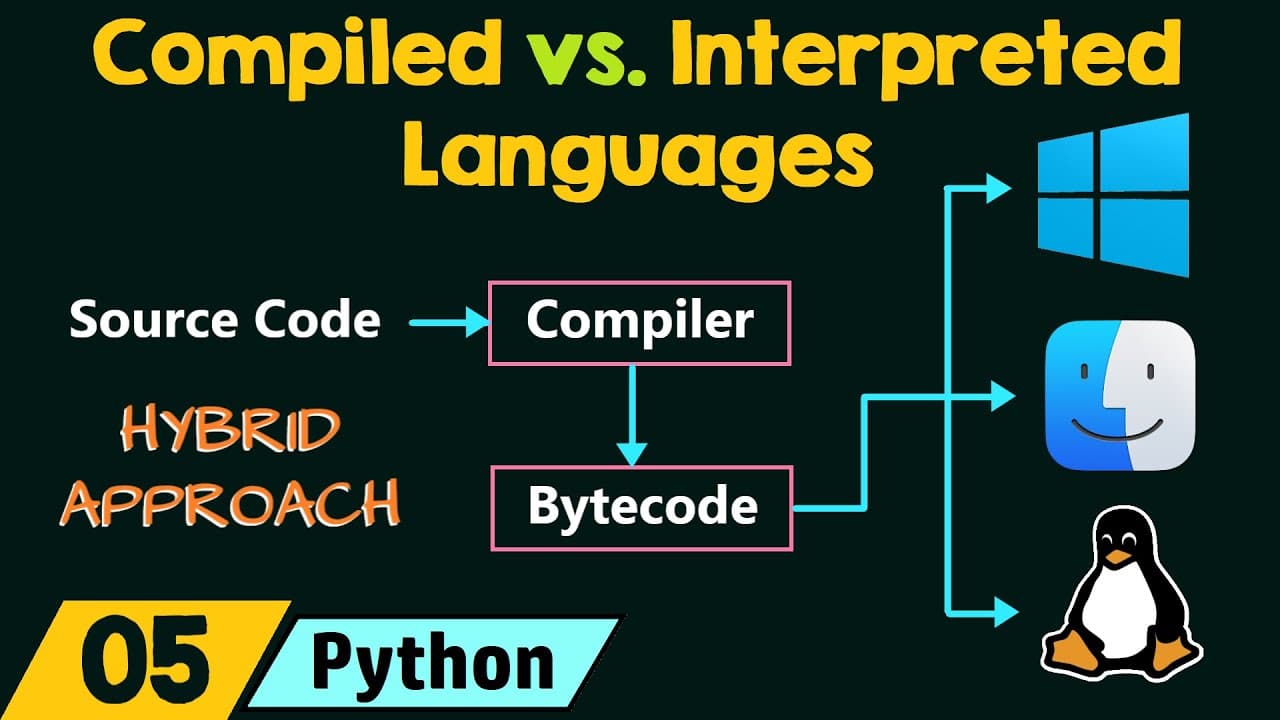
- A hybrid language compiles source code into bytecode, also called intermediate code, which an interpreter converts into machine code on the fly. This combines source-code privacy from compilation with portability across machines that have an appropriate interpreter installed.
Install to Summarize YouTube Videos and Get Transcripts
Explore YouTube Video Summarizer or Get YouTube Transcript Extractor
Questions & Answers
Q: What is the difference between compiled and interpreted languages?
Compiled languages convert source code into a machine-specific executable that can be run repeatedly without distributing the original source or translating it again each time. Interpreted languages distribute source code and require an interpreter whenever the program runs. Compilation favors faster execution and source privacy, while interpretation favors source-level portability and immediate, line-by-line error reporting.
Q: What are the advantages of compiled languages?
Compiled languages provide private source code, faster execution, and CPU-specific optimization. A developer can distribute the executable instead of the original source, preventing recipients from receiving the source code. Since compilation happens once and produces machine code, the executable can run multiple times without repeated translation. The compiler also optimizes the executable for the target CPU.
Q: What are the disadvantages of compiled languages?
Compiled languages have limited executable portability and require an additional compilation step. An executable generated for one type of machine, such as Windows, cannot run directly on another type, such as Mac or Linux. Developers must also compile the program again whenever they change its source code before they can run the updated version.
Q: Why are interpreted languages considered portable?
Interpreted languages are considered portable because their source code can be provided to different machines rather than being converted into one machine-specific executable. A recipient can run the same source as long as the appropriate interpreter is installed on that machine. The interpreter handles execution, allowing the source code to move across different machine types.
Q: Why is debugging easier in interpreted languages?
Debugging is easier in interpreted languages because an interpreter translates and processes the program line by line. When it encounters something wrong in a line, it generates an error immediately instead of waiting for the entire program to be interpreted. This behavior helps identify the location of a problem as the interpreter reaches the affected line.
Q: Why are interpreted languages slower than compiled languages?
Interpreted languages are slower because their source code must be provided to an interpreter every time the program runs. Translation therefore happens repeatedly rather than producing a machine-code executable that can be reused. Compiled programs perform the translation once and then run the resulting executable multiple times, while interpreted programs continue to depend on interpretation during execution.
Q: How does the hybrid language approach work?
The hybrid approach sends source code to a compiler, but the compiler produces bytecode, also called intermediate code, rather than a machine-specific executable. That bytecode is then given to an interpreter installed on the destination machine. The interpreter runs the bytecode and generates machine code on the fly, combining compilation and interpretation.
Q: What are examples of compiled, interpreted, and hybrid languages?
The presentation identifies C and C plus plus as examples of compiled languages. It lists JavaScript and PHP as interpreted languages. Java, C sharp, and Kotlin are presented as hybrid languages that combine compilation and interpretation. Python is initially described as interpreted, although the presentation says that classification is not the complete explanation and leaves further clarification for a later presentation.
Summary & Key Takeaways
-
Compiled languages transform source code into an executable that can be run repeatedly without distributing the original source. Their primary benefits are private code, faster execution, and optimization for the target CPU. Their disadvantages are machine-specific executables and an additional compilation step whenever the source code changes.
-
Interpreted languages distribute source code and require an interpreter on every machine that runs it. Their source-level portability and line-by-line error reporting make them convenient to move and debug. However, interpretation happens whenever the program runs, making execution slower and requiring the source code to remain visible to recipients.
-
The hybrid approach compiles source code into bytecode, also called intermediate code, instead of a machine-specific executable. That bytecode can be distributed without sharing the source and executed by interpreters on Windows, Linux, or Mac machines. The presentation classifies Java, C sharp, and Kotlin as hybrid-language examples.
Read in Other Languages (beta)
Share This Summary 📚
Summarize YouTube Videos and Get Video Transcripts with 1-Click
Try YouTube Summary with ChatGPT & Claude or YouTube Transcript Generator
Explore More Summaries from Neso Academy 📚





Summarize YouTube Videos and Get Video Transcripts with 1-Click
Try YouTube Summary with ChatGPT & Claude or YouTube Transcript Generator