How to Build Career Agency in the Age of AI
TL;DR
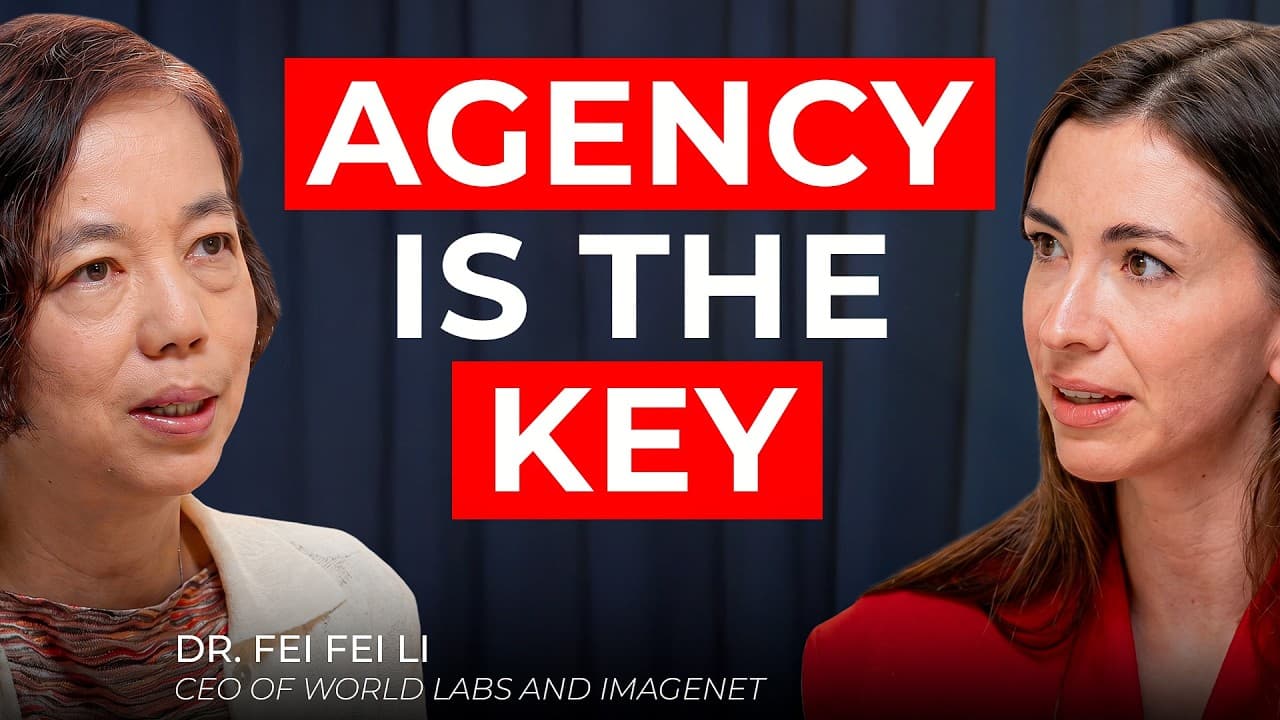
The best response to advanced AI is to build agency by using the technology directly, starting with a practical task and creating workflows suited to how you work. AI can greatly increase productivity, but its capabilities should not be confused with the full depth of human intelligence, which also includes perceptual, spatial, physical, emotional, and creative dimensions.
Transcript
This is why I think a lot of people are scared. I thought university was like a path to career. I think the word entrepreneur is very much a synonym to agency. Agency is the key in the face of a technology that is so cognitively advanced. Get familiar with that technology. >> Fe Lee built the data that made modern AI possible. Now she's raised $1 b... Read More
Key Insights
- Agency is the key response to cognitively advanced technology because people who actively use AI can accomplish far more and feel greater control over their work. Familiarity begins through direct experimentation rather than waiting for certainty about how the technology will develop.
- AI adoption is creating a widening productivity gap between workers who use the technology and workers who remain hesitant or untrained. A simple guided exercise can remove the initial barrier and encourage employees to explore additional tasks without continued supervision.
- Personal software is becoming easier to create because coding tools can reduce the work of building an application from months to a weekend. This allows individuals to design custom workflows, such as a task list that forces rapid decisions about completing, deleting, or delegating work.
- Effective AI onboarding is a hands-on process in which a leader walks hesitant employees through one basic task step by step. Rogier finds that this personal demonstration can unlock independent experimentation, even when equivalent instructional material is already available elsewhere.
- AI is a powerful human-directed tool rather than an inherently utopian or destructive force. Its effects depend on how people wield it, which makes vigilance, responsible design, practical education, and balanced public discussion essential as adoption expands.
- Human intelligence is broader than language because it also includes perceptual, spatial, physical, emotional, and creative capacities. Treating intelligence as a single commodity whose cost can fall to zero ignores the depth, variety, and still-unsolved nature of human cognition.
- Language models are already useful for business intelligence, software engineering, deductive logical reasoning, and increasingly agentic tasks. Their importance is substantial, but their strengths should be understood as one part of a more complex relationship between machine capabilities and human intelligence.
- Connected AI agents require shared intent, context, and reasoning because isolated agents can lose knowledge during handoffs. The described Internet of Cognition approach aims to help multiple agents work together rather than repeatedly treating the same customer or situation without prior context.
Install to Summarize YouTube Videos and Get Transcripts
Explore YouTube Video Summarizer or Get YouTube Transcript Extractor
Questions & Answers
Q: How can workers build agency with AI?
Workers can build agency by becoming familiar with AI through direct use, beginning with a practical task that matters to their work. The objective is not merely to memorize a list of tools, but to discover how AI can support personal workflows, increase output, and enable custom applications. Continued experimentation helps turn uncertainty into practical control and confidence.
Q: Why is AI creating a productivity gap at work?
AI is creating a productivity gap because people who use it can complete far more work, while hesitant or untrained colleagues may continue using slower processes. The difference grows as active users create new workflows and applications. Guided exposure can help reduce the gap by giving reluctant employees a successful first experience and encouraging independent exploration afterward.
Q: What is a good first task for learning AI at work?
A good first task is a basic, concrete activity that a leader can demonstrate step by step, such as using AI for research. David Rogier says he works directly with hesitant employees, sometimes in groups of two or three. The guided experience appears to remove an initial barrier, after which employees often explore many additional uses independently.
Q: How can AI help people create personalized work tools?
AI coding tools can help people build applications around their own habits and decision rules. Rogier describes creating his own productivity tools, including a task list where an item cannot remain longer than a day and a half. The rule forces him to complete the task, discard it as unimportant, or delegate it to someone on his team.
Q: Why are polarized views of AI considered dangerous?
Polarized views reduce AI to either a technology that will save the world or one that will eliminate jobs and human agency. Fei-Fei Li argues that both extremes miss the necessary middle discussion. Society needs to examine what the tool can do, how it can serve beneficial purposes, which pitfalls require vigilance, and how people should use it responsibly.
Q: Does AI make the cost of intelligence go to zero?
The claim that AI makes intelligence effectively free is presented as irresponsible because it reduces intelligence to the capabilities of language models. Human intelligence also includes perceptual, spatial, physical, emotional, and creative dimensions. Its depth and nuance remain an unsolved mystery, so the falling cost of certain language-based tasks should not be equated with eliminating the value of intelligence itself.
Q: What can language models do well today?
Language models and systems derived from them can support business intelligence, software engineering, deductive logical reasoning, and deeper tasks. The discussion also notes emerging agentic uses of language and software intelligence. These abilities are powerful and can collaborate with human intelligence, but they do not represent every form of intelligence or capture the full complexity of human activity.
Q: Why do AI agents need shared context?
AI agents need shared context because information can disappear when one agent hands work to another. The example describes a sales agent learning something about a customer, followed by a support agent interacting with that customer without the earlier context. Shared intent, context, and reasoning are proposed as a way for multiple agents to coordinate more effectively across such transitions.
Summary & Key Takeaways
-
AI is widening the gap between people who use it and those who remain hesitant. Practical exposure can help close that gap. David Rogier introduces employees to a basic task step by step, finding that guided experience often gives them enough confidence to continue experimenting independently and discover more valuable applications.
-
Fei-Fei Li rejects both utopian and catastrophic accounts of AI. She describes it as a powerful tool that people can wield for beneficial purposes, provided society remains vigilant about risks. The necessary public conversation should examine practical benefits, potential harms, responsible use, and the values embedded in technological design.
-
Current language models are powerful in business intelligence, software engineering, logical reasoning, and emerging agentic applications, but language represents only part of intelligence. Human activity combines cognitive, physical, perceptual, spatial, emotional, and creative abilities. Claims that AI reduces the cost of intelligence to zero therefore oversimplify a complex subject.
Read in Other Languages (beta)
Share This Summary 📚
Summarize YouTube Videos and Get Video Transcripts with 1-Click
Try YouTube Summary with ChatGPT & Claude or YouTube Transcript Generator
Explore More Summaries from Silicon Valley Girl 📚


Summarize YouTube Videos and Get Video Transcripts with 1-Click
Try YouTube Summary with ChatGPT & Claude or YouTube Transcript Generator