How to Extract Urea from Your Own Urine
TL;DR
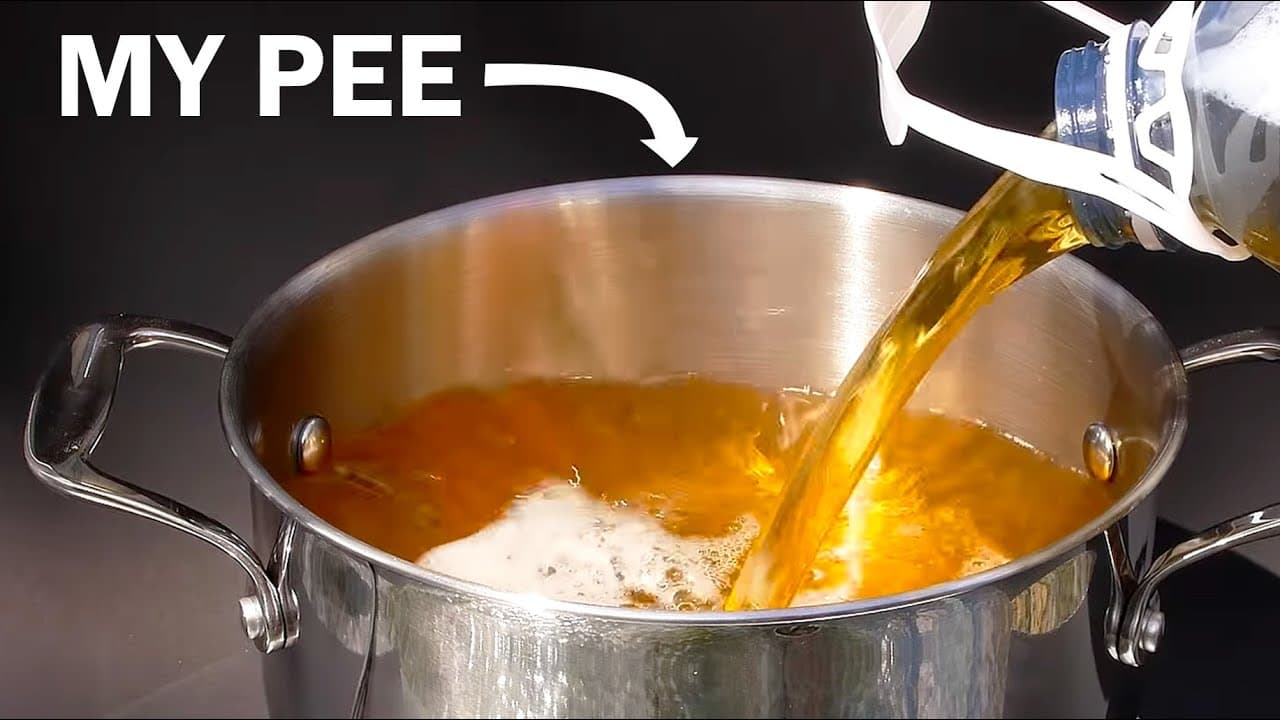
To extract urea from urine, collect it and evaporate the water outside down to about 150-200 mL, letting proteins and minerals fall out while the highly water-soluble urea stays dissolved. Filter off the solids, then add concentrated nitric acid slowly to form urea nitrate, which is cooled in the fridge, filtered, and recrystallized from hot dilute nitric acid. The creator collected over 3 liters over about 3 days, and admits buying it is far easier. Read on for each step and what the final crystals actually contain.
Transcript
Urine's produced by the kidneys and it's a way for the body to get rid of excess water and water-soluble waste. The exact composition of urine varies from person to person, but in general, this is what it contains Not counting water, the largest component is urea, which mostly comes from the metabolism of food proteins However, some of it's also ge... Read More
Key Insights
- 🧑 Urea is the main component of urine, and its composition varies from person to person.
- 🥵 Heat and evaporation are used to concentrate urine and isolate urea.
- ❓ Chemical reactions with nitric acid are employed to convert urea into urea nitrate.
- 🌸 Multiple recrystallizations are necessary to purify the urea, and each recrystallization may result in some loss of product.
- ❓ The final purified urea obtained is not completely pure, but sufficient for the creator's synthesis purposes.
- ❓ The experiment reveals the curiosity and willingness to explore unconventional chemical processes.
- 💛 Urochrome pigments contribute to the yellow color of urine.
Install to Summarize YouTube Videos and Get Transcripts
Explore YouTube Video Summarizer or Get YouTube Transcript Extractor
Questions & Answers
Q: How do you extract urea from urine?
First collect the urine and evaporate off most of the water by heating it (done outside because it is very stinky) until you reach a volume around 150 to 200 milliliters. As it heats, proteins and minerals fall out of solution while the water-soluble urea stays dissolved, so you vacuum-filter off the solids. You then add concentrated nitric acid to the dark concentrated liquid to form urea nitrate, which is cooled, filtered, and recrystallized to purify it.
Q: Can urea really be obtained from urine?
Yes. Besides water, urea is the largest component of urine, mostly coming from the metabolism of food proteins, with some generated as the body recycles its own proteins. In this project the creator saved a little over three liters of urine over about three days and processed it down to urea nitrate crystals.
Q: Is extracting urea from urine practical?
No. The creator states that unless you are living in some sort of post-apocalyptic world, this is probably the worst way to get urea. It is far easier and cheaper to simply buy it or get it from instant cold packs; he only did it to explore the science.
Q: Why does nitric acid get added during the process?
Concentrated nitric acid reacts with the urea to produce urea nitrate, which is not very soluble in water, so it precipitates out and can be separated. The acid has to be added slowly with lots of mixing because the reaction produces a lot of heat and can easily get out of control, and it foams up as the urea nitrate forms.
Q: How is the urea nitrate purified?
After the fridge-cooled mixture solidifies, it is broken up and vacuum-filtered to pull off the dark concentrated liquid. The brown urea nitrate is then recrystallized from hot dilute nitric acid: it is dissolved with heat, then cooled to room temperature and chilled in the fridge so cleaner crystals form. The crystals are washed with ice-cold dilute nitric acid to clean them further.
Q: How does the smell change during the process?
At the start of evaporation it really was not that smelly, but it slowly got worse and by the end it absolutely reeked. Once the concentrated liquid is filtered off after the nitric acid step, most of the stink is removed with it, and the washed urea nitrate ends up practically odorless.
Q: Is the final urea completely pure?
No. Even after recrystallization the crystals still are not perfectly white, though much better than before. Colored impurities such as urochrome pigments get picked up as the urea nitrate precipitates, and the result is sufficient for the creator's synthesis purposes rather than perfectly pure.
Q: What is the point of isolating urea from urine?
The creator is exploring the science of urine chemistry and plans to reuse the urea in future videos. He mentions using it to make an old, now-banned artificial sweetener as well as an anti-seizure medication, finding it interesting to turn something that was once part of him into new chemicals.
Summary & Key Takeaways
-
Urine primarily consists of water and urea, the largest component besides water being urea, which is derived from the metabolism of food proteins.
-
The creator collects and evaporates their urine outside to isolate the urea, which remains dissolved while other components precipitate out.
-
The concentrated urine is then chemically processed, creating urea nitrate that is subsequently purified to obtain urea crystals.
Read in Other Languages (beta)
Share This Summary 📚
Summarize YouTube Videos and Get Video Transcripts with 1-Click
Try YouTube Summary with ChatGPT & Claude or YouTube Transcript Generator
Explore More Summaries from NileRed 📚
Summarize YouTube Videos and Get Video Transcripts with 1-Click
Try YouTube Summary with ChatGPT & Claude or YouTube Transcript Generator