How to Manage Slowly Changing Dimensions in Data
TL;DR
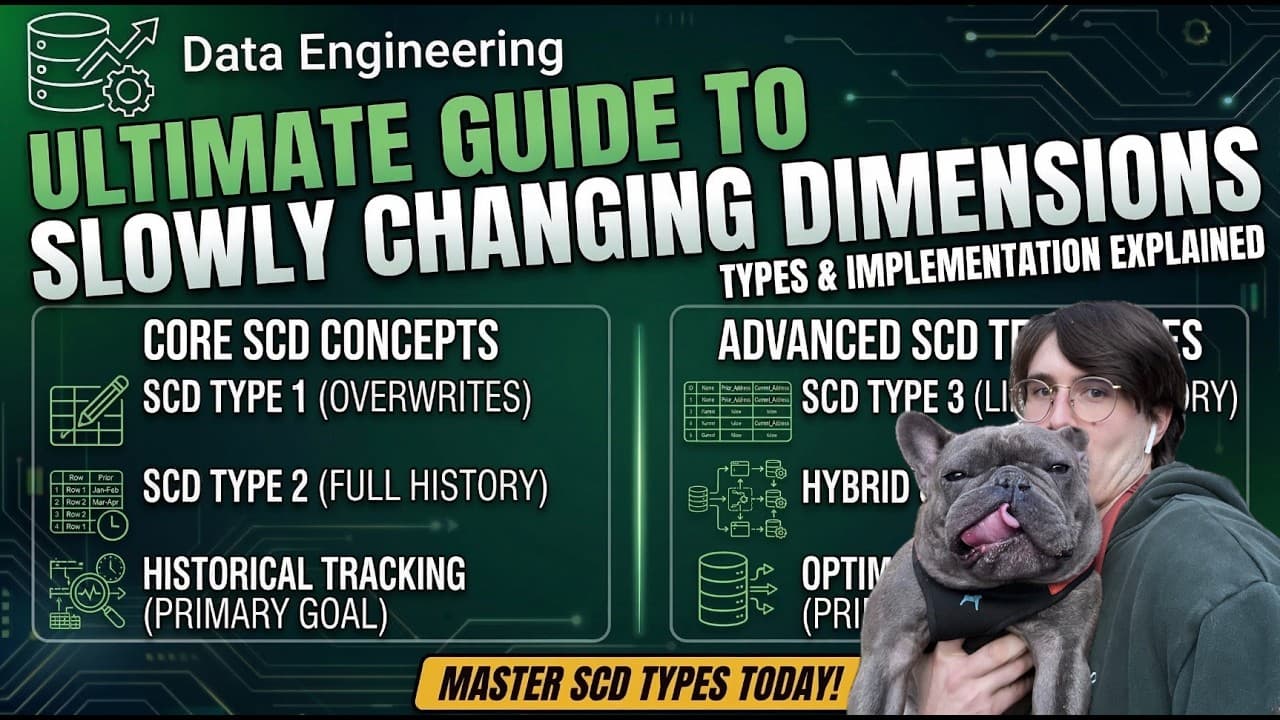
Slowly Changing Dimensions (SCDs) are strategies for handling changes in dimensional data over time. Type 1 overwrites old data with no history, Type 2 maintains full historical records, and Type 3 tracks only the most recent change. Choosing the right type depends on the need for historical accuracy, compliance, and analysis requirements.
Transcript
Imagine this, your data team just shipped a beautiful customer dashboard. CEO walks in, pulls up the report for their biggest client and the address says they're in Kansas City. But, your sales rep is on the phone right now with the same client who moved to Austin 6 months ago. The data isn't wrong, the pipeline runs clean, there's no errors, but s... Read More
Key Insights
- SCDs are crucial for managing changes in dimensional data over time in data warehouses.
- Type 1 SCD overwrites old data with new data, losing historical context.
- Type 2 SCD retains full historical records by adding new rows for changes.
- Type 3 SCD tracks only the most recent change using additional columns.
- Type 1 is suitable when historical data is irrelevant or for correcting errors.
- Type 2 is the industry standard for analytical workloads needing complete historical accuracy.
- Type 3 is useful for tracking a single change without a full audit trail.
- Choosing the right SCD type depends on the need for historical accuracy, compliance, and analytical requirements.
Install to Summarize YouTube Videos and Get Transcripts
Explore YouTube Video Summarizer or Get YouTube Transcript Extractor
Questions & Answers
Q: How to handle changes in dimensional data over time?
To handle changes in dimensional data over time, use Slowly Changing Dimensions (SCDs). There are three main types: Type 1 overwrites old data with new data, losing historical context. Type 2 retains full historical records by adding new rows for changes, making it ideal for analytical workloads. Type 3 tracks only the most recent change using additional columns, suitable for scenarios needing before-and-after analysis.
Q: What is SCD Type 1?
SCD Type 1 is a method for handling changes in dimensional data by overwriting old data with new data. This approach does not retain any historical information, making it suitable for scenarios where historical data is irrelevant or for correcting errors. However, it is not recommended when historical accuracy is required, as it retroactively changes past data.
Q: What is SCD Type 2?
SCD Type 2 is a method for handling changes in dimensional data by retaining full historical records. It adds new rows for each change, allowing for complete point-in-time accuracy. This approach is the industry standard for analytical workloads that require historical accuracy, compliance, and performance attribution. However, it can lead to increased table size and more complex queries.
Q: What is SCD Type 3?
SCD Type 3 is a method for handling changes in dimensional data by tracking only the most recent change. It uses additional columns to store current and previous values, providing a middle ground between Type 1 and Type 2. This approach is suitable for scenarios requiring before-and-after analysis, but it cannot handle multiple changes over time without adding more columns.
Q: When to use SCD Type 1?
Use SCD Type 1 when historical data is irrelevant, such as when correcting data entry errors or when the attribute has no analytical meaning over time. It is suitable for scenarios where the past does not matter, and simplicity is prioritized. However, avoid using it when historical accuracy is required, as it overwrites past data.
Q: When to use SCD Type 2?
Use SCD Type 2 when historical accuracy is essential, such as for regulatory compliance, performance attribution, or analytical workloads requiring point-in-time analysis. It retains full historical records by adding new rows for changes, ensuring accurate historical analysis. However, it can lead to increased table size and more complex queries.
Q: When to use SCD Type 3?
Use SCD Type 3 when only the most recent change needs to be tracked, such as for before-and-after analysis or in storage-constrained environments. It adds columns for current and previous values, providing a middle ground between Type 1 and Type 2. Avoid using it when multiple changes occur over time, as it cannot handle them without adding more columns.
Q: What are the trade-offs of using SCD Type 2?
The trade-offs of using SCD Type 2 include increased table size, more complex queries, and heavier ETL processes due to the retention of full historical records. While it provides complete point-in-time accuracy, the added complexity and storage requirements must be considered. It is suitable for scenarios where historical accuracy is crucial, outweighing these trade-offs.
Summary & Key Takeaways
-
Slowly Changing Dimensions (SCDs) are strategies used in data warehousing to manage changes in dimensional data over time. Type 1 SCD overwrites the old data with new data, losing historical information. Type 2 SCD retains full historical records by adding new rows for each change, making it ideal for analytical workloads needing complete historical accuracy.
-
Type 3 SCD tracks only the most recent change using additional columns, providing a middle ground between Type 1 and Type 2. Choosing the right SCD type depends on the need for historical accuracy, compliance, and analytical requirements. Type 1 is suitable for scenarios where historical data is irrelevant or for correcting errors, while Type 2 is the industry standard for most analytical workloads.
-
Type 3 is useful for tracking a single change without a full audit trail, making it suitable for scenarios where only before-and-after analysis is required. Understanding the differences between SCD types and their appropriate use cases is essential for effective data management and ensuring accurate historical analysis in data warehouses.
Read in Other Languages (beta)
Share This Summary 📚
Summarize YouTube Videos and Get Video Transcripts with 1-Click
Try YouTube Summary with ChatGPT & Claude or YouTube Transcript Generator
Explore More Summaries from The Data and AI Guy 📚
Summarize YouTube Videos and Get Video Transcripts with 1-Click
Try YouTube Summary with ChatGPT & Claude or YouTube Transcript Generator