How do neural networks work for beginners explained
TL;DR
Neural networks learn by adjusting weights through forward passes and backpropagation to minimize prediction errors. They have input, hidden, and output layers, with activation functions adding nonlinearity. The training uses loss functions to guide weight updates, enabling pattern recognition in data.
Transcript
hey y'all dat guy here and today I have another video that was inspired by a comment um saying you know neural networks are for beginners in my video about how large language models work so today I wanted to take a step back and explain exactly how neural networks work um and neural networks at their base are really honestly groundbreaking technolo... Read More
Key Insights
- Neural networks are computational models designed to recognize patterns.
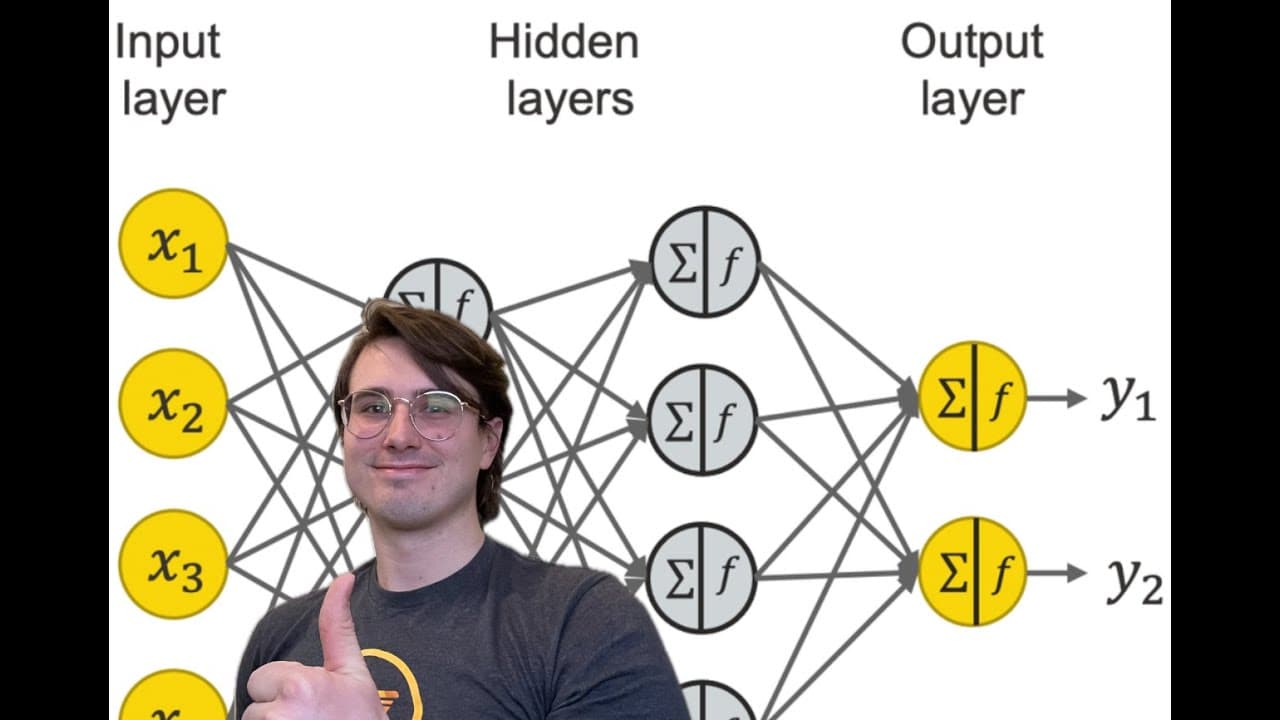
- The architecture is built from input, hidden, and output layers.
- Weights and biases drive the transformations in each layer.
- Activation functions introduce nonlinear transformations.
- Backpropagation updates weights by calculating gradients of the loss.
- Loss functions quantify how far predictions are from targets.
- The output layer yields a probability distribution for classification.
- Training scales across thousands to millions of iterations.
Install to Summarize YouTube Videos and Get Transcripts
Explore YouTube Video Summarizer or Get YouTube Transcript Extractor
Questions & Answers
Q: How do neural networks begin learning from data?
Neural networks start learning by performing forward passes where inputs are multiplied by weights, summed with a bias, and passed through activation functions across layers. This process generates a prediction that is compared to the actual target using a loss function. The difference guides subsequent updates to weights during training.
Q: What is the role of the input, hidden, and output layers?
The input layer holds the data features, with each neuron representing a feature. Hidden layers progressively transform and abstract the data through nonlinear activations to uncover patterns. The output layer produces the final prediction or classification, typically as a probability or score indicating the likely target.
Q: What does backpropagation accomplish in neural networks?
Backpropagation works by computing the gradient of the loss with respect to each weight through the chain rule and then updating weights to reduce error. This backward pass identifies which neurons and connections most influence the error, allowing targeted adjustments to improve future predictions.
Q: Why are activation functions important in neural networks?
Activation functions introduce nonlinear transformations, enabling networks to learn complex, non linear relationships beyond simple linear correlations. They determine how the input signals are transformed within a neuron, allowing the network to model patterns such as waves, thresholds, or smooth probability changes rather than just straight lines.
Q: How is a loss function used in training?
A loss function measures how far the network’s predictions are from the actual targets. Common examples include mean squared error for regression and cross entropy for classification. The loss value guides weight updates during training, indicating whether changes increased or decreased prediction accuracy.
Q: What happens during a forward pass in a neural network?
During a forward pass, each layer performs a weighted sum of inputs, adds a bias, and applies an activation function. The results feed into the next layer, and ultimately the output layer provides the network’s prediction. This sequence transforms raw data into an interpretable result.
Q: How do networks use probability distributions in output?
In classification tasks, the output layer often produces a probability distribution over classes, using functions like softmax. This distribution expresses the model’s confidence in each class, allowing a final decision based on the highest probability while conveying uncertainty across options.
Q: What scales with training data in neural networks?
Training scales with large datasets, as networks typically require thousands to millions of data points and iterations to learn robust patterns. More data generally helps networks generalize better, reducing overfitting and improving performance on unseen inputs.
Summary & Key Takeaways
-
Neural networks are computational models that recognize patterns by processing data through layered transformations to produce predictions.
-
They use input layers for raw data, hidden layers for feature extraction, and an output layer for final predictions.
-
Training relies on comparing predictions to targets using loss and adjusting weights to improve accuracy.
Read in Other Languages (beta)
Share This Summary 📚
Summarize YouTube Videos and Get Video Transcripts with 1-Click
Try YouTube Summary with ChatGPT & Claude or YouTube Transcript Generator
Explore More Summaries from The Data and AI Guy 📚

Summarize YouTube Videos and Get Video Transcripts with 1-Click
Try YouTube Summary with ChatGPT & Claude or YouTube Transcript Generator