What Is a Multi-Agent AI System and How Do They Collaborate
TL;DR
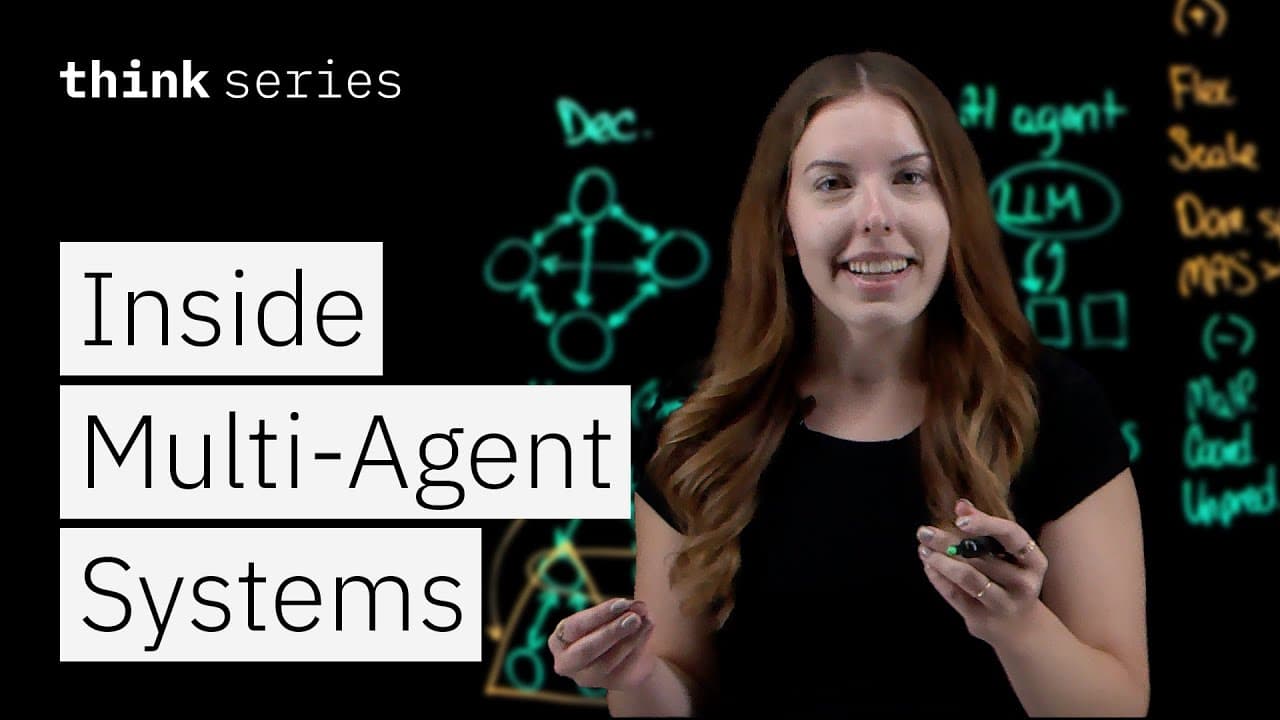
A multi-agent AI system combines many small autonomous agents to solve complex problems by coordinating, sharing information, and leveraging specialized roles. The structure can be decentralized or hierarchical, enabling scalability and flexibility while introducing coordination challenges and potential failures. Proper training, governance, and design help maximize collective performance.
Transcript
Here's a bee. On its own, it can collect nectar, but that's about it. Now add thousands of bees, and suddenly they're making honey. They're cooling the hive and defending it. That's exactly how multi-agent systems work. Many simple AI agents, each with a small job, coming together to solve big, complex problems. At its core, an AI agent is an auton... Read More
Key Insights
- A multi-agent system consists of autonomous agents that cooperate to solve large problems.
- Agent networks allow agents to communicate and share resources while maintaining equal authority across the network.
- Hierarchical structures introduce layers of authority with a top coordinator and bottom workers.
- Authority can be distributed or centralized, and dynamic reallocation is possible based on expertise and situation.
- Advantages include flexibility, scalability, and domain specialization with improved information pooling.
- Multi-agent systems outperform single agents because diverse action plans enable broader learning and reflection, enhancing results.
- Common challenges are shared pitfalls from LLMs, coordination complexity, and risks of unpredictable behavior.
- Effective use depends on task complexity, resource limits, and the need for cross-domain collaboration.
Install to Summarize YouTube Videos and Get Transcripts
Explore YouTube Video Summarizer or Get YouTube Transcript Extractor
Questions & Answers
Q: How to decide between a single agent and a multi-agent system for a given task?
To decide, assess task complexity, domain breadth, and the need for scalability. If the task spans multiple domains, requires adapting to changing environments, or benefits from specialized expertise, a multi-agent system is advantageous. For simple, well defined tasks with limited resources, a single agent may suffice.
Q: What is meant by a decentralized agent network in multi-agent systems?
A decentralized agent network refers to a setup where several AI agents can communicate and share information and resources with each other while operating with the same level of authority. This structure supports collaboration without a single controlling hub, enabling flexible coordination and resource exchange.
Q: How do hierarchical structures differ from decentralized networks in this context?
Hierarchical structures organize agents in tree like formations with varying levels of autonomy. A top level may coordinate, intermediate levels supervise, and bottom level executes tasks. This creates clear authority lines and allows scalable management of many agents while preserving coordinated decision making.
Q: What are the main advantages of using multi-agent systems?
The main advantages are increased flexibility to adapt to environments, scalability to handle larger problems, and domain specialization where different agents focus on specific tasks. This collaboration expands the pool of information, improving problem solving beyond what a single agent could achieve.
Q: What challenges are associated with multi-agent systems?
Challenges include shared pitfalls when using similar LLMs, coordination complexity to prevent resource conflicts, and the risk of unpredictable behavior as more agents are involved. Effective governance, testing, and conflict resolution mechanisms are essential to mitigate these issues.
Q: Why is coordination important in multi-agent systems?
Coordination ensures agents share information, resolve conflicts, and synchronize decisions so the system maximizes overall performance rather than competing outputs. Without good coordination, resources can be wasted and decisions can contradict each other, reducing efficiency and reliability.
Q: When is it best to stick with a single agent versus a multi-agent system?
Stick with a single agent for simple, well defined tasks with limited scope. For complex problems that span domains, require scalability, or need to adapt to changing environments, a multi-agent system tends to perform better by distributing work and leveraging specialization.
Q: What role do LLMs play in multi-agent systems?
LLMs power the agents by providing understanding, reasoning, and access to tools. The quality, alignment, and governance of the LLM determine how effectively agents can communicate, plan, and execute tasks, making LLM selection a critical factor in system performance.
Summary & Key Takeaways
-
Multi-agent systems use many simple agents each with a small job to achieve complex goals. They rely on the right mix of LLMs and tools and require a reasoning framework to turn outputs into decisions. Coordination and structure are central to their effectiveness.
-
These systems improve flexibility, scalability, and domain specialization compared to single agents, enabling more robust problem solving across changing environments. They also pose risks like miscoordination and vulnerability to shared weaknesses in the underlying models.
-
Choosing single versus multi-agent setups depends on task complexity, domain coverage, resource constraints, and the need for adaptability across environments. When tasks are diverse and scalable, multi-agent systems tend to outperform single-agent approaches.
Read in Other Languages (beta)
Share This Summary 📚
Summarize YouTube Videos and Get Video Transcripts with 1-Click
Try YouTube Summary with ChatGPT & Claude or YouTube Transcript Generator
Explore More Summaries from IBM Technology 📚





Summarize YouTube Videos and Get Video Transcripts with 1-Click
Try YouTube Summary with ChatGPT & Claude or YouTube Transcript Generator