How Do You Implement RAG From Scratch with Python? A LangChain Engineer Explains
TL;DR
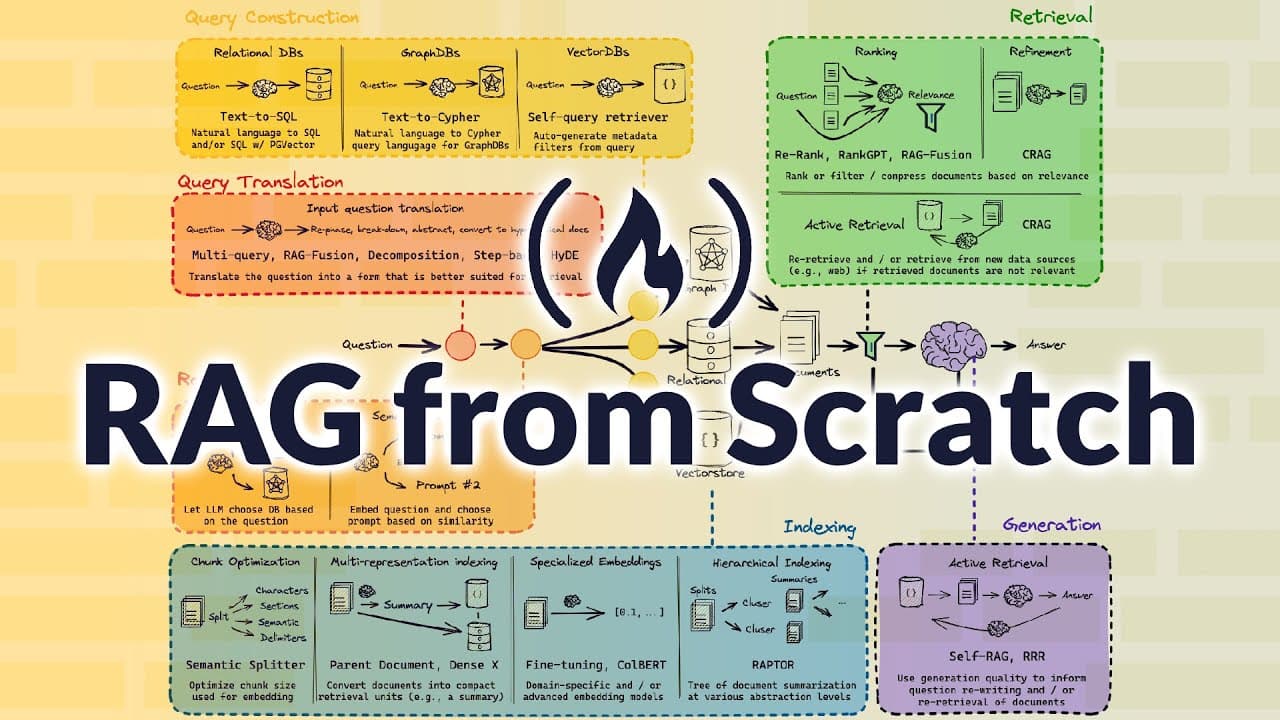
To implement RAG from scratch, index external documents, retrieve information relevant to a question, and pass it to an LLM to generate a grounded answer. LangChain engineer Lance Martin explains this core pipeline before covering query translation, routing, query construction, reranking, filtering, and feedback-driven retrieval and generation. Read on to understand how each component helps connect LLMs with private data.
Transcript
in this course Lance Martin will teach you how to implement rag from scratch Lance is a software engineer at Lang chain and Lang chain is one of the most common ways to implement rag Lance will help you understand how to use rag to combine custom data with llms hi this is Lance Martin I'm a software engineer at Lang chain I'm going ... Read More
Key Insights
- RAG is a method to enhance language models by integrating private data sources, making them more versatile.
- Indexing in RAG involves converting documents into numerical representations for efficient retrieval.
- Retrieval in RAG uses vector stores to find relevant document chunks based on semantic similarity.
- Generation in RAG involves feeding retrieved documents into a language model to produce contextually grounded answers.
- Query translation techniques, such as multi-query and decomposition, improve document retrieval accuracy.
- Routing in RAG determines the appropriate data source for a query, enhancing retrieval precision.
- Advanced indexing techniques, like multi-representation and hierarchical indexing, optimize document retrieval.
- Adaptive RAG involves dynamic retrieval strategies, adjusting based on document relevance and query context.
Install to Summarize YouTube Videos and Get Transcripts
Explore YouTube Video Summarizer or Get YouTube Transcript Extractor
Questions & Answers
Q: How do you implement RAG from scratch with Python and LangChain?
The course teaches RAG as a pipeline with three core stages: indexing, retrieval, and generation. External documents are indexed for retrieval, relevant documents are selected for a question, and an LLM uses them to produce a grounded answer. Lance Martin, a software engineer at LangChain, then extends this foundation with query translation, routing, query construction, reranking, filtering, and feedback.
Q: What is retrieval augmented generation (RAG)?
RAG combines an LLM's processing capabilities with information retrieved from external sources, including private personal or corporate data. Relevant documents are supplied to the LLM so its answer can be grounded in information that was not natively present in its training set.
Q: What are the three main steps in a RAG pipeline?
The three general steps are indexing, retrieval, and generation. Documents are first organized so they can be retrieved, relevant documents are then selected according to an input such as a question, and the LLM finally generates an answer from that retrieved information.
Q: Why is RAG useful for working with private data?
The course explains that most of the world's data is private, while LLMs are trained on publicly available data. RAG makes it possible to feed personal, corporate, or other external information to an LLM for processing without requiring that information to have been part of its training set.
Q: How does indexing work in RAG?
Indexing processes external documents so they can be retrieved using heuristics related to an input question. The underlying data may live in vector stores, SQL or relational databases, graph databases, or other sources. The course also covers embedding methods and different indexing strategies.
Q: What is query translation in RAG?
Query translation modifies a user's question to make it better suited for retrieval from an index. The transcript identifies query rewriting and decomposition into constituent subquestions as examples of this approach.
Q: How do routing and query construction differ in RAG?
Routing sends a rewritten or decomposed question to the appropriate source, such as a vector store, relational database, or graph database. Query construction converts natural language into the source's required DSL, with examples including text-to-SQL, text-to-Cypher, and metadata filters for vector databases.
Q: How does active RAG use feedback to improve answers?
Active RAG can grade retrieved documents and generated answers for relevance, faithfulness to the documents, and possible hallucinations. If a check fails, the system can retrieve again, rewrite the question, or regenerate the answer, creating a feedback loop across retrieval and generation.
Summary & Key Takeaways
-
RAG integrates private data with language models, enhancing their ability to generate contextually relevant responses. The course covers foundational elements like indexing, retrieval, and generation, alongside advanced techniques such as query translation and adaptive RAG, providing a comprehensive framework for building RAG systems.
-
Indexing converts documents into numerical forms for retrieval, while retrieval uses vector stores to find relevant document chunks. Generation involves using these chunks to produce grounded answers, with query translation and routing further refining the retrieval process.
-
Advanced techniques like multi-representation indexing and RAPTOR enhance retrieval efficiency. Adaptive RAG employs dynamic strategies, adjusting retrieval based on document relevance, ensuring the language model outputs are contextually accurate and relevant.
Read in Other Languages (beta)
Share This Summary 📚
Summarize YouTube Videos and Get Video Transcripts with 1-Click
Try YouTube Summary with ChatGPT & Claude or YouTube Transcript Generator
Explore More Summaries from freeCodeCamp.org 📚


Summarize YouTube Videos and Get Video Transcripts with 1-Click
Try YouTube Summary with ChatGPT & Claude or YouTube Transcript Generator