What Is Supply Chain Management? A Complete Guide
TL;DR
Supply chain management is a broad, cross-functional discipline covering the end-to-end cycle from customer order through procurement, production, warehousing, shipment, cash collection, and forecasting. Building a digital supply chain requires defining business processes first, then selecting technology, and finally addressing the human side through change management, which is arguably the most important step.
Transcript
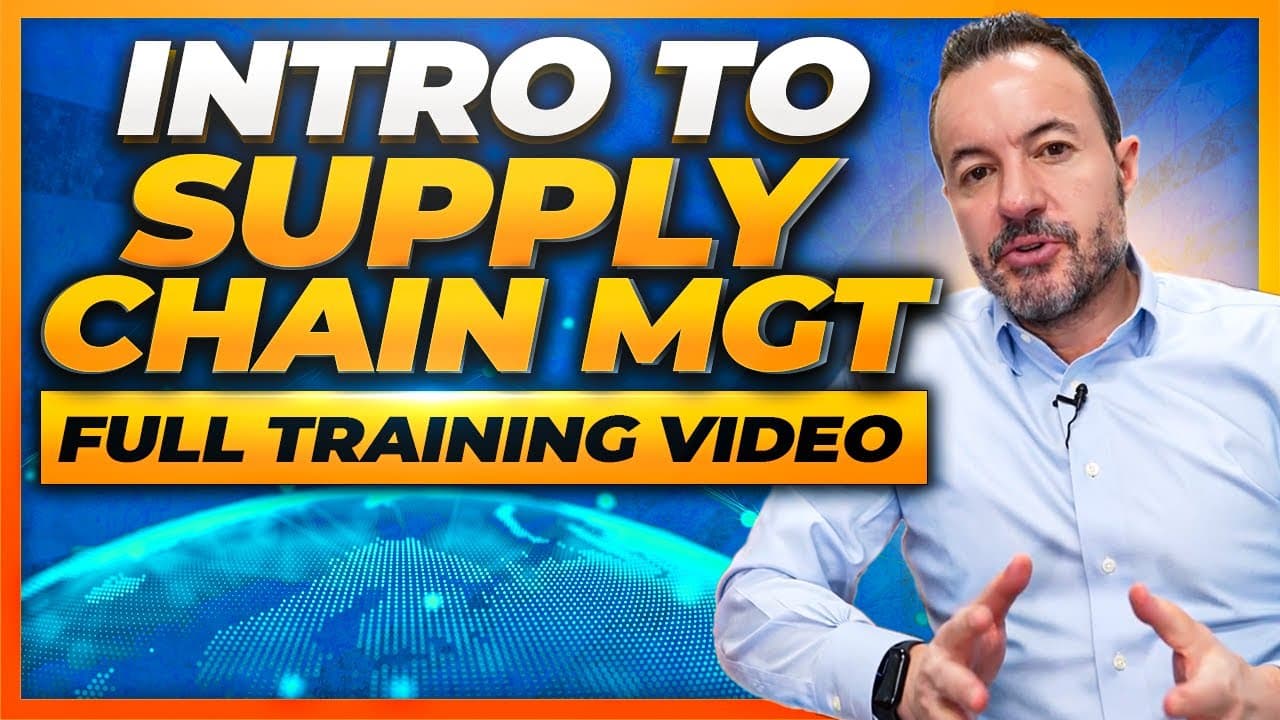
Supply Chain management is a complex discipline that's also very exciting there's a lot to learn about it what exactly do we need to know about Supply Chain management that's what I want to cover in today's training my name is Eric Kimberling and I'm the CEO of third stage Consulting we're an independent consulting firm that helps clients throughou... Read More
Key Insights
- Supply chain management is a broad, cross-functional and complex discipline whose end-to-end process starts with a customer order and runs through procurement, production, warehousing, shipment to customers or distributors, cash collection, and forecasting future demand.
- The first characteristic of a digital supply chain is improved business processes; you must define what you want those processes to be before searching for technologies to enable them.
- Supply chains broke down in the 2020s not from one massive failure but because small pieces broke, such as over-dependence on single vendors during the 2020 pandemic, causing a domino effect throughout the chain.
- Diversifying the vendor base is a common process improvement; if key raw materials come from a single vendor, changing the process to spread risk and maintain plan Bs protects against vendor failures.
- Tracking vendor supplier scorecards is a process improvement that measures how well suppliers perform and identifies the best performers within the supply chain.
- Technology options range from supply-chain-specific vendors like Manhattan Associates and Blue Yonder, to function-focused tools like Ariba (owned by SAP) for procurement, to enterprise-wide ERP systems tying the whole organization together.
- The human aspect is arguably the most important part of a digital supply chain, because without people executing correctly, the operational and technological work delivers no value.
- Organizational change management ensures people understand how new processes and technologies affect their jobs and roles, especially when automation eliminates job functions that must be replaced with higher-value work.
Install to Summarize YouTube Videos and Get Transcripts
Explore YouTube Video Summarizer or Get YouTube Transcript Extractor
Questions & Answers
Q: What is supply chain management?
Supply chain management is a complex, broad, and cross-functional discipline. Its end-to-end process starts with a customer order and goes through procurement of materials, production of materials, storage of materials in a warehouse, shipment of materials to a customer or third-party distributor, and ultimately the collection of cash and the forecasting of what might happen in the future related to that entire cycle.
Q: How do you create a digital supply chain?
The first characteristic of a digital supply chain is improved business processes. You need to start by defining what you want your future-state business processes to be, then go out and find the technologies that best help you achieve them. After processes and technology, you address the human side through change management, and finally identify the analytics and metrics that give you visibility into your supply chain data.
Q: Why did supply chains break down in the 2020s?
Supply chains broke down in the 2020s not because of a massive breakdown in the overall supply chain, but because little pieces within the supply chain broke down, causing a domino effect throughout the entire chain. When the pandemic happened in 2020, many supply chain managers found they were overly dependent on certain vendors and lacked good backups if those vendors could not fulfill demand.
Q: How can you reduce vendor risk in a supply chain?
One process improvement is to diversify your vendor base. If you notice key raw materials are being sourced by the same vendor, you can change your business process to diversify the risk of single vendors and build a better process for managing vendors with plan Bs for when problems arise. Another improvement is measuring and tracking vendor supplier scorecards to see how well suppliers perform and identify the best performers.
Q: What software options exist for supply chain management?
There are several technology options. Supply-chain-specific vendors such as Manhattan Associates and Blue Yonder automate an entire end-to-end supply chain. More focused solutions target specific functions, such as procurement software like Ariba, which is owned by SAP. There is also logistics, transportation management, and freight management software, or you can choose a broader integrated supply chain solution or an enterprise-wide ERP system tying together the whole organization.
Q: Why is the human aspect important in supply chain modernization?
The human aspect is arguably the most important part, because if you do the operational and technological work without the human piece, none of it matters since people are not executing the way you need them to. This is where organizational change management comes in, requiring a clear adoption and change strategy so people understand how new processes and technologies affect their jobs and what their new roles and responsibilities will be.
Q: What happens to jobs when a supply chain is automated?
In supply chain modernization efforts, people often automate a lot of their jobs and many job functions go away. You need to figure out how to replace those functions with something higher value and more important to the organization. Without this, you not only fail to gain the benefit and value of the new technology, but you also cause people to panic because they do not understand their new job roles and responsibilities.
Q: What are the key foundations of a digital supply chain?
A digital supply chain rests on a people, process, and technology foundation. You first define what you want your business processes to look like, then identify potential technology improvements, then address human performance through change management. The next step is to identify the analytics and metrics used to drive and manage the supply chain, making data and visibility into that data important so technology improves visibility rather than just automating processes.
Summary & Key Takeaways
-
Eric Kimberling, CEO of Third Stage Consulting, introduces a training course on supply chain management, an independent consulting firm helping clients reach digital transformation success. The training flows from what supply chain management is and how supply chains work, through why they break and strategies to improve them, ending with case studies of successful and struggling supply chains.
-
A supply chain is broad, cross-functional, and complex. Its end-to-end process begins with a customer order and moves through procurement of materials, production, warehouse storage, shipment to customers or third-party distributors, collection of cash, and forecasting future demand. Building a digital supply chain starts with defining your desired future-state business processes.
-
Digital transformation follows people, process, and technology. After defining processes and selecting technologies, teams must address human performance through organizational change management, then identify analytics and metrics that give visibility into supply chain data, ensuring technology improves visibility rather than merely automating existing processes.
Read in Other Languages (beta)
Share This Summary 📚
Summarize YouTube Videos and Get Video Transcripts with 1-Click
Try YouTube Summary with ChatGPT & Claude or YouTube Transcript Generator
Explore More Summaries from Digital Transformation with Eric Kimberling 📚
![What Are the Alternatives to Traditional ERP Systems? [Death of ERP Software, Part II] thumbnail](/_next/image?url=https%3A%2F%2Fi.ytimg.com%2Fvi%2FNTWK34u3pJE%2Fhqdefault.jpg&w=750&q=75)
![Top 10 Digital Transformation Myths [Common Pitfalls to Avoid Transformation and ERP Failure] thumbnail](/_next/image?url=https%3A%2F%2Fi.ytimg.com%2Fvi%2FfYsZYi0UoOs%2Fhqdefault.jpg&w=750&q=75)
Summarize YouTube Videos and Get Video Transcripts with 1-Click
Try YouTube Summary with ChatGPT & Claude or YouTube Transcript Generator