Top ERP Software Terms and Definitions You Need To Know
TL;DR
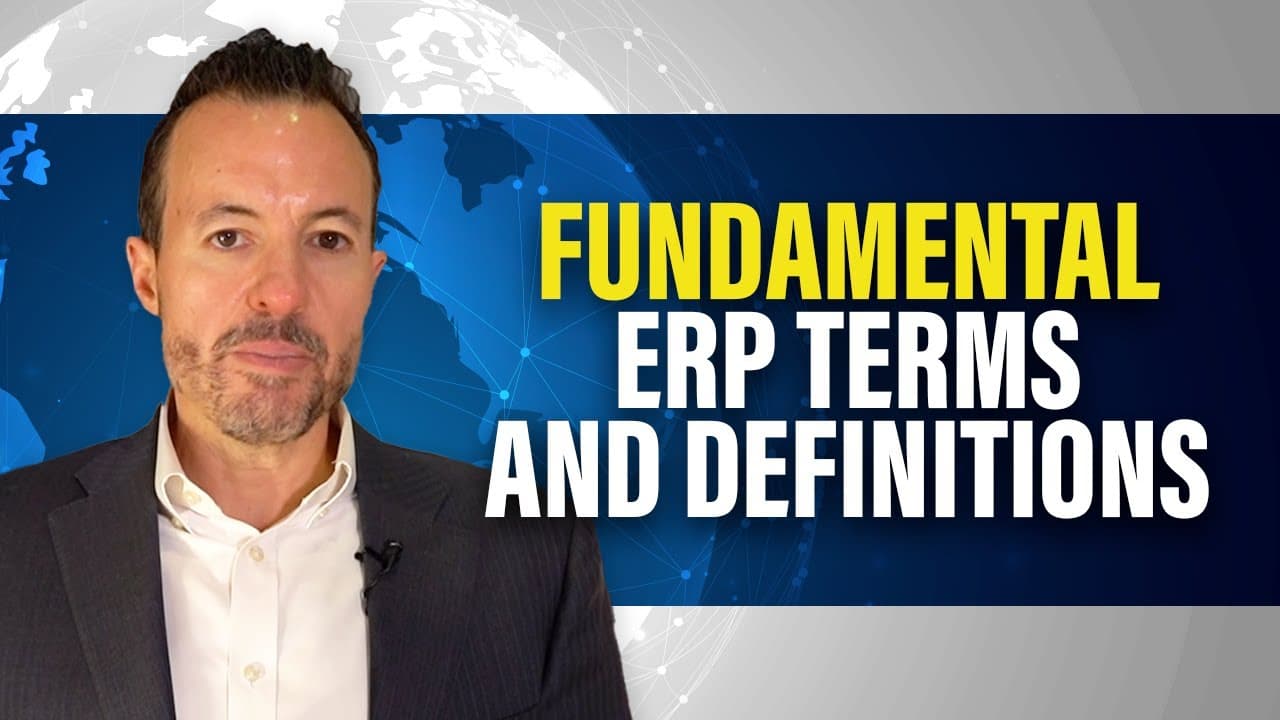
This video discusses ten essential terms and definitions related to ERP software implementation, including ERP, order to cash, procure to pay, modules, business requirements, configuration, customization, integration, enterprise architecture, and data migration.
Transcript
in order to be successful in the Erp software industry there are a number of key terms and definitions that you need to understand what exactly are those terms and definitions that's what I'm going to talk about here today my name is Eric Kimberling I'm the CEO of third stage Consulting we're an independent consulting firm that helps clients throug... Read More
Key Insights
- 📚 ERP stands for Enterprise Resource Planning and refers to a technology that ties together an entire business, integrating various processes and functions.
- 📕 Order to cash is an end-to-end business process that starts with a customer order and ends with collecting cash, encompassing inventory management, order processing, and customer service.
- 🔁 Procure to pay is another end-to-end business process that focuses on procuring materials and paying for them, necessary for running a business.
- 🔌 ERP systems are composed of modules that provide specific functionality for different parts of a business, such as finance, inventory management, and manufacturing.
- 📝 Business requirements are the needs and priorities of an organization, defined by different departments, and used to select and implement the right ERP software.
- 🔧 Configuration is the process of personalizing and setting up ERP software to fit the organization's business requirements, without changing the software's core code.
- 🖌️ Customization involves changing the code of ERP software to fit unique needs, but should be done sparingly and only when necessary, as it comes with risks and added complexity.
- 🔗 Integration allows different modules within an ERP system, as well as third-party systems, to connect and exchange data, ensuring seamless processes.
- 🏢 Enterprise architecture or solution architecture is a blueprint that outlines how different systems and their modules will integrate and share data within an organization.
- 📂 Data migration involves cleaning up and transferring historic data from old legacy systems to the new ERP system, ensuring accuracy and consistency.
Install to Summarize YouTube Videos and Get Transcripts
Explore YouTube Video Summarizer or Get YouTube Transcript Extractor
Questions & Answers
Q: What is the significance of order to cash and procure to pay processes in ERP software implementation?
The order to cash process is essential as it covers all the activities from receiving a customer order to collecting payment, including inventory management, manufacturing, and customer service. On the other hand, the procure to pay process focuses on acquiring materials and paying for them, ensuring efficient business operations and supply chain management. Both processes are core components of ERP systems and have a significant impact on overall business performance.
Q: What is the difference between customization and configuration in ERP software implementation?
Configuration involves personalizing the ERP software by adjusting settings and options within the existing framework. It does not require changing the code or development work. On the other hand, customization goes beyond configuration and involves making changes to the code itself. Customization is a more complex and time-consuming process that should only be used when necessary, as it introduces additional risks and maintenance challenges.
Q: Why is data migration important in ERP software implementation?
Data migration is crucial because it ensures that historical data from previous systems is cleaned, mapped, and transferred to the new ERP software. It allows businesses to maintain continuity, access valuable historical information, and avoid data discrepancies. By migrating data effectively, organizations can smoothly transition to the new system without losing critical data or disrupting operations.
Q: What is the role of integration in ERP software implementation?
Integration is vital in ERP software implementation as it ensures that different modules and third-party systems are connected and can share data seamlessly. Without integration, information would be isolated within different systems, leading to inefficiency and data inconsistencies. By establishing integration points, organizations can achieve a unified and holistic view of their business processes and data.
Q: How does enterprise architecture contribute to ERP software implementation?
Enterprise architecture provides a blueprint or visual representation of how different technologies, modules, and systems within an ERP system are interconnected. It defines integration points, data flows, and the ultimate source of truth for data. By establishing a clear enterprise architecture, organizations can ensure that all components work together harmoniously and support their business objectives in an integrated manner.
Summary & Key Takeaways
-
ERP stands for enterprise resource planning, which is a technology that integrates multiple business processes into a single system.
-
Order to cash is an end-to-end process that starts with a customer order and ends with collecting payment from the customer.
-
Procure to pay is another end-to-end process focused on acquiring materials and paying for them to run the business.
-
ERP systems consist of modules that provide specific functionalities for different parts of the business.
-
Business requirements are the needs of the organization that determine how ERP software is configured and set up.
-
Configuration is the process of personalizing and setting up the ERP software without changing the code.
-
Customization involves changing the code of the ERP software to tailor it to unique needs, but it comes with risks.
-
Integration ensures that different modules and third-party systems are connected and data flows smoothly.
-
Enterprise architecture is the visualization and map of how different technologies and modules communicate within the ERP system.
-
Data migration involves cleaning, mapping, and moving data from old legacy systems to the new ERP software.
Read in Other Languages (beta)
Share This Summary 📚
Summarize YouTube Videos and Get Video Transcripts with 1-Click
Try YouTube Summary with ChatGPT & Claude or YouTube Transcript Generator
Explore More Summaries from Digital Transformation with Eric Kimberling 📚
![What Are the Alternatives to Traditional ERP Systems? [Death of ERP Software, Part II] thumbnail](/_next/image?url=https%3A%2F%2Fi.ytimg.com%2Fvi%2FNTWK34u3pJE%2Fhqdefault.jpg&w=750&q=75)
![Top 10 Digital Transformation Myths [Common Pitfalls to Avoid Transformation and ERP Failure] thumbnail](/_next/image?url=https%3A%2F%2Fi.ytimg.com%2Fvi%2FfYsZYi0UoOs%2Fhqdefault.jpg&w=750&q=75)
Summarize YouTube Videos and Get Video Transcripts with 1-Click
Try YouTube Summary with ChatGPT & Claude or YouTube Transcript Generator