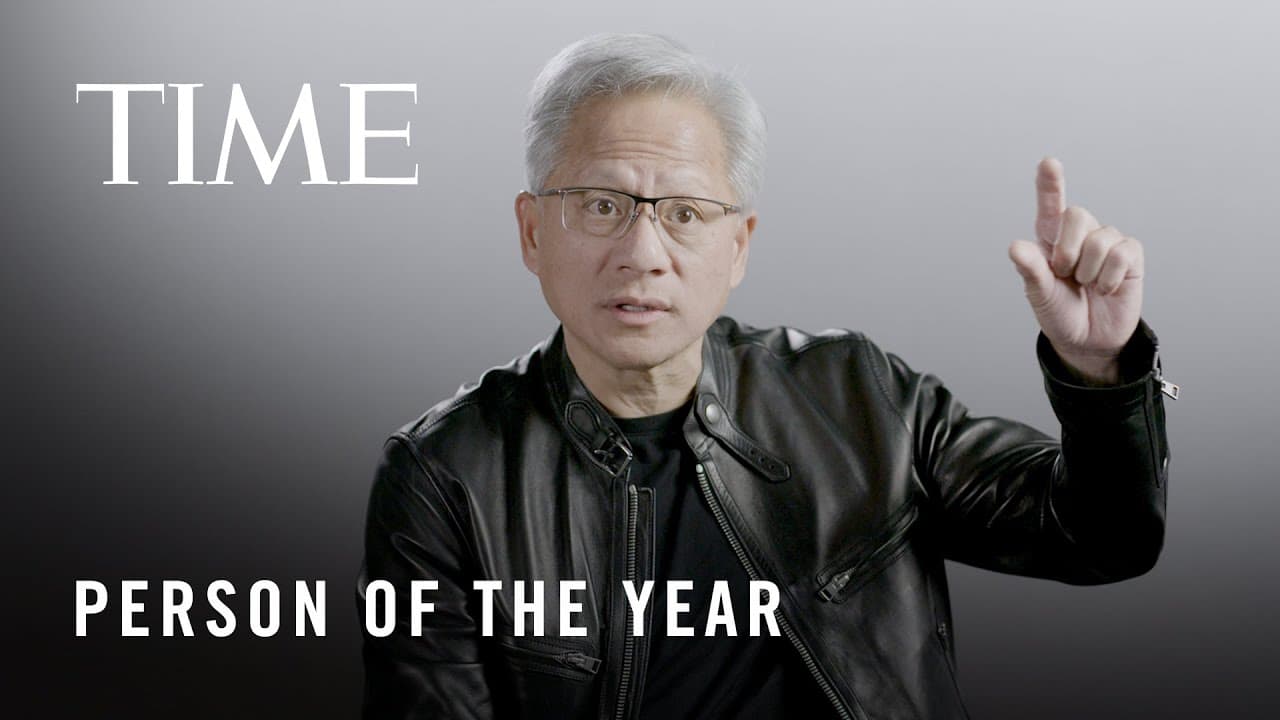
How will AI reshape jobs and industry, Huang explains
TL;DR
AI will transform every job and create many new roles, and everyone will need to use AI to stay competitive. Huang argues that the AI shift is a fundamental change in computing from general purpose to accelerated computing, with a vast economic and strategic impact across chips, infrastructure, and applications.
Transcript
This is for certain. Everybody's jobs will change as a result of AI. Some jobs will disappear. Obviously, every single industrial revolution, some jobs are just gone and but a whole bunch of new jobs are created. Everybody will have to use AI because if you don't use AI, you're going to lose your job to somebody who does. Time has named the archite... Read More
Key Insights
- AI will alter jobs and create new opportunities, with some roles disappearing and others emerging as the AI ecosystem expands across multiple layers of technology.
- The foundation of AI is a shift from general purpose computing to accelerated computing, which Huang views as the core economic driver of the AI era.
- Investments in AI ecosystems are strategic, aimed at expanding partnerships and maintaining a competitive edge, while the low single digit investment relative to revenues is not seen as creating circularity.
- Huang highlights the importance of understanding the full AI stack, including energy, chips, infrastructure, models, and applications, for U.S. competitiveness and national security.
- US China AI interdependence is deep, and managing this relationship through ongoing negotiations and collaboration is essential for balanced progress.
- China contributes a large share of AI researchers, and healthy competition with collaboration can benefit both nations and the global AI ecosystem.
- Huang defends the expansion of American tech across the world, arguing that global use of American tech stacks should be encouraged to maintain leadership and wealth creation.
- The conversation discusses leadership qualities in political figures and the role of policy, energy, and trade in shaping the AI landscape and national security.
Install to Summarize YouTube Videos and Get Transcripts
Explore YouTube Video Summarizer or Get YouTube Transcript Extractor
Questions & Answers
Q: What is the core reason Huang says AI will change the job market?
Huang argues that AI will change jobs because it represents a transformation of computing from general purpose to accelerated computing, which alters how work is done, how tasks are automated, and how new skills are required. He notes that some jobs will disappear while a large number of new roles will be created as the AI ecosystem expands across chips, infrastructure, models, and applications, necessitating broad adoption to stay competitive.
Q: How does Huang describe the AI stack and its importance for national competitiveness?
Huang explains that AI is not just a model but a full stack of technology that includes energy, chips, infrastructure, cloud services, models, and applications. Each layer must be developed to win, and American leadership depends on every layer performing well and being widely adopted. If any layer lags, the United States risks falling behind in the AI revolution.
Q: Why does Huang discuss investments in AI companies if they are only low single digits of revenue?
Huang states that investments in AI companies are about ecosystem expansion and strategic partnerships rather than immediate profit. These investments give Nvidia visibility and influence in key AI companies, offering a front row seat to how successful these ventures become, which he views as a long term, high value strategic move rather than a source of immediate circularity.
Q: What does Huang say about US China relations and AI collaboration?
Huang emphasizes that the United States and China are deeply interdependent in AI and that managing this relationship through negotiations and collaboration is essential. He argues for competing fairly while also collaborating, recognizing the deep pool of Chinese AI researchers and the mutual benefits of a competitive yet cooperative global AI ecosystem.
Q: What is Huang’s view on Trump’s approach to AI and energy policy?
Huang describes Trump as a strong listener with an exceptional work ethic and intelligence, who supports energy growth. He argues that a growth-oriented energy policy is important for AI to flourish because energy and infrastructure underpin the development of chip design, cloud services, and AI applications, which in turn drive national competitiveness.
Q: What does Huang say about China’s own chip industry and American export controls?
Huang notes that China has its own capable chip industry and that export controls are part of a broader strategy to win across all AI layers. He argues for a balanced approach where the US can engage with the Chinese market to earn revenue, while ensuring that American technology remains a global standard across all AI layers.
Q: How does Huang characterize the role of education and talent in AI leadership?
Huang highlights the importance of brilliant students and scientists, especially from China, to the AI field. He argues that the AI era depends on talent and education globally, and that recognizing and collaborating with top researchers is essential for maintaining leadership and advancing the industry responsibly.
Q: What does Huang identify as a critical misunderstanding about AI and national security?
Huang asserts that AI is a full stack technology, and misunderstanding any single layer can undermine national security and competitiveness. He stresses that ensuring the entire stack from energy to models is American-led or widely adopted is critical for sustained strength and protection in a geostrategic context.
Summary & Key Takeaways
-
The video discusses how AI will change work and society, with reference to TIME naming AI architects of the year and the role of Nvidia as a GPU leader. It frames AI as a multi-layer stack improvement spanning energy, chips, infrastructure, and models.
-
The interview covers political and geopolitical dynamics around AI, including relations with the US and China, and how collaboration and competition will shape the next era of computing and national security.
-
The discussion ends with a focus on jobs, education, and the need for broad adoption of AI tools to avoid losing out to those who embrace AI advancements.
Read in Other Languages (beta)
Share This Summary 📚
Summarize YouTube Videos and Get Video Transcripts with 1-Click
Try YouTube Summary with ChatGPT & Claude or YouTube Transcript Generator
Explore More Summaries from TIME 📚




Summarize YouTube Videos and Get Video Transcripts with 1-Click
Try YouTube Summary with ChatGPT & Claude or YouTube Transcript Generator