How Does Gemini Robotics Work Without the Cloud?
TL;DR
Gemini Robotics On-Device processes vision, language, and actions directly on a robot, enabling low-latency operation without internet access or cloud computing. It can learn specialized tasks from roughly 50 to 100 demonstrations, transfer across different robot bodies with a short adaptation pass, and operate under layered semantic and physical safety controls.
Transcript
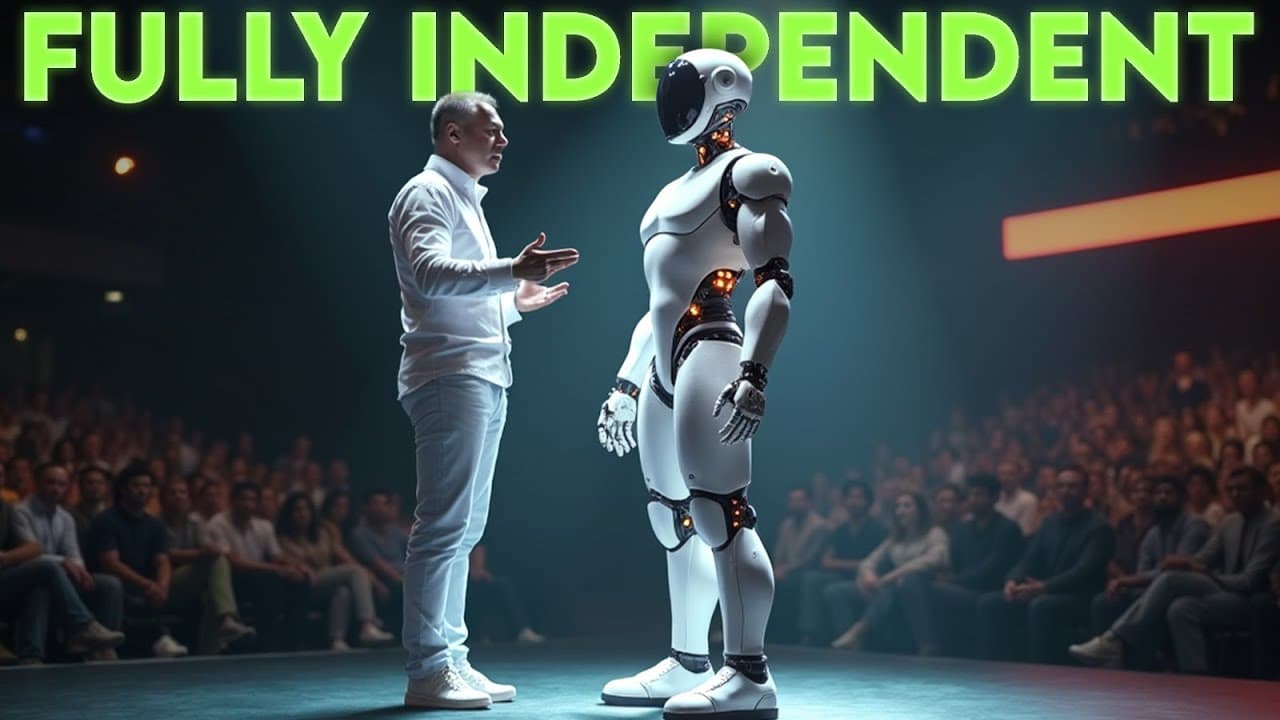
Yesterday, June 24th, Google DeepMind did something that might just change how robots work forever. Karolina Parada and her team unveiled Gemini Robotics on device, a stripped down supercharged version of Gemini 2.0 that does not need the cloud, Wi-Fi, or even a whisper of internet to function. This thing runs directly on the robot, which means no ... Read More
Key Insights
- Gemini Robotics On-Device is a compact vision-language-action model that runs directly on robot hardware without cloud access, Wi-Fi, or internet connectivity. Its integrated architecture combines vision transformers, language encoders, and action decoders within a package intended for embedded computing boards.
- Local inference reduces robot control-loop delays from hundreds of milliseconds to tens of milliseconds, according to the transcript. Faster feedback allows a planner to respond quickly when an object's position changes and improves precision during contact-rich tasks such as cable threading.
- The on-device model performs close to Google's hybrid model across reported visual, semantic, and behavioral generalization tests. It also exceeds the previously leading local vision-language-action model, particularly when handling unseen objects, unusual lighting, nuanced instructions, and multistep tasks.
- Task adaptation can require roughly 50 to 100 demonstrations rather than thousands of hours of teleoperation footage. The demonstrated skills include unzipping soft lunch boxes, folding clothes, pouring liquid into a narrow container, sliding a card from a deck, and assembling belt drives.
- Robot embodiment transfer works through a short adaptation pass instead of complete retraining. Weights trained on DeepMind's Aloha platform were ported to a Franka FR3 workstation and an Apptronik Apollo humanoid, despite substantial differences in their joints, proportions, and kinematics.
- The Gemini Robotics SDK supports live robot interfaces, MuJoCo simulation scenes, local fine-tuning, and deployment of updated weights to robot storage. Developers can create contact-rich demonstrations virtually before operating physical hardware and can tailor policies to specialized tasks.
- Safety is implemented through multiple layers that examine both meaning and motion. Semantic filters watch for unsafe instructions, while a low-level controller checks torque limits, collision cones, and velocity caps. A semantic safety benchmark also tests ambiguous language and conflicting tasks.
- Offline operation is suited to environments with unreliable connectivity, strict data-sovereignty requirements, or long communication delays. Examples identified in the transcript include warehouses, defense facilities, hospitals, offshore rigs, logistics hubs, and planetary rovers operating beyond practical cloud control.
Install to Summarize YouTube Videos and Get Transcripts
Explore YouTube Video Summarizer or Get YouTube Transcript Extractor
Questions & Answers
Q: What is Gemini Robotics On-Device?
Gemini Robotics On-Device is a compact vision-language-action model that processes perception, instructions, and robot actions directly on embedded hardware. It does not require cloud computing, Wi-Fi, or internet access during operation. The architecture combines vision transformers, language encoders, and action decoders, allowing robots to interpret spoken directions, recognize objects, and execute physical tasks through a local control loop.
Q: How does Gemini Robotics operate without cloud access?
Gemini Robotics operates offline by placing its compressed model and inference pipeline on computing hardware inside the robot. Sensor data is processed locally by the vision, language, planning, and action components, so information does not need to travel to a remote server. This design removes network delays and outages while keeping the robot's control loop within tens of milliseconds rather than hundreds.
Q: What tasks can Gemini Robotics On-Device perform?
Gemini Robotics On-Device was demonstrated unzipping soft lunch boxes, folding shirts with creases, pouring salad dressing into a narrow container, and sliding a card from a deck. On other robot platforms, it assembled belt drives, aligned pulleys, tensioned a belt, folded a long dress, followed spoken instructions, manipulated unfamiliar household objects, and placed a Rubik's cube into a pouch.
Q: How many demonstrations are needed to teach the robot a task?
The transcript reports that Gemini Robotics On-Device can learn demonstrated tasks after roughly 50 to 100 examples. These examples may be collected through simulation or through a human operator controlling physical hardware. Requiring a double-digit demonstration set reduces the burden of gathering training data and lets developers adapt the robot without maintaining thousands of hours of teleoperation footage.
Q: Can Gemini Robotics transfer skills between different robots?
Gemini Robotics can transfer learned weights between different robot bodies with a short adaptation pass rather than complete retraining. Google trained the model on its internal Aloha platform, then ported the same weights to a Franka FR3 workstation and an Apptronik Apollo humanoid. The adaptation accounted for different joint kinematics, limb proportions, and physical configurations while preserving useful learned behaviors.
Q: What safety controls protect people around the robot?
The system uses several safety layers. Semantic filters monitor instructions for dangerous intent or unsafe handling requests, such as passing a knife blade first. A low-level controller checks torque limits, collision cones, and velocity caps. DeepMind also uses a semantic safety benchmark for ambiguous or conflicting commands, conducts impact analyses, and requires review by its responsibility and safety council.
Q: How can developers customize Gemini Robotics On-Device?
Developers can use the Gemini Robotics SDK to connect live robots, create simulated tasks in MuJoCo, fine-tune the model, and deploy updated weights to a robot's flash storage. Demonstrations recorded through supported robotics environments can be converted into the expected format. Access is initially staged through a trusted tester program so real deployments can inform continuing safety audits.
Q: When is on-device robotics preferable to a hybrid cloud model?
On-device robotics is preferable when connectivity is unreliable, communication delays are unacceptable, data must remain on premises, or recurring cloud computation is undesirable. The transcript identifies warehouses with weak Wi-Fi, defense facilities with data restrictions, hospitals needing self-contained equipment, offshore rigs, logistics hubs, and planetary rovers as relevant settings. The hybrid model remains stronger for especially novel multimodal reasoning tasks.
Summary & Key Takeaways
-
Gemini Robotics On-Device is a compact vision-language-action model designed to run on embedded robot hardware. Local inference removes dependence on network connectivity, reduces control-loop latency from hundreds to tens of milliseconds, protects data from cloud transmission, and supports responsive perception and motion in factories, homes, remote facilities, and space missions.
-
Demonstrations include unzipping lunch boxes, folding clothing, pouring dressing, handling cards, assembling belt drives, and manipulating unfamiliar household objects. The model can acquire tasks from roughly 50 to 100 examples. Its weights were also transferred from DeepMind's Aloha platform to a Franka FR3 workstation and an Apptronik Apollo humanoid.
-
Developers can access the system through a staged trusted tester program and use an SDK for robot interfaces, simulation, supported fine-tuning, and deployment. Safety measures include semantic instruction filters, torque and velocity limits, collision checks, semantic benchmarks, impact analyses, and internal review before code reaches real-world deployments.
Read in Other Languages (beta)
Share This Summary 📚
Summarize YouTube Videos and Get Video Transcripts with 1-Click
Try YouTube Summary with ChatGPT & Claude or YouTube Transcript Generator
Explore More Summaries from AI Revolution 📚

Summarize YouTube Videos and Get Video Transcripts with 1-Click
Try YouTube Summary with ChatGPT & Claude or YouTube Transcript Generator