Khan Academy CEO Sal Khan: How Can Workers Stay Relevant as AI Reshapes Jobs?
TL;DR
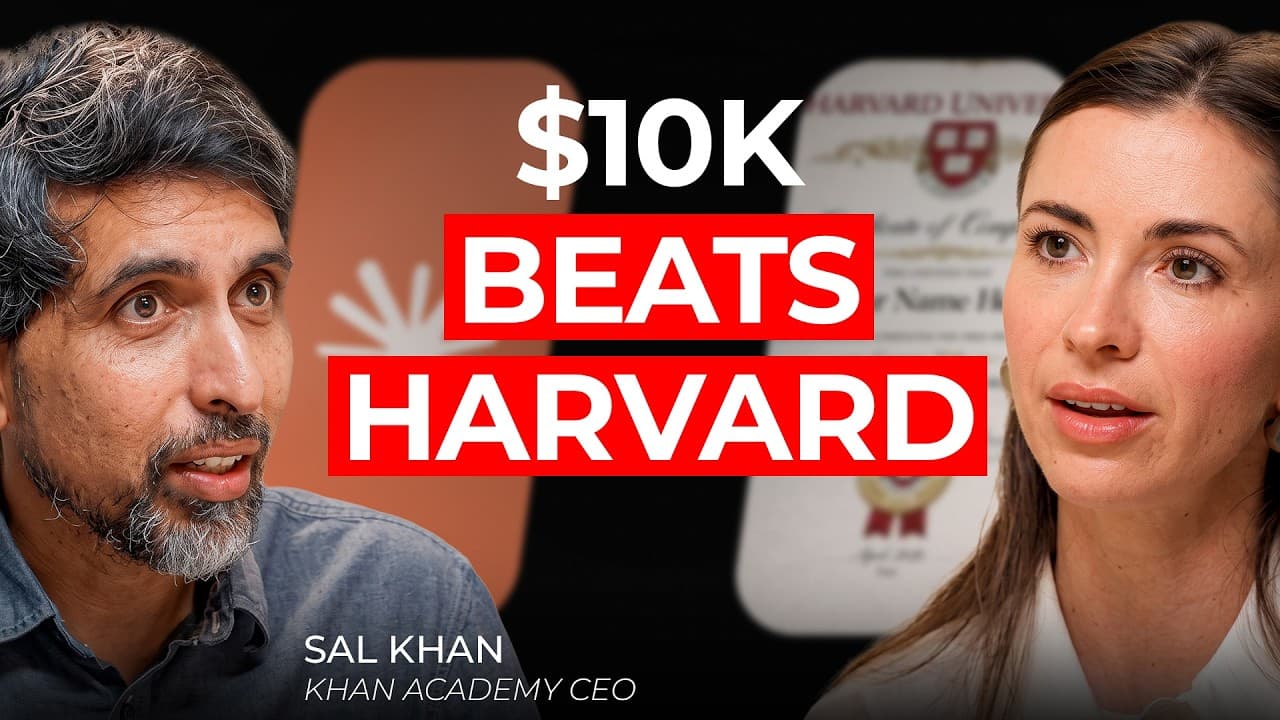
Workers can stay relevant by using AI, learning new tools, and adapting as their responsibilities evolve. Sal Khan expects serious employment disruption within four or five years, citing a portfolio company that automated 80% of a Philippines-based call center workforce. Khan Academy plans to turn AI productivity into more educational work instead of layoffs. Read on for Khan’s outlook on exposed jobs, reskilling, assessment, and meaningful work.
Transcript
And so they're asking and we're saying, "Hey, use more AI, use more AI, software engineering, design, product management, and all of these tech firms, including at Khan Academy, are changing fundamentally." >> This is Salcon. He runs Khan Academy. 100 million people learn on it every year. He built one of the first AI tutors in the world. >> Excell... Read More
Key Insights
- AI-driven job displacement is already occurring in call centers. Sal Khan describes a portfolio company that automated 80% of a Philippines-based call center workforce with a generative AI solution, potentially affecting hundreds or thousands of workers at that single operation.
- Serious labor disruption could begin within four or five years. Khan expects autonomous vehicles to make a meaningful dent in driving employment within five or ten years, a timeline that remains rapid enough to affect current workers and families.
- Technology roles are changing fundamentally because of AI. Software engineering, design, and product management are among the functions being reshaped inside technology companies, including Khan Academy, although Khan says he is genuinely unsure whether these workers will ultimately lose their jobs.
- Khan Academy treats AI productivity as additional capacity rather than a reason for layoffs. The organization says that becoming three times more productive would allow its team to complete three times more work because its mission substantially exceeds its available resources.
- Adaptability is becoming an explicit requirement for career growth. Khan Academy is adding the ability to learn new tools and keep up with changing practices to its career rubric, signaling that employees are expected to participate actively in their own role evolution.
- Early AI tutors can fail when students do not know what to ask. Khan Academy learned from classroom use of KIGO that a passive assistant was insufficient for some learners, so its newer version is designed to motivate students, provide practice, and keep teachers involved.
- AI can strengthen assessment through interactive verification. Caltech admissions is using AI-supported oral examinations to determine whether applicants understand research papers they submit, addressing uncertainty about whether the students personally completed or comprehended the work.
- Universal basic work is Khan's preferred direction over universal basic income. He argues that people need a sense of contribution and that large-scale unemployment, particularly among drivers, could increase anger, political polarization, and movement toward ideological extremes.
Install to Summarize YouTube Videos and Get Transcripts
Explore YouTube Video Summarizer or Get YouTube Transcript Extractor
Questions & Answers
Q: How can workers stay relevant as AI reshapes jobs?
Workers should use AI tools, learn how their roles are changing, and keep adapting to new practices. Khan Academy is adding the ability to learn new tools and adapt to change to its career rubric, making continued adaptability an explicit expectation for career growth.
Q: How soon could AI begin seriously disrupting jobs?
Sal Khan expects serious employment disruption to begin within four or five years. He also predicts that autonomous vehicles could make a meaningful dent in driving employment within five or ten years.
Q: Which jobs are most exposed to AI-driven change?
Call center work is already being automated, while driving could face growing pressure from autonomous vehicles. Khan also says software engineering, design, and product management are changing fundamentally, although he remains uncertain whether workers in those roles will ultimately lose their jobs.
Q: What example convinced Sal Khan that AI job displacement is already happening?
A college friend told Khan that one of his portfolio companies had automated 80% of a Philippines-based call center workforce with a generative AI solution. Khan did not know the exact headcount, but said it sounded like hundreds or possibly thousands of people at that one call center.
Q: Will Khan Academy lay off employees because of AI productivity gains?
Khan says AI productivity will not be the catalyst for layoffs at Khan Academy. The organization has 350 employees and more work than its resources can support, so becoming three times more productive would mean completing three times more work.
Q: What could cause layoffs at Khan Academy?
Khan says financial shortfalls could force layoffs if Khan Academy cannot secure enough philanthropy or earned revenue. AI adoption itself is not presented as a reason to reduce staff, and employees who automate their existing jobs would be offered better jobs with better pay.
Q: Why is Khan Academy making its KIGO AI tutor more proactive?
Khan Academy found that its first AI assistant waited to be asked for help, but some students did not know what to ask. The newer KIGO version is designed to motivate students, provide more practice, and keep teachers involved.
Q: How is Caltech using AI to assess applicants?
Caltech admissions is using AI-supported oral examinations to determine whether applicants understand the research papers they submit. The approach addresses uncertainty about whether students personally completed or understood the work in these high-stakes university applications.
Summary & Key Takeaways
-
Sal Khan has become more concerned about employment disruption after seeing generative AI automate 80% of a portfolio company's call center workforce. He expects displacement to become significant within four or five years, affecting call centers, driving, software engineering, design, product management, and other roles shaped by automation.
-
Khan Academy encourages its 350 employees to use more AI while promising that productivity gains will not trigger layoffs. Because the organization has extensive work and limited resources, becoming three times more productive would mean doing three times more. Financial shortfalls, not AI adoption, would be the reason for staff reductions.
-
Education and assessment are also changing. Caltech admissions is already using AI-supported oral examinations to test whether applicants understand submitted research. Khan Academy is developing a more proactive version of KIGO after finding that some students did not know what to ask, with motivation, practice, and teacher involvement guiding the redesign.
Read in Other Languages (beta)
Share This Summary 📚
Summarize YouTube Videos and Get Video Transcripts with 1-Click
Try YouTube Summary with ChatGPT & Claude or YouTube Transcript Generator
Explore More Summaries from Silicon Valley Girl 📚


Summarize YouTube Videos and Get Video Transcripts with 1-Click
Try YouTube Summary with ChatGPT & Claude or YouTube Transcript Generator