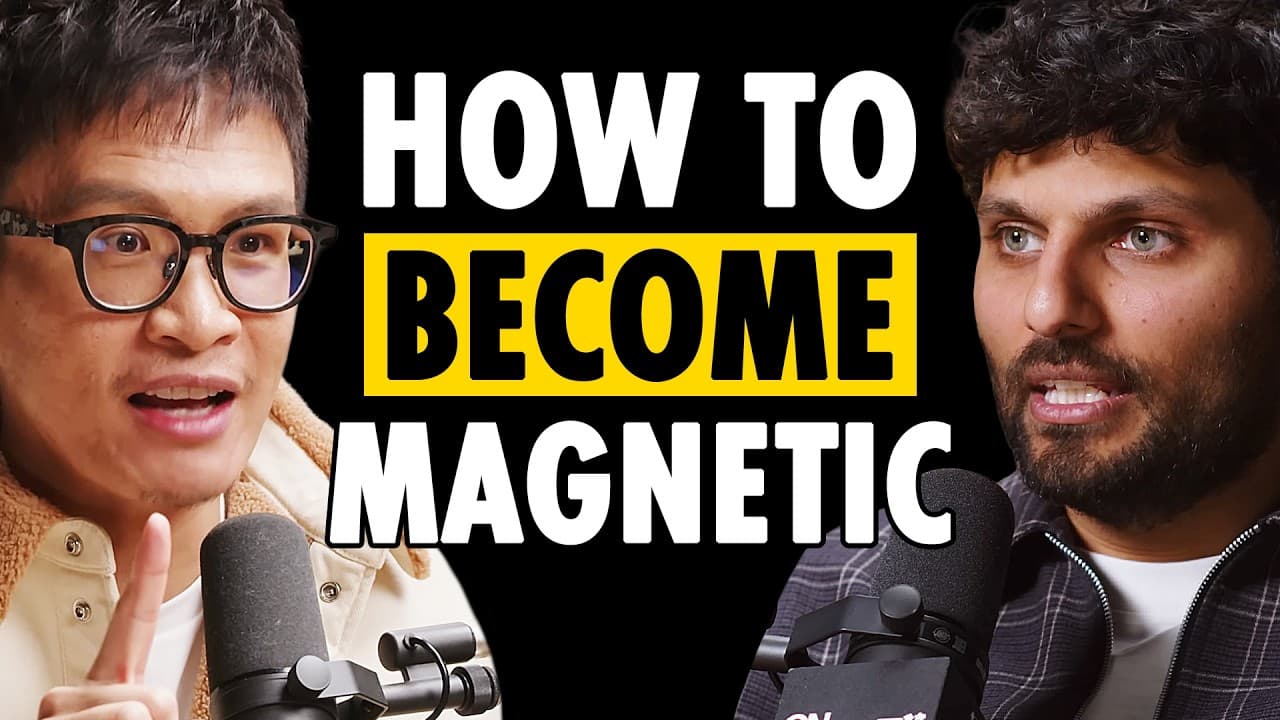
Vinh Giang on Overcoming Shyness and Finding Your Voice
TL;DR
Shyness is not a fixed trait. It is a set of behaviors practiced for years, and confident communication is another set of behaviors anyone can practice. Communication coach Vinh Giang explains that your current voice is a habitual voice learned in childhood. Growth means pushing through the stage where new behaviors feel fake until they become unconscious mastery.
Transcript
you take a deep breath and then continue speaking The reason people aren't comfortable with the pause is because they don't know what the pause is for Right The pause allows people to process what you're saying Think about it now Listeners as you're listening to that the moment I paused you had a moment to process the things that I was saying Do yo... Read More
Key Insights
- Shyness is a series of practiced behaviors, not a fixed identity. Giang tells people who say they are shy that they have been practicing shy behaviors for 15 to 40 years, and that confident communication is simply another set of behaviors they can practice instead.
- Your current voice is a habitual voice, not your natural voice. According to Giang, people lose their natural voice at around two or three years old and build a new one by mimicking the people who influenced them when they were young.
- Habits feel like part of your identity once they move from the conscious to the subconscious mind. A child consciously copies a parent who speaks softly, but after two or three years the behavior becomes automatic and feels like who they are.
- The four stages of competence are unconscious incompetence, conscious incompetence, conscious competence, and unconscious competence. The final stage is mastery, where skilled communication happens without deliberate thought, while earlier stages require awareness and effort.
- Conscious competence is the most frustrating stage because people know what to do but still have to think about it. Giang's students often say new delivery feels fake or phony, yet passing through this stage is required to reach unconscious competence.
- The difference between growth and faking it is familiarity. Giang argues people mislabel unfamiliar behavior as fake, when it is simply new, and that this label causes them to stop exploring the full range of their communication ability.
- Communication range can be pictured as a piano with 88 keys. Most people only play the five keys they are familiar with, and as they practice new behaviors, their sense of home expands to include the whole instrument.
- Self-awareness is the first practical problem people bring to a communication coach. Once someone becomes aware of one weakness in how they speak, the next question is how to become aware of more, which moves them out of unconscious incompetence.
Install to Summarize YouTube Videos and Get Transcripts
Explore YouTube Video Summarizer or Get YouTube Transcript Extractor
Questions & Answers
Q: Can a shy person become a confident speaker?
Yes, according to communication coach Vinh Giang. He argues that shyness is a set of behaviors a person has practiced for 15, 20, 30, or 40 years, not a permanent trait. Confident communication is simply another series of behaviors, including how you move your mouth, manage airflow, and use your hands. If you practice those confident behaviors consistently over time, you can become a confident communicator.
Q: What is the difference between a natural voice and a habitual voice?
Vinh Giang explains that the voice most people consider natural is actually a habitual voice. People lose their natural voice at around two or three years old and then learn to speak by mimicking those around them. He sees this in his one-year-old daughter copying her mother's frustrated sounds and in his seven-year-old son picking up his speech nuances. The habitual voice is just a series of habits that can change.
Q: What are the four stages of competence in communication?
The four stages are unconscious incompetence, conscious incompetence, conscious competence, and unconscious competence. In the first stage you do not know what you are doing wrong, such as filling every pause. In the second you become aware of how body language, voice, and tonality affect you. In the third you know what to do but must think about it. The fourth stage is mastery, where good communication becomes automatic.
Q: Why does practicing new speaking skills feel fake?
New speaking behaviors feel fake because they are unfamiliar, not because they are wrong. Vinh Giang says his students reach the conscious competence stage, try a new delivery, and then say it feels phony. He explains that people label unfamiliar behavior as fake, and the moment they do, they stop exploring. Pushing through that discomfort is necessary to reach unconscious competence, which is mastery.
Q: What does the piano analogy mean for communication skills?
Vinh Giang compares your communication ability to a piano with 88 keys. Most people only play about five keys because those are the behaviors they are familiar with, and those keys feel like home. As you practice and explore new ways of speaking, your sense of home expands until it includes the entire piano. Calling unfamiliar keys fake keeps you limited to the same five keys for life.
Q: Why do people rarely change the way they communicate?
Vinh Giang argues that people are overattached to the familiar. Most people change their clothes, glasses, house, and car, yet they never change the way they talk. Because their speaking habits have been repeated for 10 to 30 years, those habits feel like part of their identity. He tells students not to be so attached to who they are in the present that they deny their future self a chance to grow.
Q: How did Vinh Giang become a communication coach?
Vinh Giang struggled to communicate when he was young because English is his third language, after a Chinese dialect and Vietnamese. He went through a period where he did not understand what people said to him and felt isolated. He later worked as a magician for years, but the applause began to feel empty. When he started teaching public speaking and communication, he found deep fulfillment and committed fully to it.
Q: What is the first step to improving your communication skills?
The first step is self-awareness. Vinh Giang says the top problem people bring to him is wanting to move beyond unconscious incompetence: once they notice one flaw in how they speak, they want to know how to become aware of more. Building awareness of your voice, body language, and tonality is the starting point that lets you consciously choose and practice better communication behaviors.
Summary & Key Takeaways
-
Vinh Giang grew up speaking a Chinese dialect, then Vietnamese, with English as his third language. He struggled to understand people and felt isolated. After learning to communicate and becoming a professional speaker, he found that teaching the skill gave him a fulfillment he never felt during his years as a magician.
-
Giang argues that every communication skill, from how you move your mouth and hands to how you manage airflow, is a behavior. Shy people have practiced shy behaviors for decades. The voice people call natural is really a habitual voice copied from people around them in early childhood, as seen in his own children.
-
Using the four stages of competence, Giang explains that new behaviors feel fake at the conscious competence stage, and many people quit there. He compares communication to a piano with 88 keys: most people play only five familiar keys and label anything unfamiliar as phony, which stops them from exploring their full range.
Read in Other Languages (beta)
Share This Summary 📚
Summarize YouTube Videos and Get Video Transcripts with 1-Click
Try YouTube Summary with ChatGPT & Claude or YouTube Transcript Generator
Explore More Summaries from Jay Shetty Podcast 📚





Summarize YouTube Videos and Get Video Transcripts with 1-Click
Try YouTube Summary with ChatGPT & Claude or YouTube Transcript Generator