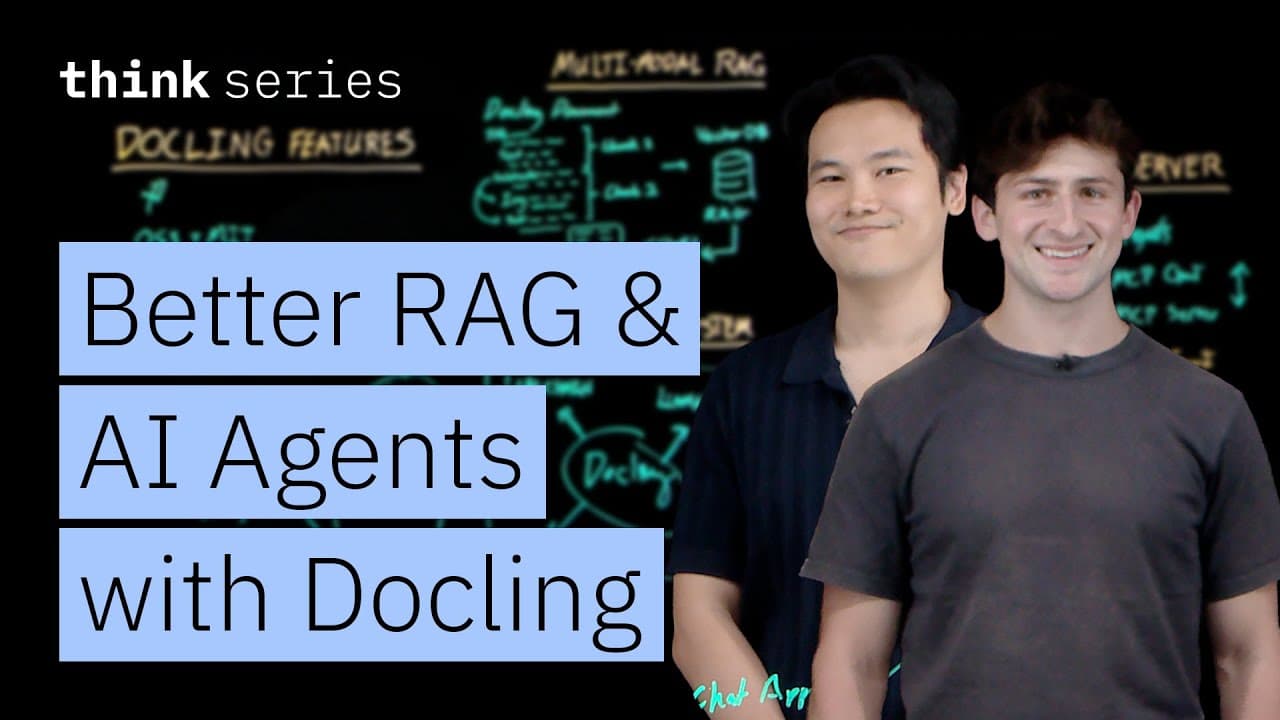
How to Improve RAG and AI Agents with Docling
TL;DR
Docling improves RAG and AI agents by converting PDFs, presentations, spreadsheets, images, and other unstructured files into structured formats that language models can use. Its hierarchical output supports structure-aware chunking, multimodal retrieval, provenance tracking, schema-based extraction, and integration with major RAG frameworks, while its MCP server lets compatible applications request document conversion through natural language.
Transcript
Let's talk about one of the biggest missing pieces in retrieval augmented generation pipelines, or AI agents, because it's all about data preparation. Because in order for your model to provide better and more accurate responses, it needs to fully understand the data that you're using, right? Whether that data is formatted perhaps as a PDF, right? ... Read More
Key Insights
- Docling is an open-source document-processing framework that converts PDFs, Word files, PowerPoint presentations, scanned images, spreadsheets, and other unstructured sources into structured formats such as Markdown, plain text, and JSON for use by language models, RAG pipelines, and AI agents.
- The central challenge in RAG and agentic AI is curating useful knowledge and context, not merely building the agent. Accurate responses depend on preparing source documents so models can understand their content, structure, relationships, and relevant metadata instead of receiving disconnected extracted text.
- Docling's MCP server connects with compatible clients such as Claude Desktop, LM Studio, and Cursor. An application can use natural-language instructions to request operations such as converting a PDF into Markdown, while the standardized interface works across supported models and agents with tool-calling capabilities.
- Structure-aware chunking is enabled by Docling's hierarchical document output, which includes element types, headings, and per-element metadata. Content can be divided by sections, tables, and captions while retaining parent titles and headers, creating more cohesive chunks and stronger retrieval signals than fixed-size splitting.
- Multimodal RAG is supported by preserving images and tables within processed documents. Figures can optionally receive text descriptions, making them retrievable alongside written passages and allowing systems to use more of the source material instead of limiting retrieval to plain extracted text.
- Provenance is recorded for every document element through page and bounding-box information. Applications can use this location data to show where retrieved spans originated, overlay highlights, link results back to source pages, and make generated answers easier for reviewers to inspect and trust.
- Schema-based information extraction turns unstructured business documents into validated application data. Users can define fields such as an invoice number or price, then receive structured output matching the requested schema or Pydantic model, with type safety and validation available from the beginning of the workflow.
- Docling integrates with LangChain, LlamaIndex, Haystack, LangFlow, automation pipelines, chat applications, agents, and analytics systems. Its outputs can flow into batch or real-time processing, reducing glue code and allowing teams to parse documents once while changing downstream framework configurations.
Install to Summarize YouTube Videos and Get Transcripts
Explore YouTube Video Summarizer or Get YouTube Transcript Extractor
Questions & Answers
Q: What is Docling used for in RAG pipelines?
Docling prepares source data for retrieval augmented generation by converting unstructured files into formats that language models and retrieval systems can use. It processes sources such as PDFs, Word files, PowerPoint presentations, scanned images, and spreadsheets, then produces structured Markdown, plain text, JSON, or hierarchical Docling documents containing headings, element types, metadata, tables, images, and provenance.
Q: How does Docling improve document chunking for RAG?
Docling improves chunking by preserving a document's hierarchy rather than treating its content as an undifferentiated stream of text. Its output supports splitting by sections, tables, and captions while automatically carrying parent context such as titles and headers. These cohesive, context-rich chunks provide better retrieval signals than fixed-size splits that may separate related information or omit structural meaning.
Q: How does the Docling MCP server work with AI agents?
The Docling MCP server provides a standardized connection between document-processing tools and compatible AI applications. Clients such as Claude Desktop, LM Studio, or Cursor can connect to a locally running server and request a conversion through natural language, such as asking for a PDF to become Markdown. Any supported model or agent with tool-calling capabilities can use this workflow through the MCP interface.
Q: How does Docling support multimodal RAG?
Docling supports multimodal RAG by retaining images and tables rather than discarding them during document conversion. It can optionally enrich figures with text descriptions, which makes visual material retrievable alongside ordinary passages. This lets retrieval systems use information contained in several document element types and preserve their relationship to the surrounding structure, captions, headings, and source location.
Q: How does Docling make retrieved information traceable?
Docling associates every processed element with provenance information, including its page and bounding box. A downstream application can use this metadata to identify where a retrieved span came from, overlay a highlight on the corresponding source region, or link users back to the relevant page. These capabilities make retrieval results easier to review, verify, and trust.
Q: How does Docling differ from typical OCR?
Typical OCR returns the text detected in a document, but that result may omit the hierarchy needed to interpret relationships among headings, sections, tables, captions, and other elements. Docling preserves this document structure and can produce clean, hierarchical output with metadata. It can also extract selected fields into validated schemas, making the result more directly usable by applications and APIs.
Q: How can Docling extract structured fields from invoices?
Docling's information-extraction feature lets users define a template or schema containing the fields they need, such as an invoice number or price. It then processes the unstructured document and returns clean, validated data matching that schema or a Pydantic model. The resulting type-safe structure can feed directly into an application, API, data pipeline, or RAG workflow.
Q: Which RAG tools and workflows integrate with Docling?
Docling outputs can be used with major RAG frameworks named in the source, including LangChain, LlamaIndex, Haystack, and LangFlow. Documents can become structured chunks or Markdown for retrieval and prompting, then flow through automated batch or real-time pipelines. The same processing layer can support downstream chat applications, AI agents, analytics products, and changing framework configurations.
Summary & Key Takeaways
-
Docling addresses data preparation for RAG systems and AI agents by transforming varied business files into structured Markdown, plain text, JSON, or rich Docling documents. Unlike basic OCR, which primarily returns text, Docling preserves document hierarchy, element types, headings, metadata, tables, images, captions, and information about each element's original location.
-
Docling's hierarchical output enables chunks based on sections, tables, and captions instead of fixed-size divisions. Parent context, including titles and headers, can follow each chunk to improve cohesion and retrieval signals. Multimodal RAG can preserve images and tables, enrich figures with descriptions, and make visual content retrievable alongside regular text.
-
Docling can extract selected business fields through templates or schemas and return validated data matching a schema or Pydantic model. Its outputs integrate with LangChain, LlamaIndex, Haystack, and LangFlow, while its MIT license, Linux Foundation governance, and on-premises operation support adoption in secure and regulated organizational environments.
Read in Other Languages (beta)
Share This Summary 📚
Summarize YouTube Videos and Get Video Transcripts with 1-Click
Try YouTube Summary with ChatGPT & Claude or YouTube Transcript Generator
Explore More Summaries from IBM Technology 📚
Summarize YouTube Videos and Get Video Transcripts with 1-Click
Try YouTube Summary with ChatGPT & Claude or YouTube Transcript Generator