How to Assemble a Dual TEC12710 Cooler for Optimal Cooling
TL;DR
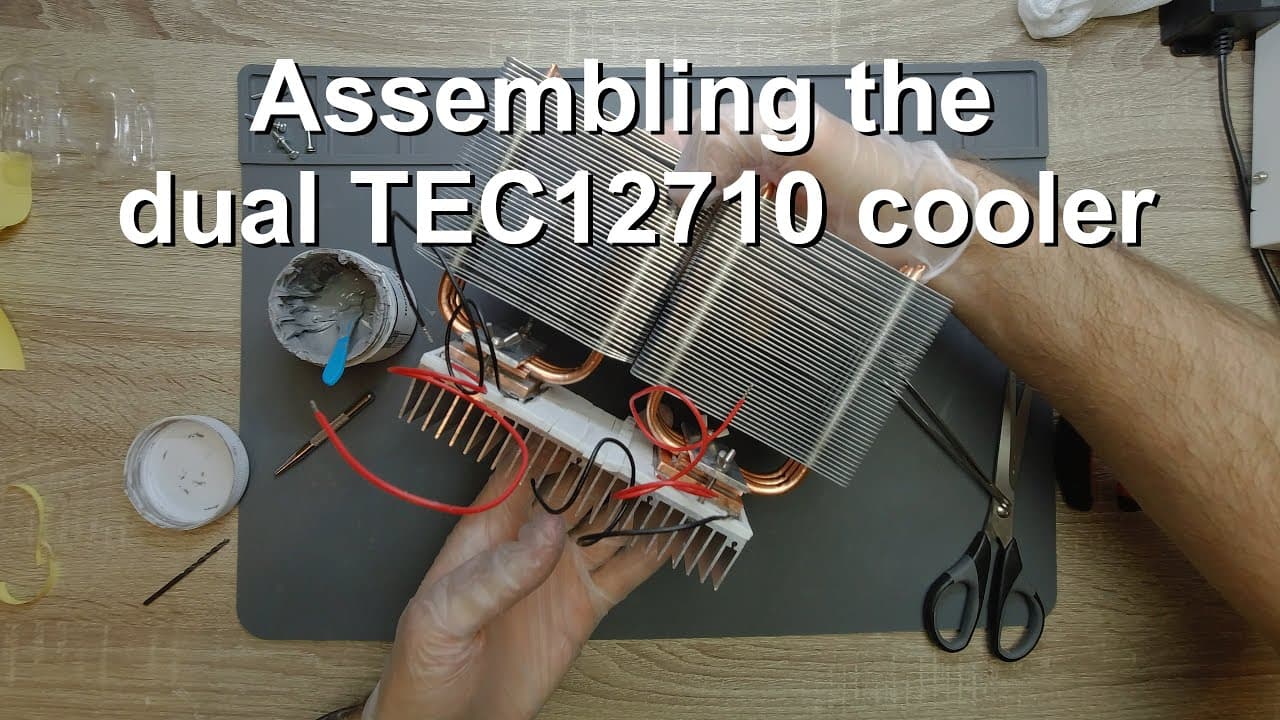
To assemble a dual TEC12710 cooler, focus on securely mounting CPU coolers and ensuring proper weight distribution with support structures. Use thermometers to monitor temperature during testing; initial results show cooling capabilities nearing zero degrees Celsius on the cold side, highlighting effective heat transfer and indicating a well-functioning system.
Transcript
so as you could see from this time lapse i assembled the cooling system so what we have this down here is the cold side of the patio cooler and these two coolers are these arctic cooling freezer 7 pro cpu coolers with roughly 115 120 watt of tdp so that's the amount of heat that they can get rid of once again so first we have the cold side heatsink... Read More
Key Insights
- 😎 The assembly of the cooling system requires careful consideration of mechanical forces to ensure stability and functionality.
- 🥵 Using a copper plate enhances heat transfer from the hot side to the cold side, improving overall cooling performance.
- 😎 Power supply settings are critical; varying the voltage and current can significantly impact the cooling effectiveness of the system.
- 👻 Temperature monitoring allows for real-time feedback, helping to troubleshoot and optimize system performance during testing.
- 📪 A properly insulated box is expected to yield even lower temperatures by creating a closed environment for the cooling system.
- 🥵 The importance of airflow and fan placement was highlighted, as they directly influence the efficacy of heat dissipation.
- ♿ The arrangement of components must facilitate accessibility for adjustments and maintenance during testing phases.
Install to Summarize YouTube Videos and Get Transcripts
Explore YouTube Video Summarizer or Get YouTube Transcript Extractor
Questions & Answers
Q: What are the main components used in this cooling system?
The cooling system primarily utilizes Arctic Cooling Freezer 7 Pro CPU coolers, a copper plate for heat transfer, and a power supply. The system's assembly involves careful consideration of weight distribution to prevent mechanical issues and ensure efficient cooling performance.
Q: Why is weight distribution important in this assembly?
Weight distribution is crucial because uneven weight can cause torsional stress on components such as the polycarbonate sheet. If the assembly isn't properly supported, it could lead to bending or breaking of the materials, resulting in an inefficient cooling system and potential failure.
Q: How is temperature monitored during the tests?
Temperature is monitored using a combination of thermometers, including a four-channel digital thermometer and a K-type thermocouple. These devices are strategically placed to track the temperature across different points, enabling the user to analyze the cooling system's performance effectively.
Q: What initial results were obtained from the cooling system tests?
Initial tests showed that the cold side temperature decreased to around 1.5 degrees Celsius when operating at optimal power, indicating the cooling system's efficiency. The temperatures measured on both the cold and hot sides demonstrated effective heat transfer and cooling capabilities.
Summary & Key Takeaways
-
The content describes an innovative cooling system being assembled using Arctic CPU coolers, highlighting the importance of weight distribution and structural support to prevent mechanical issues.
-
Testing procedures are explained, involving thermometers to monitor temperatures across various components while adjusting power supply to optimize cooling efficiency.
-
The results from initial tests show promising cooling capabilities, with temperatures approaching zero degrees Celsius on the cold side, indicating effective heat transfer.
Read in Other Languages (beta)
Share This Summary 📚
Summarize YouTube Videos and Get Video Transcripts with 1-Click
Try YouTube Summary with ChatGPT & Claude or YouTube Transcript Generator
Explore More Summaries from Curious Scientist 📚
![Building a Peltier cooler-based cooling box - First iteration, improvements [Part 2/6] thumbnail](/_next/image?url=https%3A%2F%2Fi.ytimg.com%2Fvi%2F0YlNw0EGnzI%2Fhqdefault.jpg&w=750&q=75)





Summarize YouTube Videos and Get Video Transcripts with 1-Click
Try YouTube Summary with ChatGPT & Claude or YouTube Transcript Generator