What Are Optical Aberrations in Electron Microscopy?
TL;DR
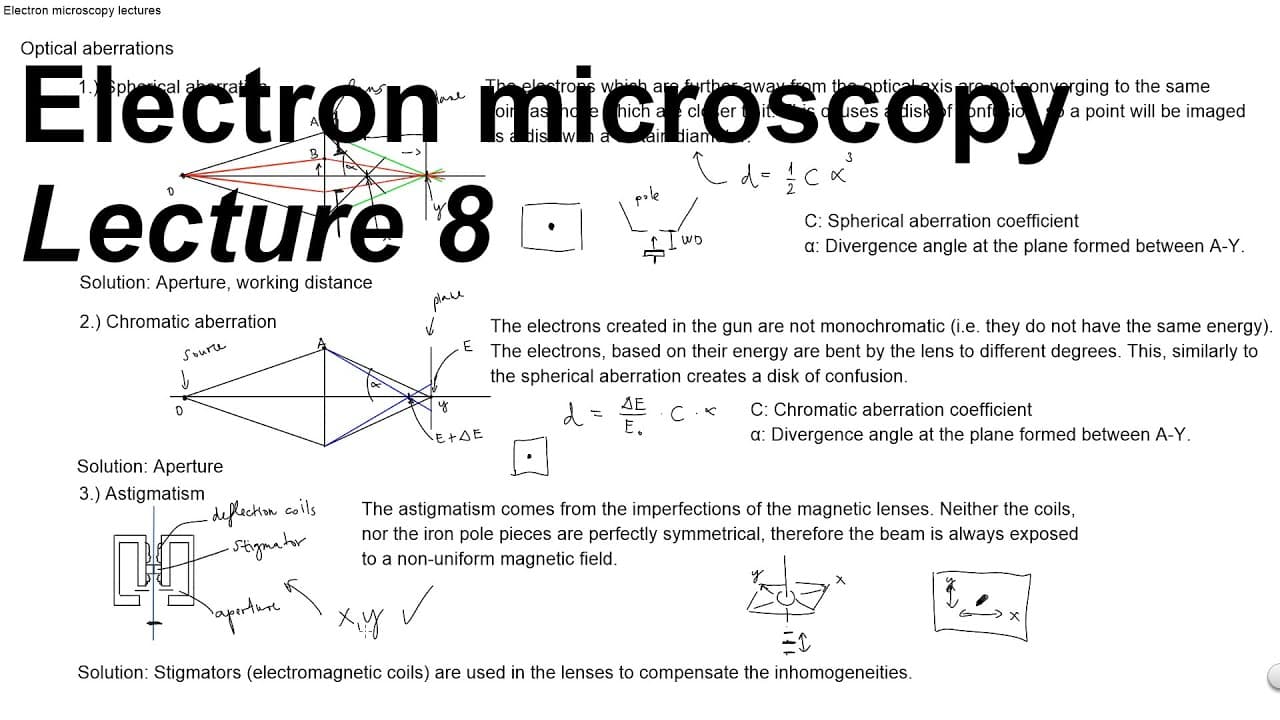
Optical aberrations in electron microscopy include spherical aberration, chromatic aberration, astigmatism, and diffraction. Spherical aberration leads to defocused images due to uneven ray deflection, while chromatic aberration arises from energy distribution among electrons. Astigmatism requires user adjustments to align apertures and correct magnetic fields, whereas diffraction effects can be minimized by balancing aperture size with beam wavelength.
Transcript
welcome anyone in this video I will continue the discussion of the last lecture there I was talking about the lenses and since we have the lenses and we discussed the optics of the electrons then we can continue with the optical operations so what kind of defects can occur on your images when you are using an electron microscope so there are basica... Read More
Key Insights
- 🧑🏭 Optical aberrations are critical factors in determining the quality of images produced by electron microscopes.
- 😁 Spherical aberration results from uneven electron beam deflection, leading to focus errors that can be mitigated through proper adjustments.
- 🥋 Chromatic aberration emphasizes the importance of producing electrons at uniform energy levels to improve focus and reduce image distortion.
- 👤 Astigmatism, a common aberration, requires active user intervention to align the aperture and adjust magnetic fields for optimal imaging.
- 😁 Diffraction is minimized by maintaining a balance between aperture size and beam wavelength, essential for obtaining high-resolution images.
- 🥶 Modern electron microscopes are equipped with computerized corrections, making them user-friendly and efficient compared to older, manually adjusted systems.
- 🤩 Understanding the geometric principles of lens construction is key in managing aberrations effectively.
Install to Summarize YouTube Videos and Get Transcripts
Explore YouTube Video Summarizer or Get YouTube Transcript Extractor
Questions & Answers
Q: What are the main types of optical aberrations in electron microscopes?
The main types of optical aberrations in electron microscopes include spherical aberration, chromatic aberration, astigmatism, and diffraction. Each type arises from different issues related to lens structure and the behavior of electron beams, affecting the quality of the images produced. Understanding these errors is vital for achieving high-resolution imaging.
Q: How does spherical aberration affect imaging in electron microscopes?
Spherical aberration occurs when electron beams passing through a lens are deflected unevenly, resulting in a spread of beam focus points rather than a single point. This leads to a disc of confusion in images. To counter this, users can apply apertures to filter out rays far from the optical axis and adjust working distance for improved focus.
Q: What is the relationship between chromatic aberration and electron beam energy?
Chromatic aberration happens when an electron beam consists of a spectrum of energies; different energies are bent in varied degrees by the lens. This results in some electrons focusing before or after the intended image plane, causing blurriness. The chromatic aberration coefficient helps quantify and manage this error in electron microscopy.
Q: Why is astigmatism considered significant in electron microscopy?
Astigmatism is significant because it results from imperfectly aligned magnetic fields in the optical system, causing the electron beam to form elliptical spots. Accurate correction requires adjusting magnetic fields in devices like stigmatism correctors and aligning apertures, which is essential for producing clear images.
Q: How does diffraction occur in electron microscopy?
Diffraction in electron microscopy occurs when the aperture size approaches the wavelength of the electron beam. This causes the focused image to display a disc of confusion. To minimize diffraction effects, users typically avoid very small apertures unless absolutely necessary for high-resolution imaging.
Q: What methods are used to correct astigmatism in electron microscopes?
To correct astigmatism in electron microscopes, operators must first align the aperture to ensure the electron beam crosses centrally through it. After focusing the image, adjustments can be made using a stigmatism corrector that alters the magnetic fields to eliminate the elliptical errors in the beam, leading to more accurate image outputs.
Q: How do modern microscopes handle optical aberrations compared to older systems?
Modern electron microscopes incorporate advanced technologies that streamline the correction of optical aberrations. Digital controls allow for precise adjustments and easier corrections, whereas older systems required more manual input and had less consistent results due to less advanced mechanical tolerances.
Q: What role does the divergence angle play in optical aberrations?
The divergence angle plays a critical role in determining the size of the disc of confusion created by both spherical and chromatic aberration. It defines how widely the rays spread as they travel through the lens system, influencing the focus quality and precision of the final image in electron microscopy.
Summary & Key Takeaways
-
The lecture discusses main types of optical aberrations in electron microscopes, including spherical aberration, chromatic aberration, astigmatism, and diffraction, all related to the microscope's structure and principles.
-
Spherical aberration occurs when rays from a source are deflected unevenly due to lens imperfections, causing a disc of confusion instead of a focused point image; it can be mitigated by using apertures and adjusting working distance.
-
Astigmatism arises from asymmetrical magnetic fields in lens construction, leading to elliptical spots; correction involves adjusting the stigmatism using active magnetic field modifications and aligning the sample apertures.
Read in Other Languages (beta)
Share This Summary 📚
Summarize YouTube Videos and Get Video Transcripts with 1-Click
Try YouTube Summary with ChatGPT & Claude or YouTube Transcript Generator
Explore More Summaries from Curious Scientist 📚




Summarize YouTube Videos and Get Video Transcripts with 1-Click
Try YouTube Summary with ChatGPT & Claude or YouTube Transcript Generator