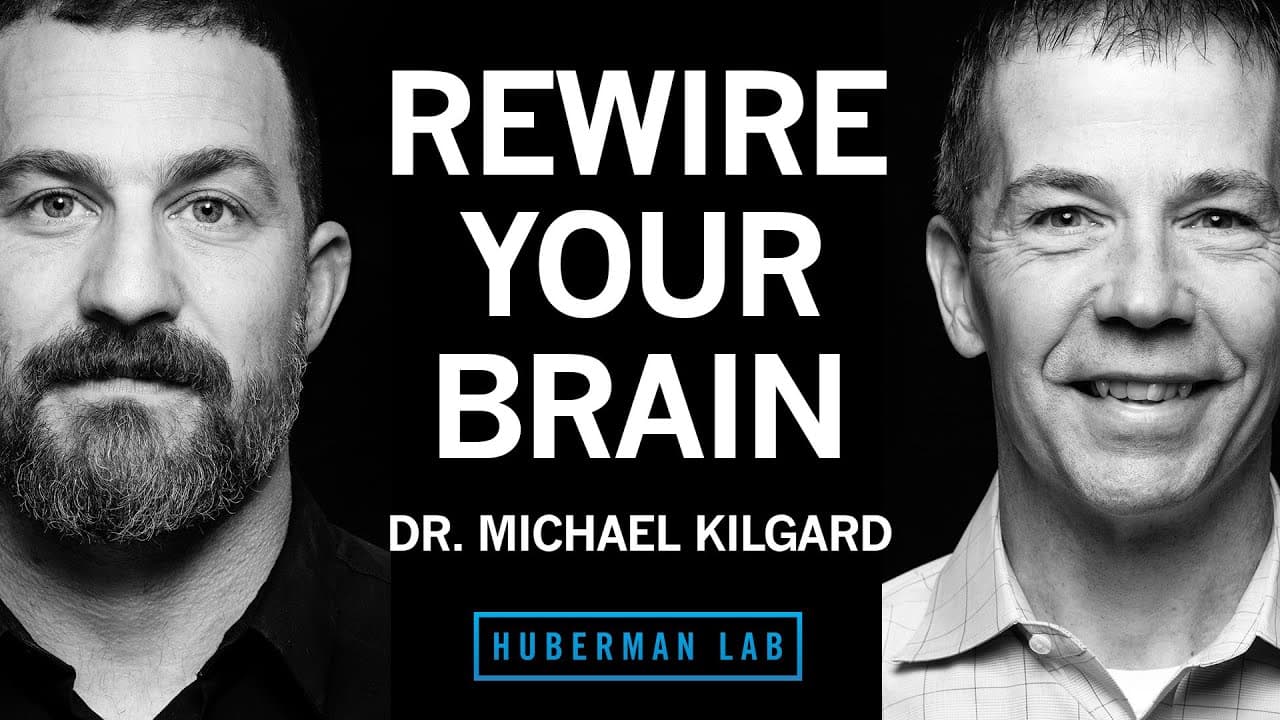
How Can You Rewire Your Adult Brain and Learn Faster? | Dr. Michael Kilgard
TL;DR
Adults can rewire their brains and learn faster when neuromodulators such as acetylcholine, norepinephrine, serotonin, or dopamine are released under the right learning conditions. Dr. Michael Kilgard explains how alertness, effortful focus, post-learning reflection, and sleep support plasticity, while precisely timed vagus nerve stimulation can help target circuit changes. Read on to understand how adult learning works and what makes lasting brain change possible.
Transcript
Welcome to the Hubberman Lab podcast, where we discuss science and science-based tools for everyday life. I'm Andrew Huberman and I'm a professor of neurobiology and opthalmology at Stanford School of Medicine. My guest today is Dr. Michael Kilgard. Dr. Michael Kilgard is a professor at the University of Texas at Dallas, and he is one of the world'... Read More
Key Insights
- Neuroplasticity is the brain's ability to change in response to experience, and it works in both directions, meaning circuits can be wired for better or for worse depending on what is repeatedly practiced and reinforced.
- The adult brain can be rewired massively if the right conditions are set, a finding Dr. Kilgard and his colleagues established in the late 1990s that overturned the century-old belief that only the young brain can change.
- Neuromodulators are the trigger for adult rewiring: when acetylcholine, norepinephrine, serotonin, or dopamine are released in the adult brain, brain circuits can reorganize and learning can occur even outside childhood.
- Vagus nerve stimulation lets researchers precisely control the timing of neuromodulator release, and Kilgard's lab has used it to help people overcome tinnitus, stroke effects, and restore mobility after spinal cord injuries.
- The brain is constantly active, evaluating trillions of new connections every second and deciding whether to strengthen, weaken, or leave each one unchanged, which matches our lived sense of an active inner life.
- Developmental plasticity is highest from birth to about age 25, after which change becomes harder but is still possible, so the window for learning stays open far longer than the old zero-to-six emphasis suggested.
- No single formative experience determines a child's life, because learning depends on vast numbers of experiences rather than any one moment, which is both a caution about details and a relief for parents.
- Children largely train themselves through practice, picking up around 100,000 words and dextrous movements by exploring their environment, so the adult role is to set conditions where a child can succeed and not quit.
Install to Summarize YouTube Videos and Get Transcripts
Explore YouTube Video Summarizer or Get YouTube Transcript Extractor
Questions & Answers
Q: Can the adult brain still change through neuroplasticity?
Yes. Dr. Michael Kilgard and his colleagues showed in the late 1990s that the adult brain can change massively when the right conditions are established, overturning the long-held view that substantial plasticity was limited to young brains.
Q: What triggers the adult brain to rewire itself?
Adult brain rewiring can occur when acetylcholine, norepinephrine, serotonin, or dopamine is released during an experience. These neuromodulators enable brain circuits to reorganize, supporting learning even in adulthood.
Q: What conditions support faster learning and adult neuroplasticity?
The episode identifies alertness, effortful focus, post-learning reflection, and sleep as important conditions for plasticity. Together with neuromodulator release, these states help the adult brain change its circuits in response to learning.
Q: What is neuroplasticity?
Neuroplasticity is the brain’s ability to change in response to experience. It can work for better or worse because connections may strengthen, weaken, or remain unchanged according to what is repeatedly practiced and reinforced.
Q: How does vagus nerve stimulation support neuroplasticity?
Vagus nerve stimulation allows researchers to control the timing of neuromodulator release precisely. By stimulating a particular branch of the pathway connecting the body and brain, Kilgard’s laboratory can direct plasticity toward targeted circuit changes.
Q: What conditions has Dr. Michael Kilgard’s vagus nerve stimulation research addressed?
Kilgard’s research has used vagus nerve stimulation in work involving tinnitus, stroke, and spinal cord injuries. The episode says this approach has even helped restore mobility to people who experienced paralysis.
Q: Is brain plasticity limited to early childhood?
No. Developmental plasticity is highest from birth to about age 25, but brain change remains possible afterward even though it becomes harder. Kilgard’s work shows that the adult brain can still undergo substantial rewiring when the necessary conditions are present.
Q: How active is the brain when forming and changing connections?
The brain continually evaluates trillions of new connections every second. It determines whether each connection should be strengthened, weakened, or left unchanged, showing that the brain is active and responsive rather than permanently hardwired.
Summary & Key Takeaways
-
Dr. Michael Kilgard, a professor at the University of Texas at Dallas and a leading expert on neuroplasticity, explains that the brain's ability to change was long thought limited to childhood, but the adult brain can also be rewired when the right conditions are present.
-
Adult rewiring depends on neuromodulators: releasing acetylcholine, norepinephrine, serotonin, or dopamine during learning drives large-scale circuit change. The episode also covers the behavioral requirements for plasticity, including alertness, effortful focus, post-learning reflection, and sleep.
-
Kilgard's more recent work uses vagus nerve stimulation to control the timing of neuromodulator release, helping people overcome tinnitus, stroke, depression, PTSD, and paralysis, while childhood plasticity shows that countless everyday experiences, not any single one, shape the developing brain.
Read in Other Languages (beta)
Share This Summary 📚
Summarize YouTube Videos and Get Video Transcripts with 1-Click
Try YouTube Summary with ChatGPT & Claude or YouTube Transcript Generator
Explore More Summaries from Andrew Huberman 📚



Summarize YouTube Videos and Get Video Transcripts with 1-Click
Try YouTube Summary with ChatGPT & Claude or YouTube Transcript Generator