How to Make Anhydrous Ethanol at Home Easily
TL;DR
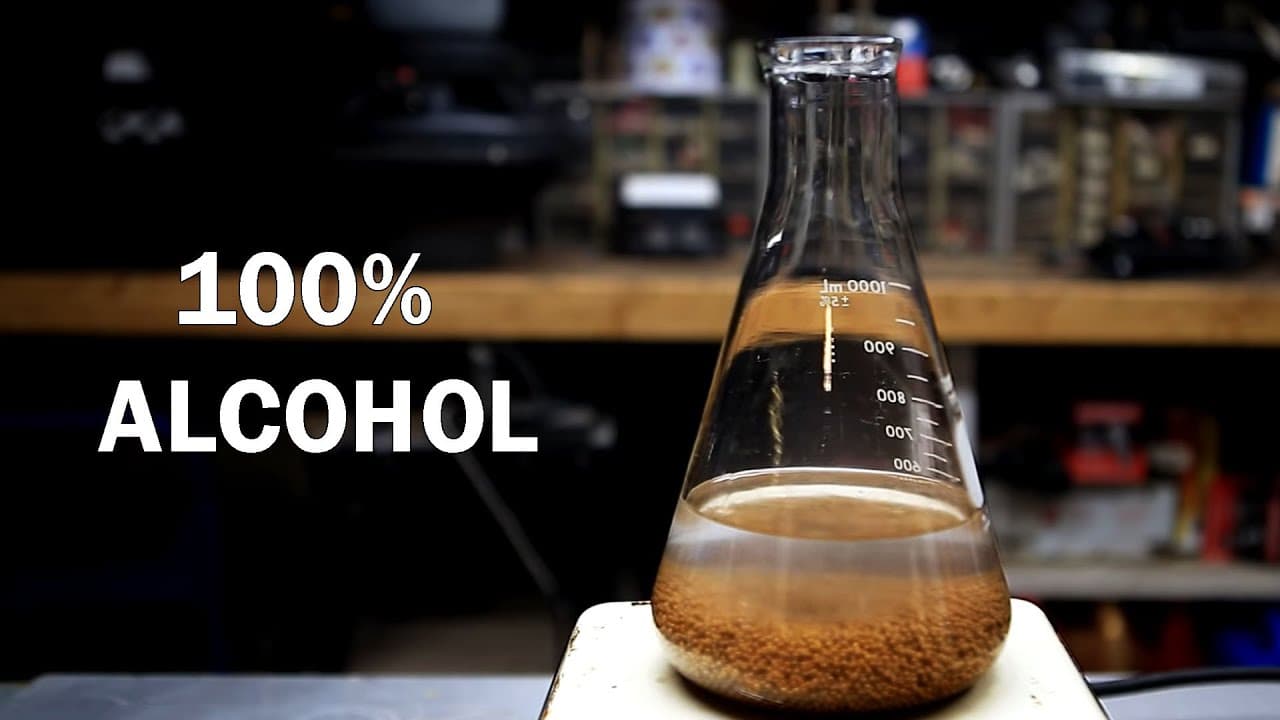
To make anhydrous ethanol at home, start with 95% ethanol and add 3A molecular sieves, which trap water while leaving ethanol intact. Seal the mixture overnight, filter out the sieves, and distill if needed to remove impurities. This method allows you to achieve 100% ethanol efficiently without complex distillation techniques.
Transcript
Water and ethanol form what is known as an azeotrope. This occurs when a mixture of liquids has a higher or lower boiling point, than each of the individual components. In the case of ethanol a mixture of ninety-five percent ethanol to water boils at a lower temperature than pure ethanol. So the concentration of ninety-five percent there's really n... Read More
Key Insights
- 😥 Ethanol and water form an azeotrope, which affects their boiling points.
- 😒 Distillation and the use of drying agents like molecular sieves are two methods to obtain 100% ethanol.
- 💦 Molecular sieves selectively absorb water, leaving ethanol untouched.
- ❓ The concentration of ethanol can be determined using a hydrometer.
- ❓ The sieves, once used, can be regenerated for reuse.
- 🫗 Sieves may contain dust particles that can be minimized by being gentle while pouring the ethanol.
- 🏪 Distillation can remove denaturing agents from store-bought ethanol.
Install to Summarize YouTube Videos and Get Transcripts
Explore YouTube Video Summarizer or Get YouTube Transcript Extractor
Questions & Answers
Q: How do you make 100% (anhydrous) ethanol at home?
Start with 95% ethanol and add a drying agent that soaks up the water. The video uses 3A molecular sieves, adds them to the sealed ethanol container, and lets it sit overnight. The ethanol is then separated from the sieves with a coffee filter, and can be distilled afterward for extra purity.
Q: Why can't distillation get ethanol above 95%?
Ethanol and water form an azeotrope, a mixture that boils at a lower temperature than pure ethanol. A 95% ethanol-to-water mixture boils below pure ethanol, so once you reach that concentration there is nothing distillation alone can do to concentrate it further. The azeotrope actually sits at about 95.6%.
Q: What are molecular sieves and why are they used to dry ethanol?
Molecular sieves are beads with very small pores that can absorb water molecules while blocking larger molecules. Because the pores are too small for ethanol to enter, water binds to the beads and the ethanol is left untouched. The video specifically uses 3A sieves, since some sieve sizes would also absorb ethanol.
Q: What other drying agents can be used instead of molecular sieves?
You can add another solvent that forms a lower-temperature azeotrope with water, so the solvent and water boil off together and leave pure ethanol behind. As direct drying agents, some people use magnesium sulfate or copper sulfate, though the video prefers molecular sieves because they are easy to regenerate.
Q: How do you check the concentration of the ethanol?
Use a hydrometer, which works on buoyancy. Water is denser than ethanol, so the more water present, the higher the density and the more the hydrometer is pushed out of the liquid. An alcohol hydrometer reports concentration directly, or a regular density hydrometer can be matched to a table online.
Q: Can the molecular sieves be reused after drying ethanol?
Yes. The sieves are easy to regenerate by letting the residual ethanol evaporate and then driving off the absorbed water in an oven. Because they can be regenerated, there is little downside to adding extra sieves, aside from some ethanol loss when it sticks to the beads during decanting.
Q: Why distill the ethanol after using the sieves?
Distillation is optional but useful depending on your ethanol source. Store-bought ethanol often contains denaturing agents, which can be easily removed by distillation. It also clears out any leftover sieve dust that passes through the coffee filter, leaving a cleaner final product.
Q: What is 100% ethanol used for?
Anhydrous ethanol is used in chemical reactions that require ethanol but cannot tolerate any water present. Another common use, which the creator does not need it for, is adding it to gasoline. Note that the final anhydrous ethanol should be stored over sieves to keep it dry.
Summary & Key Takeaways
-
Water and ethanol form an azeotrope, a mixture with a boiling point lower than that of pure ethanol.
-
Two methods to obtain 100% ethanol are through distillation or by using drying agents like molecular sieves.
-
Molecular sieves, with their small pores, selectively absorb water and leave ethanol untouched, resulting in pure ethanol.
Read in Other Languages (beta)
Share This Summary 📚
Summarize YouTube Videos and Get Video Transcripts with 1-Click
Try YouTube Summary with ChatGPT & Claude or YouTube Transcript Generator
Explore More Summaries from NileRed 📚
Summarize YouTube Videos and Get Video Transcripts with 1-Click
Try YouTube Summary with ChatGPT & Claude or YouTube Transcript Generator