The Ladder Paradox - Can You Solve It?
TL;DR
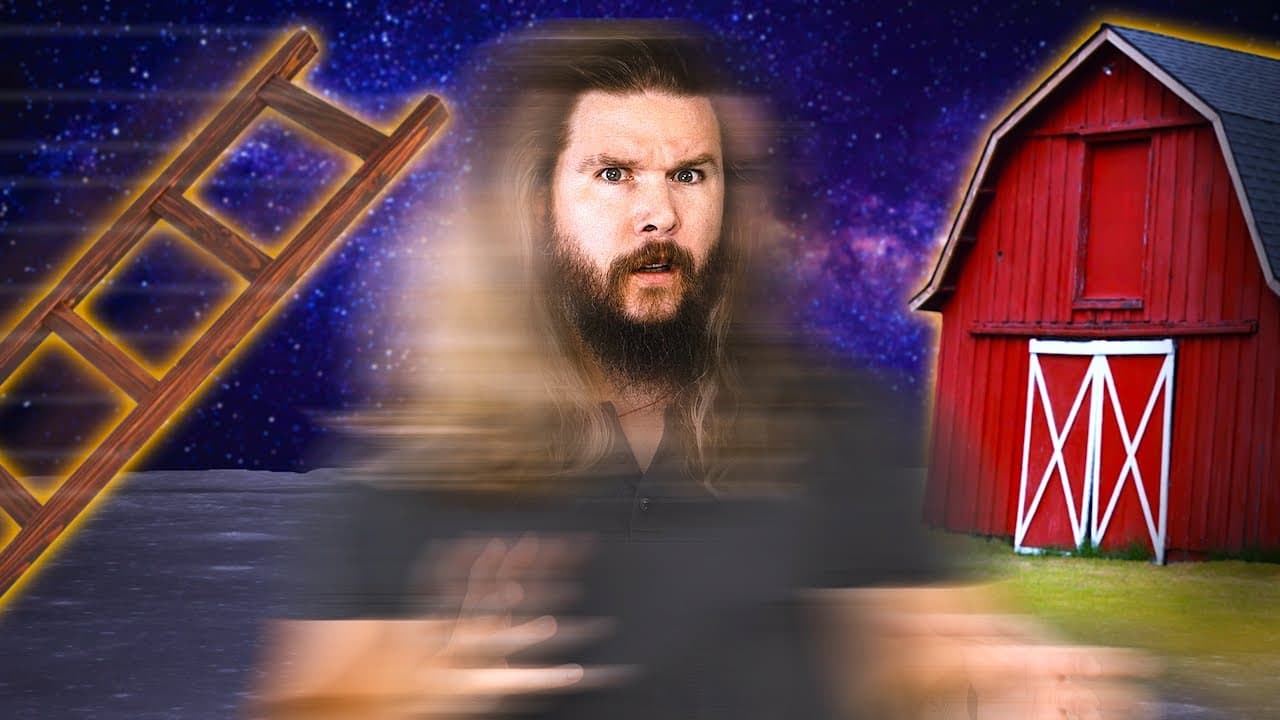
The Ladder Paradox shows how a near-light-speed ladder can fit inside a barn from the barn’s perspective while being too long from the ladder’s perspective, with relativity treating both views as correct. Because light’s speed remains constant, observers in relative motion measure space and time differently through time dilation and length contraction. Read on to see how reference frames produce this seemingly impossible result.
Transcript
Oreo what's going on right now scanning it appears that you are both time dilated and Link contracted can you compensate compensating oh okay much better it's going to be a lot easier to have the following discussion when we're both in the same frame of reference if you and I start disagreeing about where when how what why when who what where thing... Read More
Key Insights
- "relativity is one of the most important ideas anyone has ever had" (0:57)
- "modern physics doesn't work without it and practically useful for example GPS would fail without relativistic math" (1:17)
- "spoiler alert relativity says both of these perspectives are correct but how is that possible" (2:04)
- "this is time dilation and it really does mean that if you were watching my ship speed past you and you looked at my watch it would literally be ticking more slowly than your watch" (5:18)
- "there is also length contraction which literally compresses me according to you along my direction of motion" (5:40)
Install to Summarize YouTube Videos and Get Transcripts
Explore YouTube Video Summarizer or Get YouTube Transcript Extractor
Questions & Answers
Q: What is the Ladder Paradox?
The Ladder Paradox imagines a ladder moving toward a barn at near the speed of light. From the barn’s perspective, the ladder fits inside when its front reaches the back, but from the ladder’s perspective, the approaching barn is too short to contain it.
Q: How can both perspectives in the Ladder Paradox be correct?
Relativity says observers moving relative to each other can measure different spaces and times. The barn and ladder perspectives therefore describe the same event from different reference frames, and relativity treats both descriptions as correct.
Q: What are Einstein’s two key insights about relativity?
The first insight is that the laws of physics are equal in equal reference frames. The second is that the speed of light in a vacuum is measured as equal in every possible reference frame.
Q: What is time dilation?
Time dilation means a moving clock runs more slowly when observed from a reference frame relative to which it is moving quickly. In the laser-clock example, the light follows a longer diagonal path, so the measured time must become longer if the speed of light remains constant.
Q: What is length contraction?
Length contraction compresses a moving object along its direction of motion from another observer’s perspective. It works together with time dilation so that observers continue to measure the same speed of light in a vacuum.
Q: How does a laser clock explain time dilation?
A laser clock records a tick when a pulse travels to a mirror and returns. When the clock moves quickly relative to an observer, that observer sees the pulse follow a longer diagonal zigzag, so the moving clock must run more slowly if light’s speed cannot change.
Q: Why does relativity matter to modern physics and GPS?
The transcript describes relativity as theoretically critical because modern physics does not work without it. It is also practically useful because GPS would fail without relativistic math.
Q: How can the Ladder Paradox be represented on graph paper?
The explanation begins with a Minkowski diagram of space-time. Its y-axis represents time, while its x-axis represents distance.
Summary & Key Takeaways
-
Relativity, crucial in modern physics and practical applications like GPS, reveals non-intuitive truths about time and space.
-
The "ladder paradox" illustrates how different perspectives in relativity can be simultaneously correct.
-
Time dilation and length contraction occur at high speeds, challenging everyday perceptions of space-time.
Read in Other Languages (beta)
Share This Summary 📚
Summarize YouTube Videos and Get Video Transcripts with 1-Click
Try YouTube Summary with ChatGPT & Claude or YouTube Transcript Generator
Explore More Summaries from Kyle Hill 📚


![What Made MEGALODON So Huge? | [OFFICE HOURS] Podcast #025 thumbnail](/_next/image?url=https%3A%2F%2Fi.ytimg.com%2Fvi%2F2F_zCTfPt-I%2Fhqdefault.jpg&w=750&q=75)


![🔴 Viral "Hanger Reflex" Explained! | [OFFICE HOURS] Podcast 090 thumbnail](/_next/image?url=https%3A%2F%2Fi.ytimg.com%2Fvi%2F-GQPNu0erKc%2Fhqdefault.jpg&w=750&q=75)
Summarize YouTube Videos and Get Video Transcripts with 1-Click
Try YouTube Summary with ChatGPT & Claude or YouTube Transcript Generator