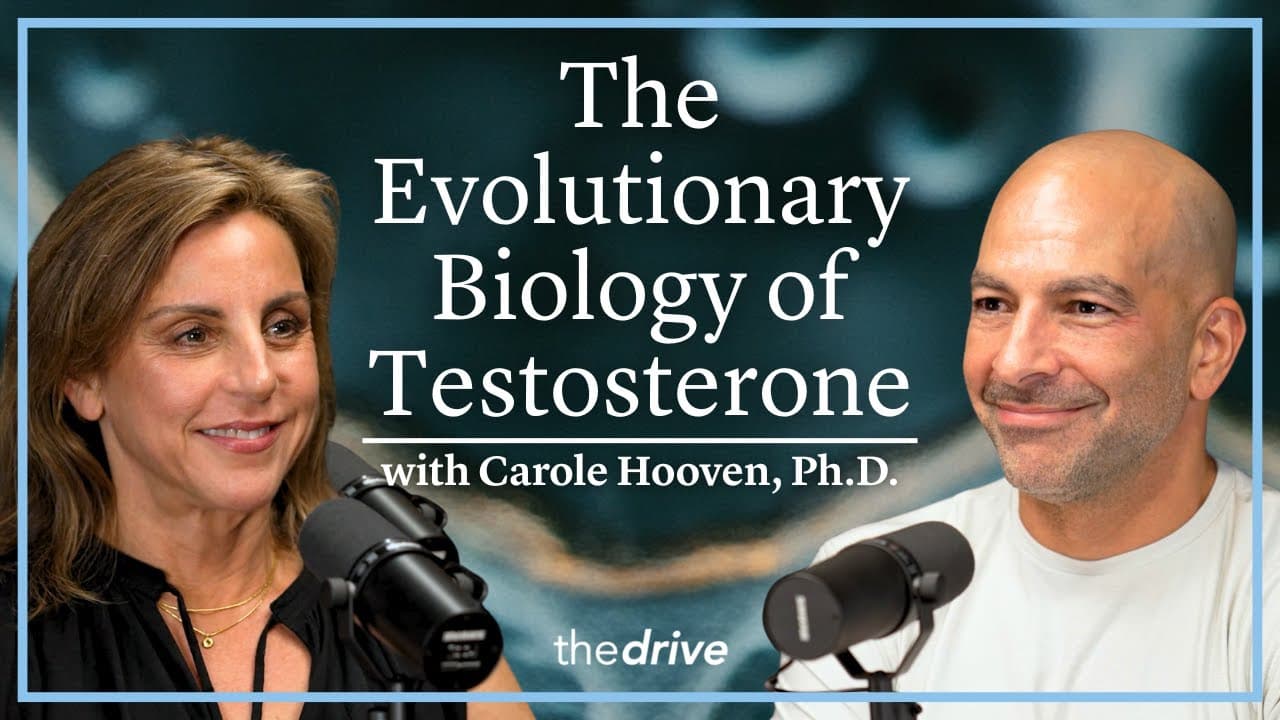
What role does testosterone play in male development and behavior
TL;DR
Testosterone shapes both body and brain from the embryo through adulthood, establishing basic male differences before birth and guiding later behavioral patterns. It helps explain why males and females diverge in aggression, energy use, and social dynamics, while revealing how environment and development interact with ancient biological drives.
Transcript
Hey everyone, welcome to the Drive Podcast. I'm your host, Peter Aia. Carol, thank you so much for coming out to Austin. Great to great to meet you in person. Thank you so much for having me. I'm thrilled to be here. This is a topic that we we talk a lot about on the podcast, but usually from a pretty narrow lens, right, which is in the form of rep... Read More
Key Insights
- Testosterone is a central driver of sex differences across species, linking reproductive biology to behavior.
- The SRY gene and early hormones guide embryonic sexual differentiation, setting body and brain development paths.
- Hormonal effects on aggression and energy use vary by developmental stage and species, not just by current hormone levels.
- Maternal and adrenal hormones can influence female development, contributing to sex-specific traits.
- Sex differences arise from both biology and ecology, with evolutionary pressures shaping strategies for mating and competition.
- Humans share core mechanisms with other mammals, but cultural context modulates the expression of biological drives.
- Testosterone influences cognition and behavior during adulthood as well as development, affecting responses to social and environmental cues.
- Rare natural examples like sex-differentiation disorders illuminate how hormones sculpt phenotype without typical genetic patterns
Install to Summarize YouTube Videos and Get Transcripts
Explore YouTube Video Summarizer or Get YouTube Transcript Extractor
Questions & Answers
Q: What is the prenatal role of testosterone in male development?
Prenatal testosterone plays a key role in directing the development of body and brain toward male-typical patterns, aligning with the evolutionary purpose of male reproductive strategies. This hormonal influence begins early and helps establish differences in aggression, energy use, and social behavior that persist into adulthood. The level and timing of exposure are crucial for these outcomes.
Q: How do chromosomes and early hormones interact to shape embryonic sex?
Chromosomes determine genetic sex and guide the development of the reproductive system, while early hormones like testosterone drive the differentiation of body and brain toward male or female trajectories. The interaction between these biological signals results in distinctive phenotypes that influence later behavior, with hormones acting as mediators of the underlying genetic blueprint.
Q: Do all species show the same testosterone effects on aggression?
No, testosterone effects on aggression vary across species and developmental contexts. While higher testosterone in males often correlates with greater aggression or energy expenditure, the exact behavior depends on ecological factors, mating systems, and species-specific neural and hormonal regulation. In some species, aggression is mediated more by other hormones or by maternal or adrenal influences.
Q: What can studying chimps tell us about human sex differences?
Studying chimps reveals that basic sex differences in energy, aggression, and social behavior are shared across primates, suggesting deep evolutionary roots. This cross-species similarity helps explain why human sex differences persist beyond cultural explanations and illustrates how testosterone-linked biology interacts with social structures to shape behavior.
Q: How does the SRY gene relate to sexual differentiation?
The SRY gene is a key driver in initiating male development at early stages, influencing gonadal formation and subsequent hormone production. Its activity sets in motion a cascade of hormonal events that shape both physical traits and neural circuits, ultimately contributing to male-typical development and behavior observed later in life.
Q: What is the role of testosterone in adult cognition and behavior?
In adults, testosterone continues to influence cognition and behavior by modulating energy, risk-taking, and social interactions. Its effects are modulated by contextual factors such as environment and culture, and by interactions with other hormones, leading to a nuanced expression of masculine behaviors that can vary across individuals and settings.
Q: How might environmental factors interact with testosterone-driven drives?
Environmental factors can amplify or dampen testosterone-driven drives by shaping social norms, opportunities, and stress levels. For example, culture may either constrain or encourage competitive behaviors, while early life experiences and current context determine how hormonal tendencies are expressed in aggression, decision-making, and social interactions.
Q: Why are rare sex differentiation conditions informative for biology?
Rare conditions that alter typical sex differentiation, such as 5-alpha-reductase deficiency, reveal how testosterone and related hormones contribute to physical and behavioral sex characteristics. They act as natural experiments showing which traits are robustly tied to hormones and which can be influenced by development, genetics, or environment, deepening our understanding of sex biology.
Summary & Key Takeaways
-
In this episode, Carole Hooven explains how prenatal testosterone orchestrates male development and how early hormone surges influence lifelong behavior, linking biology to observed sex differences in humans and other primates. The discussion emphasizes that sex differences arise from an interplay of chromosomes, hormones, and evolutionary pressures.
-
The conversation covers cross species comparisons, the role of the SRY gene, and how testosterone and other hormones shape aggression styles and social behavior across life stages, highlighting the complexity of biological sex beyond simple cultural explanations.
-
Finally, the host and guest examine the implications of suppressing biological drives, hormone therapies, and personal experiences with menopause, offering a nuanced view of masculinity and the limits of social constructs in shaping behavior.
Read in Other Languages (beta)
Share This Summary 📚
Summarize YouTube Videos and Get Video Transcripts with 1-Click
Try YouTube Summary with ChatGPT & Claude or YouTube Transcript Generator
Explore More Summaries from Peter Attia MD 📚





Summarize YouTube Videos and Get Video Transcripts with 1-Click
Try YouTube Summary with ChatGPT & Claude or YouTube Transcript Generator