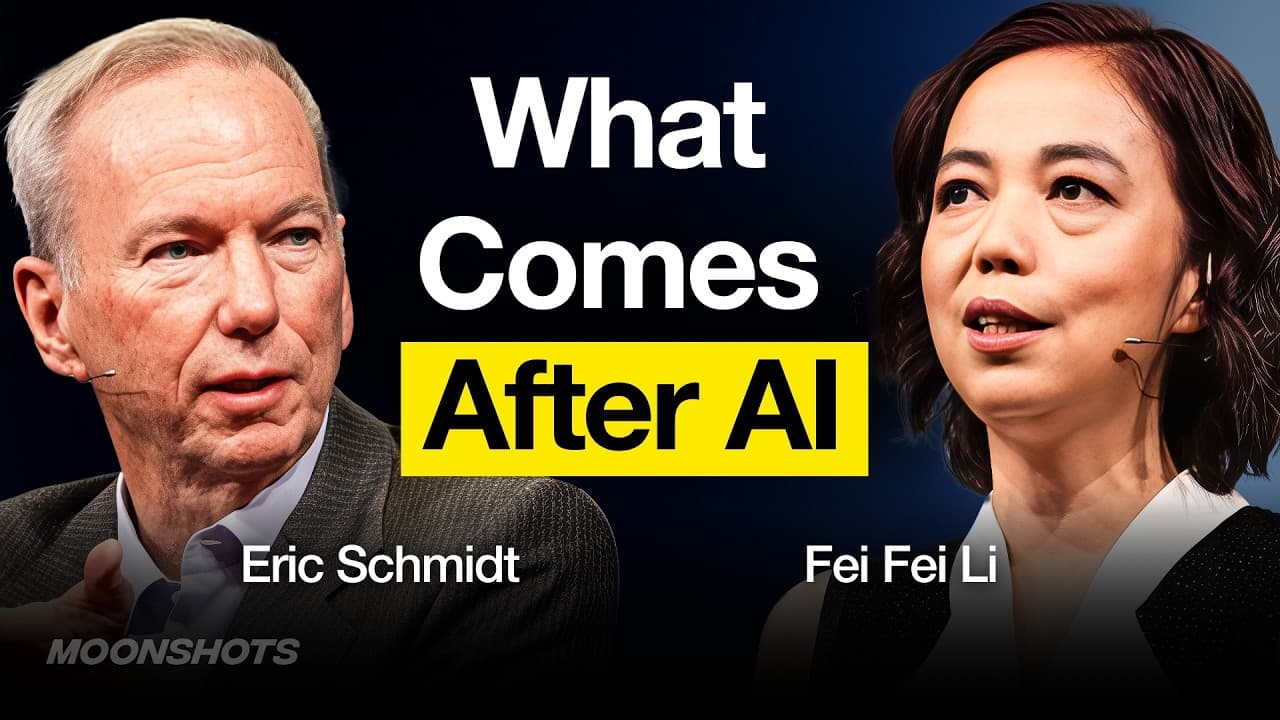
Eric Schmidt and Fei-Fei Li on AI Superintelligence
TL;DR
Superintelligence means AI whose intelligence equals or exceeds the combined intelligence of all humans. Eric Schmidt expects it to take longer than the three to four years many in San Francisco predict, and thinks another algorithmic breakthrough is needed. Fei-Fei Li notes that AI already beats humans at some tasks but cannot yet match the creativity of Newton or Einstein. Both see human and AI collaboration as the most productive path.
Transcript
What does super intelligence mean and when is it likely to be here? Eric, we've talked about this. What are your thoughts? Super intelligence is defined as AI's ability to know from chemistry to biology to to sports. It's already super to human in many ways. But the collaboration between humans and AI will be the most productive and fruitful way of... Read More
Key Insights
- Superintelligence is defined as intelligence equal to the sum of all humans, or better than all humans combined. AGI, by contrast, is generally accepted as human-level intelligence, according to Eric Schmidt's framing of the two terms.
- The 'San Francisco consensus' is Eric Schmidt's name for the group of people who believe superintelligence will arrive within three to four years because of compounding effects. Schmidt personally believes it will take longer than that.
- Today's AI is already superhuman in several ways, says Fei-Fei Li: it can speak and translate between dozens of languages, calculate very fast, and hold vast knowledge across chemistry, biology and sports, which no single human can do.
- Current AI lacks the creative abstraction behind scientific breakthroughs. Fei-Fei Li argues that giving an AI all observed celestial data would not let it deduce Newton's laws of motion, and Schmidt adds that AI given 1902 knowledge could not invent relativity.
- The key technical barrier to real superintelligence is what Schmidt calls non-stationarity of objectives. Systems are trained against fixed objectives, but human-style creativity requires changing the objectives while working on a problem.
- Brute-force reinforcement learning is a poor route to creativity because its combinatorial cost is enormous, Schmidt says, and the industry is already running out of electricity. He believes another algorithmic breakthrough is probably needed instead.
- Robotics has a long way to go, according to Fei-Fei Li. She cautions that human-level dexterity in manipulation will take much longer, and she is less bullish on a post-scarcity future than a typical Silicon Valley person.
- AI wealth may concentrate rather than spread evenly because these technologies have network effects. Schmidt expects gains to center on early adopters, well-run countries, and perhaps capital, which makes distribution a public policy question.
Install to Summarize YouTube Videos and Get Transcripts
Explore YouTube Video Summarizer or Get YouTube Transcript Extractor
Questions & Answers
Q: What is the difference between AGI and superintelligence?
According to Eric Schmidt, the generally accepted definition of artificial general intelligence (AGI) is human-level intelligence: the ability to have ideas, think about things and be creative as a person can. Superintelligence is defined as intelligence equal to the sum of everyone, or even better than all humans combined. AGI matches one human, while superintelligence exceeds all of humanity together.
Q: When will artificial superintelligence arrive?
No one knows exactly. Eric Schmidt describes a group he calls the San Francisco consensus, people living in San Francisco who believe superintelligence will arrive within three to four years because of compounding effects that are accelerating progress. Schmidt personally thinks it will take longer than that, and he believes another algorithmic breakthrough is probably needed to reach real superintelligence.
Q: Is AI already smarter than humans?
In some ways, yes. Fei-Fei Li points out that AI can already speak and translate between dozens of languages, calculate things very fast, and hold a vast amount of knowledge from chemistry to biology to sports, which no human can match. However, she says it remains an open question whether AI could ever be a Newton, an Einstein or a Picasso, because it lacks that creative abstraction.
Q: Why can't current AI make discoveries like Newton or Einstein?
Fei-Fei Li explains that if you gave all observed celestial data to any AI algorithm, it would not be able to deduce Newton's laws of motion, because that requires a combination of creativity and abstraction. Eric Schmidt adds that a computer with all the knowledge of 1902 could not invent relativity today. Current reasoning systems also cannot quickly feed what they learn back into themselves, as a mathematician builds each proof on the last.
Q: What algorithmic breakthrough is needed for superintelligence?
Eric Schmidt says the technical problem is called non-stationarity of objectives. Today's systems are trained against fixed objectives, but the creativity humans show requires changing objectives while working. Creative people often see that a mechanism from their expert field can solve a problem in a different area. Brute-force reinforcement learning could try to replicate this, but its combinatorial cost is enormous and the industry is already running out of electricity.
Q: Will AI lead to a post-scarcity society?
Fei-Fei Li is cautious. She says the discussion often combines the hottest Silicon Valley words, such as AI, superintelligence and humanoid robots, and that robotics has a long way to go, especially human-level dexterity in manipulation. She is not as bullish as a typical Silicon Valley person on post-scarcity, though she believes AI will augment human capabilities profoundly and that human and AI collaboration will be most productive.
Q: Will the economic benefits of AI be shared equally?
Eric Schmidt sees a possible flaw in the abundance argument. These technologies have network effects that concentrate benefits among a small number of winners, so a few countries, firms and people could capture most gains. Wealth will certainly be created through efficiency, but he thinks the gains are more likely to center on early adopters, well-run countries and perhaps capital. How they are distributed is a public policy question.
Q: How can AI create economic value for countries and companies?
Eric Schmidt says every company that has implemented AI has seen huge gains, and companies that adopt it quickly get a disproportionate return. In Saudi Arabia, AI could improve oil distribution networks and reduce losses by 10% to 20%. In biology and medicine it can speed drug approval and lower trial costs, and in materials it can make building more efficient. Peter Diamandis also cites a projection of 15 trillion dollars in AI value by 2030.
Summary & Key Takeaways
-
Peter Diamandis, Eric Schmidt and Fei-Fei Li discuss digital superintelligence in a live conversation in Saudi Arabia. Schmidt defines AGI as human-level intelligence and superintelligence as the sum of all human intelligence. He says many in San Francisco expect it within three to four years, but he thinks it will take longer.
-
Fei-Fei Li traces AI back to Alan Turing's question about thinking machines. She says AI already beats humans at languages, calculation and breadth of knowledge, but doubts it can deduce Newton's laws from data. Schmidt agrees and says reaching true superintelligence likely needs an algorithmic breakthrough around non-stationary objectives.
-
On the economy, Diamandis cites a projection of 15 trillion dollars in AI value by 2030 and a demonetization of health care and transport. Schmidt warns that network effects may concentrate gains in a few firms and countries. Li is cautious about robotics and post-scarcity, stressing that human and AI collaboration works best.
Read in Other Languages (beta)
Share This Summary 📚
Summarize YouTube Videos and Get Video Transcripts with 1-Click
Try YouTube Summary with ChatGPT & Claude or YouTube Transcript Generator
Explore More Summaries from Peter H. Diamandis 📚



Summarize YouTube Videos and Get Video Transcripts with 1-Click
Try YouTube Summary with ChatGPT & Claude or YouTube Transcript Generator