How to Fix an App That Converts but Cannot Retain
TL;DR
Strong distribution cannot rescue an app that attracts trials but fails to retain paying users. The founders rebuilt their product around what customers actually wanted, monitored behavior and conversion data, then resumed influencer marketing after the experience improved. Their case suggests that founders should diagnose where users leave, simplify the core value, and scale promotion only after the product consistently delivers on its promise.
Transcript
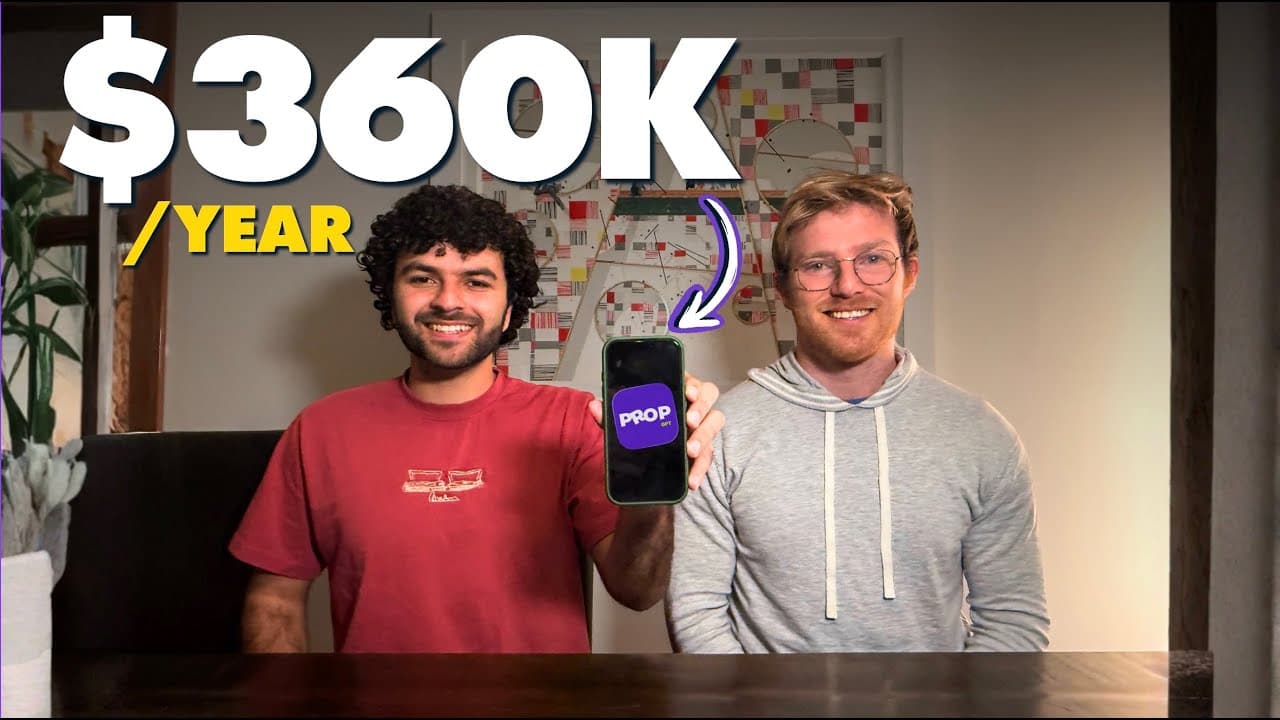
This is Aayall and Yali, two college students who built an app that at first crushed it with downloads. We were averaging 20 downloads a day right off the bat. But they had a problem. Almost nobody stayed after the trial ended. Their conversion was horrible. If your product is nobody's going to buy it. They were stuck at $2,000 a month and they had... Read More
Key Insights
- A high trial conversion rate can coexist with a weak product. The founders saw strong interest at the paywall but poor retention after the trial, indicating that users liked the promise of the app but did not receive the experience or value they expected.
- Distribution is ineffective when the product does not satisfy customers. Influencer marketing generated downloads and trials for the first version, but the app remained stuck at low recurring revenue because acquisition could not compensate for weak conversion from trial to paid use.
- The central product improvement was giving customers the answers they wanted more directly. Users preferred access to pre-analyzed sports betting picks and model outputs instead of navigating sportsbooks, entering bets, and checking each opportunity themselves.
- A complete pause in marketing can create space for product repair. The founders shut down promotion and spent four months focused on engineering and design, then resumed marketing only after rebuilding the experience around observed customer behavior and pain points.
- Analytics reveal whether the promise and product experience are aligned. The founders used PostHog, Superwall, and revenue data to examine trials, paid conversion, onboarding drop-off, and feature clicks, allowing behavior rather than assumptions to guide product decisions.
- Feature-level tracking can improve both development and marketing. Identifying the features customers use most helps founders recognize the product's strongest value proposition, while onboarding data shows which screens fail to communicate that value clearly enough.
- Influencer marketing works best after product quality improves. Followers may engage deeply when they see someone they admire using an app, and a successful organic video can rapidly increase awareness, downloads, and recurring revenue when the underlying product converts effectively.
- A sustainable app business requires honest demand validation and dependable founder support. The founders recommend approaching evidence scientifically, admitting when a product is weak, and working with a co-founder who can provide mutual support when rebuilding and growth become difficult.
Install to Summarize YouTube Videos and Get Transcripts
Explore YouTube Video Summarizer or Get YouTube Transcript Extractor
Questions & Answers
Q: How do you know if an app has a product problem?
An app likely has a product problem when many people show initial interest but few remain after trying it. In this case, downloads converted well into free trials, yet trial users rarely became paying customers. That pattern meant customers believed the idea could be valuable, but the actual experience did not meet their expectations. Analytics and direct user conversations helped expose the mismatch.
Q: Why did influencer marketing fail to grow the first app version?
Influencer marketing successfully generated attention, downloads, and free trials, but it could not make an unsatisfying product retain customers. The founders were receiving around twenty downloads a day and converting several of them into trials, yet recurring revenue remained stuck. Their experience showed that distribution can reveal demand for an idea, but promotion alone cannot fix weak value delivery after installation.
Q: What product change helped the app convert more users?
The founders simplified the experience around what customers actually wanted. Instead of requiring users to browse sportsbooks, enter bets, and evaluate those bets themselves, the rebuilt app provided access to model outputs and pre-analyzed picks scanned each day. This change made the core value more immediate and aligned the product with the outcome users were seeking when they downloaded it.
Q: How should app founders use conversion data?
App founders should compare conversion at multiple stages rather than treating downloads or trials as proof of success. The founders examined the path from download to trial and from trial to paid use. Strong trial interest paired with weak paid conversion showed that the sales promise was attractive but the product disappointed users. Tracking onboarding exits and feature clicks can then reveal what needs improvement.
Q: What is the founders' playbook for building a better app?
Their playbook begins with defining exactly who the product serves and understanding that audience's pain points. Next, founders should listen closely to conversion data, track onboarding behavior and feature usage, and identify where users abandon the experience. After improving the product around its strongest value proposition, they can scale distribution through channels such as influencer marketing and organic social content.
Q: When should an app company scale its marketing?
An app company should scale marketing after behavior and conversion data indicate that the product delivers enough value to retain paying users. The founders initially had distribution but could not move beyond low recurring revenue. They stopped marketing during the rebuild, improved the product, and then promoted it again during the NBA playoffs. The same acquisition strategy performed far better after paid conversion improved.
Q: What technology and tools were used to build the app?
The app was built from a React Native repository, with TypeScript used extensively for development and Python used for machine learning algorithms and automated data fetching. Its large database was stored on Neon. The founders used RevenueCat for revenue dashboards and Superwall for paywalling, while additional analytics tools helped them monitor conversion, onboarding behavior, and feature usage.
Q: What business lessons did the founders share with new app builders?
The founders advised builders to remain humble about product quality, talk with enough users, and evaluate demand scientifically rather than defending their original assumptions. They also recommended having a co-founder who can provide support when the work becomes difficult. Proving that genuine demand justifies the struggle can also make the opportunity easier to communicate to investors and future team members.
Summary & Key Takeaways
-
The founders initially attracted steady downloads through influencer marketing, yet the business remained stuck because many users started trials and then left. Analytics revealed a gap between interest in the idea and satisfaction with the actual experience. That evidence led them to stop marketing and reconsider the product rather than merely acquiring more users.
-
Customer behavior showed that users wanted direct access to useful, pre-analyzed sports betting picks instead of manually entering bets and evaluating them. The founders spent four months rebuilding the app around that simpler outcome. After relaunching, paid conversion improved sharply, revenue climbed, and renewed marketing produced much stronger results than it had before.
-
Their playbook combines a precise customer definition, honest interpretation of conversion data, detailed feature and onboarding analytics, and influencer-led distribution. The app uses React Native, TypeScript, Python, Neon, RevenueCat, and Superwall. The founders also emphasize co-founder support, humility about product quality, and scientific evaluation of genuine market demand.
Read in Other Languages (beta)
Share This Summary 📚
Summarize YouTube Videos and Get Video Transcripts with 1-Click
Try YouTube Summary with ChatGPT & Claude or YouTube Transcript Generator
Explore More Summaries from Starter Story 📚



Summarize YouTube Videos and Get Video Transcripts with 1-Click
Try YouTube Summary with ChatGPT & Claude or YouTube Transcript Generator