Euler angles and the orientation matrix
TL;DR
Euler angles and orientation matrices are essential for analyzing material microstructures.
Transcript
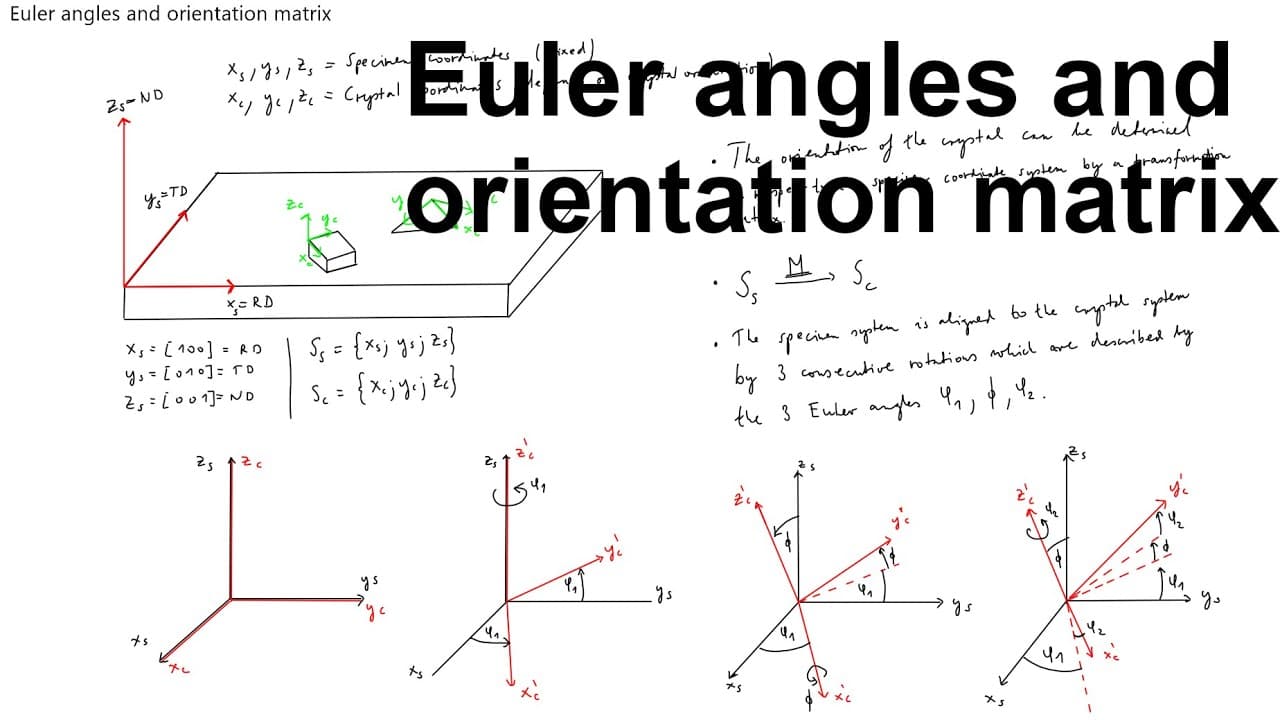
welcome everyone in this video I'm going to talk about the Euler angles and the orientation matrix and this topic is very important for texture analysis so when you are investigating the microstructure of your specimen for example some metals or some kind of minerals you want to know what is the inner structure of the individual grains or how they ... Read More
Key Insights
- 👾 Euler angles provide a systematic way to represent rotations in three-dimensional space, which is crucial for material analysis.
- 👻 The orientation matrix serves as a bridge to connect specimen coordinates with crystal coordinates, allowing for detailed microstructural studies.
- 🆘 Understanding how individual grains within a material can vary in orientation helps in predicting material behavior under different processing conditions.
- 🔺 Accurate rotation calculations using Euler angles are essential, as mistakes in angle units (degrees vs. radians) can lead to significant errors in results.
- 🦻 The first and last columns of the rotation matrix can be directly related to crystallographic directional information, aiding in precise material characterization.
- 🌍 The relationship between different coordinate systems through rotation matrices is not just theoretical but can be applied to real-world material science challenges.
- 😥 Calculating the Schmidt vector and measuring misorientation between points utilizing orientation matrices is vital for identifying grain boundaries in materials.
Install to Summarize YouTube Videos and Get Transcripts
Explore YouTube Video Summarizer or Get YouTube Transcript Extractor
Questions & Answers
Q: What are Euler angles and why are they important in texture analysis?
Euler angles are three angles that describe the rotation of a coordinate system in three-dimensional space. They are crucial in texture analysis as they enable the transformation of the coordinate system of a specimen to that of its crystalline structure, allowing for a better understanding of the orientation of individual grains.
Q: How do the specimen coordinate system and crystal coordinate system relate to each other?
The specimen coordinate system is defined by the rolling direction, transverse direction, and normal direction of a slab or sheet. The crystal coordinate systems of individual grains can be different, and their relationship is established through a series of three rotations around specified axes, enabling the detailed understanding of how grains are oriented relative to the specimen.
Q: Can you explain the process of using rotation matrices in analyzing material properties?
Rotation matrices represent the transformations between coordinate systems. By applying the Euler angles to create a 3x3 rotation matrix, one can rotate vectors of the specimen's coordinate system to obtain their orientation in the crystal coordinate system, helping to describe properties like texture and response to external stresses.
Q: What practical example did the video provide to illustrate the use of orientation matrices?
The video presented a detailed example where specific numerical values were used in a rotation matrix to compute the HKL and UVW coordinates. It showed how to round these values to determine the texture components of a specimen, demonstrating the practical application of theoretical concepts.
Summary & Key Takeaways
-
The video explains Euler angles and rotation matrices, emphasizing their significance in analyzing the microstructures of metals and minerals.
-
It describes how the orientation of individual grains within a specimen can be assessed using a coordinate system, highlighting the relationships through defined rotations.
-
Practical examples show how to apply these concepts to determine texture components and other material properties based on orientation data.
Read in Other Languages (beta)
Share This Summary 📚
Summarize YouTube Videos and Get Video Transcripts with 1-Click
Try YouTube Summary with ChatGPT & Claude or YouTube Transcript Generator
Explore More Summaries from Curious Scientist 📚





![Building a Peltier cooler-based cooling box - First iteration, improvements [Part 2/6] thumbnail](/_next/image?url=https%3A%2F%2Fi.ytimg.com%2Fvi%2F0YlNw0EGnzI%2Fhqdefault.jpg&w=750&q=75)
Summarize YouTube Videos and Get Video Transcripts with 1-Click
Try YouTube Summary with ChatGPT & Claude or YouTube Transcript Generator