What Is the ICT PM Trend in Index Futures Trading?
TL;DR
The PM trend is the afternoon price swing in index futures that runs from 1 pm to 4 pm New York time, with the true day high or low usually forming between 3 pm and 4 pm. It can either continue the morning trend or reverse into the close, and its measured moves tend to be faster than the AM session, typically heating up around 2 pm.
Transcript
okay folks welcome back again we're dealing with a commodity issue so it's important you read this disclaimer as a reminder I'm not a licensed CTA I'm not giving you commodity trade advice everything that's being discussed here is for informational purposes only and should be viewed in light of a paper trade only okay June 2017 ICT mentorship ICT i... Read More
Key Insights
- The New York PM session is defined by the 1 pm to 4 pm New York time window, and the true day high or low tends to form in the last hour between 3 pm and 4 pm as price swings toward the close.
- The PM trend can be either a continuation of the AM trend direction or an intraday reversal going into the close, so the afternoon does not always follow the morning's direction.
- Measured moves in the afternoon tend to be faster than those in the AM session, with the move typically beginning around 2 pm New York time, though it can start as early as 1 pm.
- The New York lunch hour is generally noon to 1 pm but can run from 11 am to 2 pm; a fast morning market produces short consolidation as traders work through lunch, while a lethargic morning allows a fuller lunch pause.
- Order blocks and rejection blocks formed during the AM or lunch session act as reference points that PM price trades into and reacts off, sending price toward the opposite end of the range into the close.
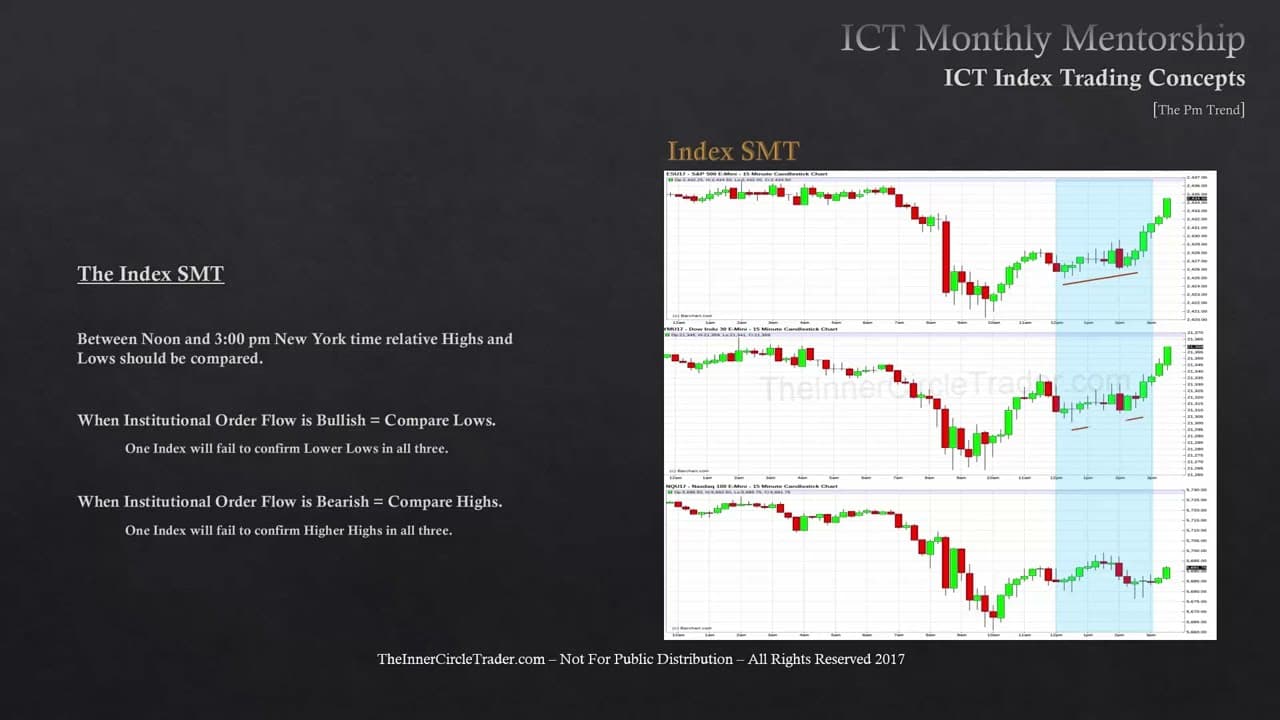
- Index SMT divergence for the PM session compares the relative highs and lows of the S&P, Dow, and NASDAQ e-mini futures between noon and 3 pm New York time to gauge institutional order flow.
- When order flow is bullish one index fails to confirm a lower low, and when it is bearish one index fails to confirm a higher high; that failure among the three indices signals accumulation or distribution.
- The last trading hour from 3 pm to 4 pm New York time generally creates the opposite end of the day's range from the AM session, and the bond market close at 3 pm often coincides with the market forming its high or low.
Install to Summarize YouTube Videos and Get Transcripts
Explore YouTube Video Summarizer or Get YouTube Transcript Extractor
Questions & Answers
Q: What time is the ICT PM trend session in index futures?
The PM trend is the North American afternoon session defined by the 1 pm to 4 pm New York time window, occurring after the noon New York lunch hour. Within this period there is typically a trend or price swing seen daily, referred to as the PM trend or afternoon swing. The true day high or low tends to form in the last hour, between 3 pm and 4 pm New York time, as the session moves toward the closing basis of each trading day.
Q: How does the PM trend relate to the AM session trend?
The PM trend can be either a continuation of the AM trend direction or an intraday reversal going into the close, so the afternoon does not always match the morning. If the AM session creates the low of the day and lunch shows no retracement while the PM starts pushing higher, a trader can feel confident that a trade in the same direction as the AM will continue into the last hour. Alternatively, the afternoon can create a reversal, such as a rejection of a previous high or a turtle soup.
Q: When does the PM trend move typically begin?
The measured moves in the afternoon tend to be faster than those seen in the AM session, and typically 2 pm New York time sees the move begin. It can start as early as 1 pm New York time, but generally around two o'clock in the afternoon it really starts to heat up and the sessions begin to move toward the closing basis of each trading day. The focus is on how the market trades between the 1 pm and 4 pm time windows.
Q: What is the New York lunch hour in ICT index trading?
The New York lunch hour generally implies noon to 1 pm, but it can be as early as 11 am to as late as 2 pm depending on the current market environment. If there is a fast market in the morning, traders will want to work through lunch, so short lunch periods or brief consolidation and retracement are typically seen. When the morning session was lethargic, a fuller lunch hour from 11 o'clock to 1 or even 2 o'clock can appear. Traders should expect some consolidation or retracement around the noon to 1 pm window.
Q: What is index SMT divergence in the PM session?
Index SMT divergence for the PM session looks at the relative highs and lows that form between noon and 3 pm New York time across the S&P, Dow, and NASDAQ e-mini futures. When institutional order flow is bullish, one index will fail to confirm a lower low that the others make, which is read as bullish. When order flow is bearish, the highs are compared and one index fails to confirm a higher high, which is deemed bearish. This crack among the three indices signals accumulation or distribution by smart money.
Q: How does a NASDAQ lower low signal a bullish setup?
In one example, the e-mini S&P formed a higher low and the Dow also showed a higher low, but the NASDAQ made a lower low. Normally a symmetrical market would show the NASDAQ making a higher low too as confirmation. Instead, the NASDAQ acted as the lethargic sister while the Dow and S&P showed relative strength by failing to make a lower low. This divergence indicated strong accumulation in the S&P and Dow, and reactions followed after the divergence was noted.
Q: Why does the last trading hour create the opposite end of the range?
If the AM session or first-hour trading creates the higher low or low of the day, then the last hour from 3 pm to 4 pm New York time generally creates the opposite end of the range, meaning the high of the day. Conversely, if the first hour creates the high of the day and it is a down-close day, price will continue lower until the bond market closes at 3 pm, after which the low forms and price moves into the 4 pm close.
Q: Which index did ICT focus on trading with these divergences?
ICT used the SMT divergences among the three indices as reference points to signal trades primarily in the e-mini S&P. He was not trying to trade the Dow or the NASDAQ futures; instead he focused on the crack among all three to tell him whether there would be an upside or downside movement in the S&P. On the bar chart shown, 2 pm equaled 3 pm New York time because the chart used central or Chicago time, and the divergence revealed strong accumulation in the S&P and Dow.
Summary & Key Takeaways
-
The PM trend, or afternoon swing, is the North American afternoon session running 1 pm to 4 pm New York time after the noon lunch hour. A trend or price swing is seen daily in this window, and the true day high or low typically forms in the last hour between 3 pm and 4 pm.
-
The PM trend can continue the AM direction or reverse into the close, and its measured moves are faster than the morning, usually beginning around 2 pm. Price trades into AM or lunch-session order blocks and rejection blocks, then reacts off them; examples showed moves of about 18 handles and roughly 9 handles into the close.
-
Index SMT divergence compares relative highs and lows of the S&P, Dow, and NASDAQ e-mini futures between noon and 3 pm. When two indices hold while a third fails to confirm, it flags accumulation or distribution; ICT used this crack to trade the S&P, with the last hour after the 3 pm bond close creating the range's opposite end.
Read in Other Languages (beta)
Share This Summary 📚
Summarize YouTube Videos and Get Video Transcripts with 1-Click
Try YouTube Summary with ChatGPT & Claude or YouTube Transcript Generator
Explore More Summaries from The Inner Circle Trader 📚


Summarize YouTube Videos and Get Video Transcripts with 1-Click
Try YouTube Summary with ChatGPT & Claude or YouTube Transcript Generator