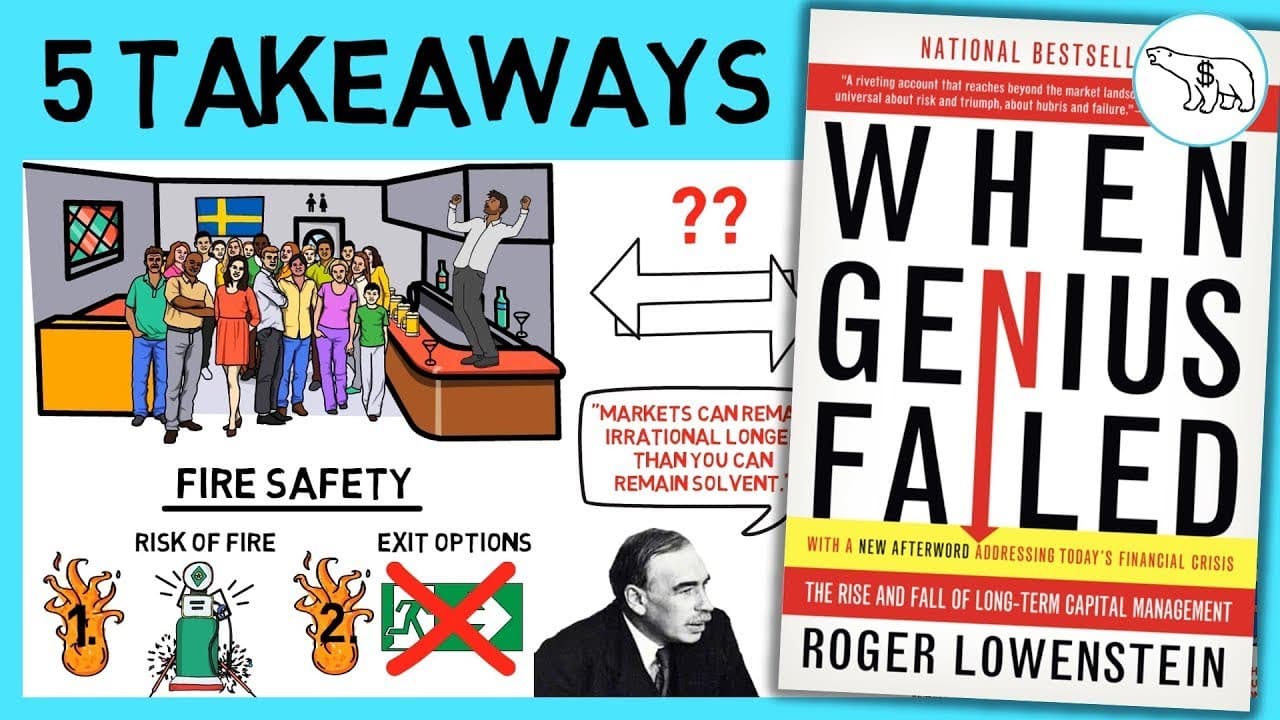
Why Did Long-Term Capital Management Fail? 5 Takeaways from Roger Lowenstein’s When Genius Failed
TL;DR
Long-Term Capital Management failed because excessive leverage, illiquid assets, and flawed mathematical assumptions left it dangerously exposed during a market downturn. Before collapsing in September 1998, LTCM had generated a $2.1 billion profit and a 56% return in 1996. Its dramatic rise and fall reveal enduring lessons about arbitrage, liquidity, overconfidence, and investment risk. Read on for the five central takeaways from Roger Lowenstein’s When Genius Failed.
Transcript
In 1996, a certain firm with less than 200 employees made a profit of $2.1b. To put that into perspective, during that same year, McDonald’s made a profit of $1.6b. Disney made a profit of $1.2b. Even Warren Buffett’s mighty Berkshire Hathaway had look-through earnings of “just” $1.5b. These staggering results seem even crazier when you consider th... Read More
Key Insights
- 😤 LTCM's impressive success was fueled by innovative trading strategies and a team of brilliant individuals.
- 🧑🏭 Excessive leverage and illiquidity were major factors in LTCM's collapse.
- ❓ Flawed assumptions in financial models can have catastrophic consequences.
- ✳️ Investing requires an awareness of potential risk and a focus on favorable asymmetric bets.
- 🍝 The LTCM saga should serve as a lesson for the financial industry to avoid repeating past mistakes.
- 🙈 Hubris and overconfidence can blind investors to the risks they are taking.
- 🪡 Liquidity is often most needed when it is least available.
Install to Summarize YouTube Videos and Get Transcripts
Explore YouTube Video Summarizer or Get YouTube Transcript Extractor
Questions & Answers
Q: Why did Long-Term Capital Management fail?
LTCM relied on excessive leverage, held illiquid assets, and used mathematical assumptions that failed during a market downturn. Its positions were typically leveraged 20–30 times its equity, leaving little room for error when markets moved against the fund.
Q: What was Long-Term Capital Management?
Long-Term Capital Management, or LTCM, was a hedge fund founded by John Meriwether in 1994. It sought to reproduce the success of the fixed-income arbitrage group he had led at Salomon Brothers.
Q: How successful was LTCM before its collapse?
LTCM returned 28% in 1994, compared with 1.3% for the S&P 500, and investors received 20% after fees. Returns reached 59% before fees in 1995, followed by a 56% return and $2.1 billion profit in 1996.
Q: How did LTCM’s 1996 profit compare with major companies?
With fewer than 200 employees, LTCM earned a $2.1 billion profit in 1996. That exceeded the cited profits of McDonald’s at $1.6 billion and Disney at $1.2 billion, as well as Berkshire Hathaway’s $1.5 billion in look-through earnings.
Q: Who founded LTCM and who were its notable partners?
John Meriwether founded LTCM after leaving Salomon Brothers. Its original partners included Lawrence Hilibrand, Robert C. Merton, Myron Scholes, Victor Haghani, and former Federal Reserve vice chairman David W. Mullins.
Q: What investment strategy drove LTCM’s early success?
LTCM specialized in bond arbitrage, seeking to exploit price discrepancies between related bonds. The strategy applied scientific analysis and intensive number crunching in a field that was still relatively new and offered limited competition.
Q: How did leverage and illiquidity make LTCM vulnerable?
LTCM’s positions were generally leveraged 20–30 times its equity, magnifying both gains and losses. When markets declined, its illiquid assets were difficult to sell, demonstrating that liquidity may be least available precisely when investors need it most.
Q: What investment lessons does When Genius Failed offer?
The LTCM story warns against excessive leverage, illiquidity, hubris, and unquestioning confidence in mathematical models. It also emphasizes staying aware of risk, seeking favorable asymmetric bets, and remaining cautious outside one’s circle of competence.
Summary & Key Takeaways
-
LTCM, a hedge fund founded in 1994, achieved remarkable profits and outperformed major corporations like McDonald's and Disney.
-
The fund was led by a group of renowned individuals with expertise in trading and finance.
-
However, LTCM's success was short-lived, as the fund's reliance on leverage, lack of liquidity during market downturns, and flawed mathematical assumptions contributed to its downfall.
Read in Other Languages (beta)
Share This Summary 📚
Summarize YouTube Videos and Get Video Transcripts with 1-Click
Try YouTube Summary with ChatGPT & Claude or YouTube Transcript Generator
Explore More Summaries from The Swedish Investor 📚




Summarize YouTube Videos and Get Video Transcripts with 1-Click
Try YouTube Summary with ChatGPT & Claude or YouTube Transcript Generator