How Does the Compound Effect Turn Small Choices Into Success?
TL;DR
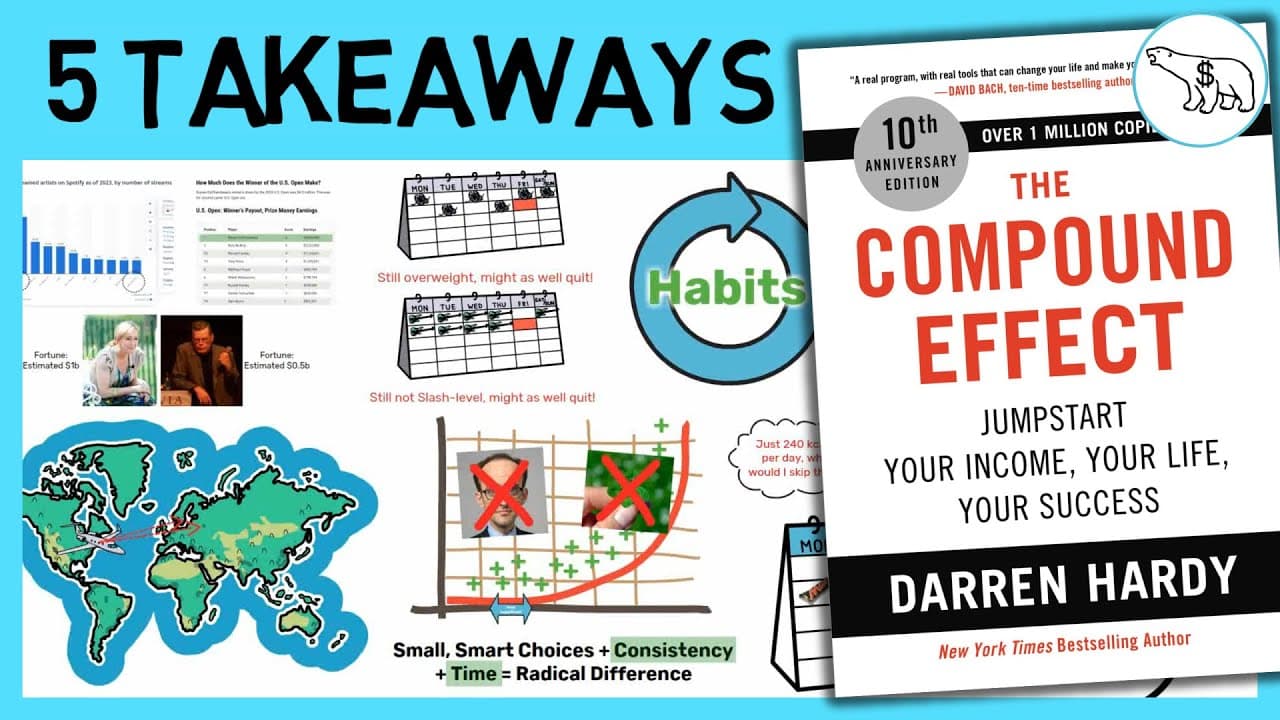
Success comes from a simple formula: small, smart choices plus consistency plus time equals a radical difference. Darren Hardy's The Compound Effect argues that you must take 100% responsibility for your life, track your habits to break free of autopilot, and replace willpower with why-power by connecting daily choices to your deepest desires.
Transcript
The guiding principle for success – whether you want to get more fit, richer, more influential, a better guitar player, even a better sculpturer – doesn’t have to be learned from a $297 online course. If all we needed was more information, then everyone with access to Google and ChatGPT would be enjoying their days in a mansion, have abs of steel a... Read More
Key Insights
- The compound effect is the principle of getting massive rewards from a series of small, smart choices. Its formula is simple: small, smart choices plus consistency plus time equals a radical difference in results.
- Small changes produce large differences over time. A plane leaving New York lands in Stockholm instead of Moscow if the pilot shifts the heading just 2.4 degrees north, showing how a tiny adjustment changes the destination.
- Skipping a 240-calorie snack on weekdays adds up to about 63,000 calories, or 8 kg of fat, over a year, even though nobody would notice the difference after the first day.
- Results often arrive in an exponential fashion. Taylor Swift earned roughly 4x more than the 10th most streamed artist in 2023, though she is not 4x better, just a little better.
- The hardest part of the compound effect is that each step feels insignificant. Most people quit running by week 2 because they are still overweight, abandoning effort before results appear.
- Taking 100% responsibility for your life is the single most important lesson from the book, according to Darren Hardy. A relationship is not 50/50; it works only when you give 100% with no expectations.
- Tracking is Darren Hardy's go-to method for disarming bad autopilot habits. What gets measured gets managed, and simply becoming aware of your behavior greatly improves your odds of success.
- Willpower is ineffective against instant gratification, so you need why-power instead. Connecting choices to your real dreams and desires provides the motivation to build momentum until new habits become your autopilot.
Install to Summarize YouTube Videos and Get Transcripts
Explore YouTube Video Summarizer or Get YouTube Transcript Extractor
Questions & Answers
Q: What is the compound effect according to Darren Hardy?
The compound effect is the principle of getting massive rewards for a series of small, smart choices. Darren Hardy expresses it as a formula: small, smart choices plus consistency plus time equals a radical difference. It does not require a 180 IQ or a lucky breakthrough, but it does demand hard work, discipline and commitment sustained over a long period.
Q: How do small daily choices add up over a year?
Small daily choices accumulate into large outcomes. Skipping a Mars bar snack on weekdays saves about 240 calories each time, which nobody would notice after one day. Over a year, however, that totals roughly 63,000 calories, or about 8 kg of fat. Similarly, a pilot shifting the heading just 2.4 degrees north lands in Stockholm instead of Moscow.
Q: Why do people give up before the compound effect pays off?
People give up because each individual step feels insignificant and brings no instant gratification. Most people quit running by week 2 because they are still overweight, or stop playing guitar because they are not yet skilled. This is compared to a miner who quits just before reaching the gold. Without visible early results, people abandon the consistency the compound effect requires.
Q: Why are results from slightly better performance often exponential?
Results often come in an exponential fashion because rewards concentrate at the top. Taylor Swift earned roughly 4x more than the 10th most streamed artist despite not being 4x better. The US Open golf winner received about 2x the prize money of the runner-up after winning by a single point. Applying yourself a little more than competitors can bring outsized rewards.
Q: Why should you take 100% responsibility for your life?
Taking 100% responsibility is the one lesson Darren Hardy most wants readers to remember. Blaming partners, parents or outside forces is comfortable but keeps you stuck. Until you can honestly say you are what you are today because of choices you made yesterday, you cannot choose otherwise. In relationships, you cannot demand love, but you can be loveable, which improves your chances.
Q: How can tracking help you break bad habits?
Tracking makes you aware of habits running on autopilot, and what gets measured gets managed. Darren Hardy tracks expenses, food, exercise, sales calls and relationship choices. A useful approach is to track what works against your goal, such as unhealthy snacks or purchases, writing each one down immediately by hand. This makes bad choices a hassle and makes you feel sheepish when you indulge.
Q: What is the difference between willpower and why-power?
Willpower is a weak tool against instant gratification, because the rational mind struggles to resist the pleasure of things like a Big Mac. Why-power means connecting your choices to your real dreams and desires. The plank example shows this: nobody walks a plank between skyscrapers for $20, but anyone would do it to save their child. A strong reason drives action that willpower cannot.
Q: How does momentum help new habits stick?
Momentum works like Newton's first law: objects at rest stay at rest and objects in motion stay in motion unless acted on by an external force. New habits are difficult at first, but with a strong why to get started and consistent repetition, they gain momentum and eventually become your new autopilot, requiring far less effort to maintain over time.
Summary & Key Takeaways
-
The compound effect means small, smart choices made consistently over time produce radically different results. Examples include a 2.4 degree course change sending a plane to a different city, and skipping a daily 240-calorie snack saving about 63,000 calories, or 8 kg of fat, in one year.
-
Rewards for being slightly better than the competition can be huge, as with Taylor Swift and J.K. Rowling, yet each step feels insignificant. People often quit too early, like a miner who stops just before hitting gold, because their efforts bring no instant gratification.
-
Hardy urges taking 100% responsibility for your outcomes, citing Viktor Frankl's view that we can always choose our attitude. He then recommends tracking habits to escape autopilot and using why-power, connecting choices to deep desires, to build momentum that turns new habits into automatic behavior.
Read in Other Languages (beta)
Share This Summary 📚
Summarize YouTube Videos and Get Video Transcripts with 1-Click
Try YouTube Summary with ChatGPT & Claude or YouTube Transcript Generator
Explore More Summaries from The Swedish Investor 📚



Summarize YouTube Videos and Get Video Transcripts with 1-Click
Try YouTube Summary with ChatGPT & Claude or YouTube Transcript Generator