What Is the Cannizzaro Reaction and How Does It Work?
TL;DR
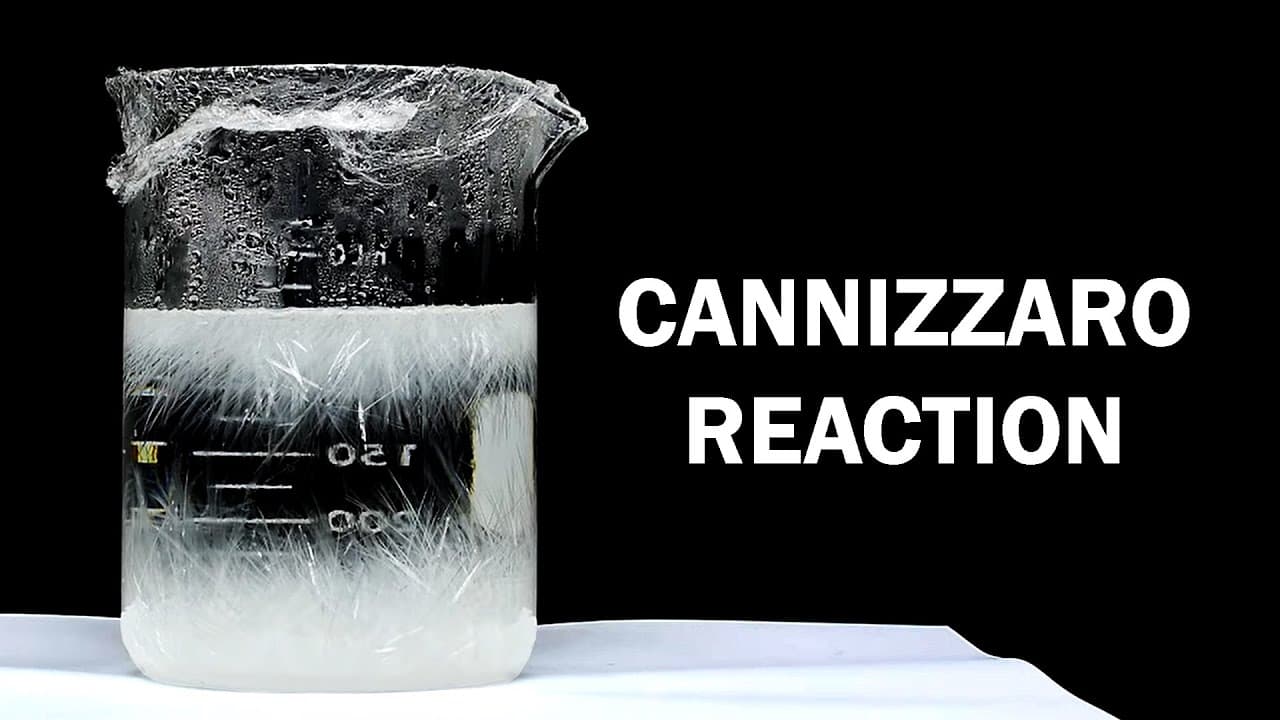
The Cannizzaro reaction converts aldehydes without acidic alpha hydrogens into a carboxylic acid and an alcohol under strong basic conditions. For example, benzaldehyde yields benzyl alcohol and benzoic acid, typically achieving a reaction efficiency of around 70%. Optimization of workup techniques may reduce product loss, which can be significant.
Transcript
this video we're going to be exploring the reaction named after the Italian chemist can it sorrow the candid sorrow reaction is useful because it gives us a way to convert an aldehyde group to a carboxylic acid and an alcohol this reaction doesn't work on all aldehydes though and it only works on aldehyde groups that do not have an acidic alpha hyd... Read More
Key Insights
- 💪 The Candid Sorrows reaction converts an aldehyde group to a carboxylic acid and an alcohol under strong basic conditions.
- ❓ Benzyl alcohol is mainly used as a solvent and in the perfume and flavoring industry.
- 😋 Benzoic acid finds applications as a food preservative and in the production of plasticizers and phenol.
- 🌸 The reaction efficiency is around 70%, with a potential 19% loss during the workup.
- 😒 The use of sodium hydroxide and the washing of benzyl alcohol with dichloromethane are critical steps in the reaction.
- ❓ Multiple purification techniques, such as distillation and recrystallization, can improve the purity of the products.
- 🌸 Exploration of alternative workup methods and solvents may help minimize product loss and increase yield.
Install to Summarize YouTube Videos and Get Transcripts
Explore YouTube Video Summarizer or Get YouTube Transcript Extractor
Questions & Answers
Q: How does the Candid Sorrows reaction work?
The reaction involves the use of sodium hydroxide to convert the aldehyde group to a carboxylic acid (benzoic acid) and an alcohol (benzyl alcohol) through a redox reaction.
Q: What are the applications of benzyl alcohol and benzoic acid?
Benzyl alcohol is used as a solvent and in the perfume and flavoring industry. Benzoic acid is commonly used as a food preservative and in the production of plasticizers and phenol.
Q: What are the necessary chemicals for the Candid Sorrows reaction?
The reaction requires benzaldehyde as the aldehyde and sodium hydroxide as the base. Benzaldehyde can be distilled from bitter almond oil, and sodium hydroxide can be purchased locally.
Q: How can benzyl alcohol and sodium benzoate be separated after the reaction?
The benzyl alcohol can be extracted using dichloromethane, which is immiscible with water. The dichloromethane layer containing benzyl alcohol is separated from the water layer containing sodium benzoate.
Q: How can the purity of benzyl alcohol and benzoic acid be improved?
Multiple purification steps can be employed, such as washing benzyl alcohol with distilled water and performing a second distillation, and recrystallizing benzoic acid.
Summary & Key Takeaways
-
The Candid Sorrows reaction is useful for converting an aldehyde group to a carboxylic acid and an alcohol.
-
It only works on aldehydes without an acidic alpha hydrogen, and occurs under strong basic conditions.
-
The reaction uses benzaldehyde as the aldehyde, forming benzyl alcohol and benzoic acid as the products.
Read in Other Languages (beta)
Share This Summary 📚
Summarize YouTube Videos and Get Video Transcripts with 1-Click
Try YouTube Summary with ChatGPT & Claude or YouTube Transcript Generator
Explore More Summaries from NileRed 📚



Summarize YouTube Videos and Get Video Transcripts with 1-Click
Try YouTube Summary with ChatGPT & Claude or YouTube Transcript Generator