How to Write Better ChatGPT Prompts: 21 Expert Techniques
TL;DR
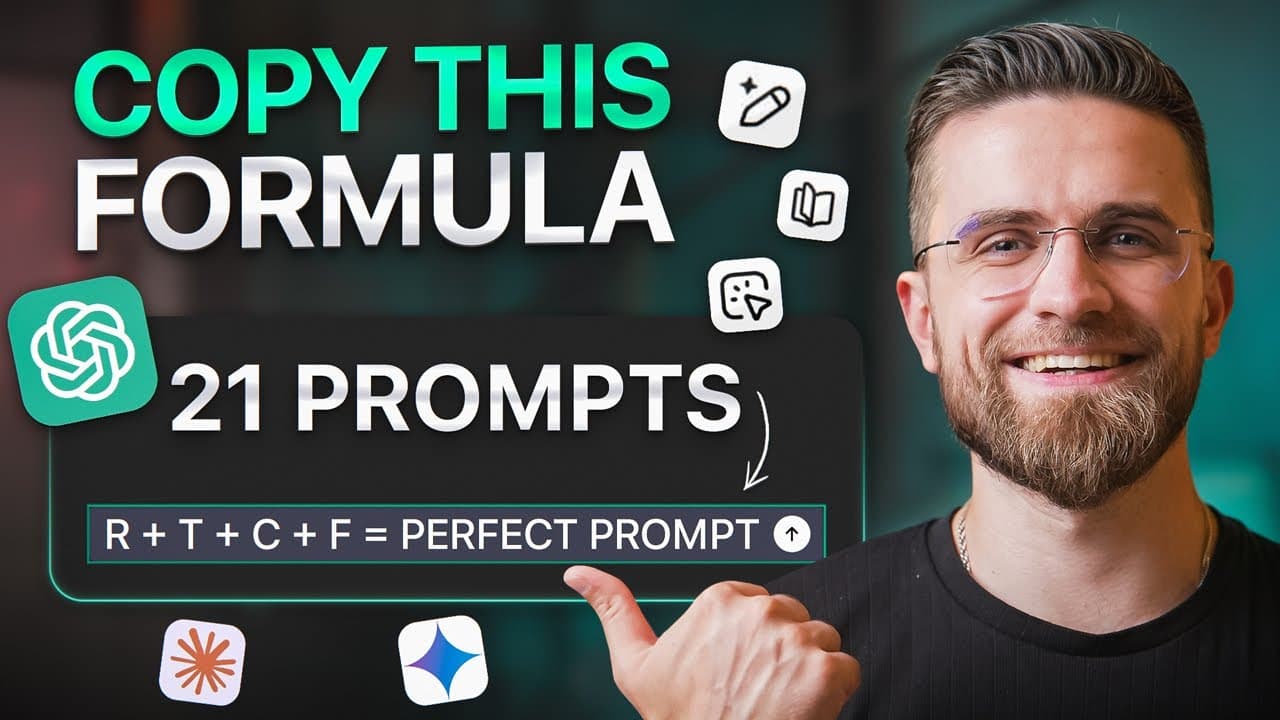
Professional prompting means giving ChatGPT a role, a specific task, clear constraints, and formatting requirements instead of vague one-liners like 'Write me a blog post about marketing.' Assigning specific personas, breaking complex requests into steps, controlling output format, and correcting errors with targeted feedback turn the AI from a search engine into a methodical assistant.
Transcript
Most people are using Chad GBT completely wrong. They type in basic questions and basic answers and think that's all there is to it. But here's what they don't realize. The difference between beginner and an expert isn't just knowledge. It's knowing the right prompts to unlock GPT's true potential. The problem is most tutorials show you surface lev... Read More
Key Insights
- A professional prompt combines four elements: a defined role, a specific task, clear constraints, and formatting requirements. Telling ChatGPT exactly what you want produces structured, expert-level content instead of output that 'screams AI generated.'
- Role-playing works because ChatGPT was trained on interviews, shows, and expert writing, letting it embody any expertise. Specific roles like 'a patient kindergarten teacher helping a frustrated parent' create more authentic responses than boring roles like 'be a teacher.'
- Step-by-step prompting turns ChatGPT into a consultant rather than a search engine by forcing it to ask clarifying questions and build a customized road map instead of generating shallow, generic answers to complex one-shot requests.
- Formatting control makes outputs immediately usable in presentations, reports, or client communications. Specifying tables with named columns, comparison points, and follow-up paragraphs turns raw information into professionally formatted deliverables.
- Context and constraints have a sweet spot between too little and too much. Providing enough background plus limits like word count and tone ensures relevant, specific output rather than a generic 500-word pitch nobody would send.
- Style mirroring lets ChatGPT write in your exact voice when you paste samples of your own writing and ask it to match tone, sentence structure, and communication approach across emails, proposals, and content.
- Error correction separates experts from beginners: instead of typing 'that's wrong,' explain what went wrong and how to fix it, such as asking for simpler language for a non-technical audience, so the AI does not have to guess.
- Chain-of-thought prompting forces the model to show its complete reasoning process before giving a final recommendation, revealing flaws in logic and making the AI methodical rather than just generating text that sounds good.
Install to Summarize YouTube Videos and Get Transcripts
Explore YouTube Video Summarizer or Get YouTube Transcript Extractor
Questions & Answers
Q: How do I write a professional ChatGPT prompt instead of an amateur one?
Replace vague requests like 'Write me a blog post about marketing' with a prompt that includes four elements: a defined role, a specific task, clear constraints, and formatting requirements. For example, 'You are an experienced marketing strategist. Write a 1,000-word blog post about email marketing for small businesses. Include specific tactics, avoid generic advice, and format it with clear subheadings and bullet points.' Telling ChatGPT exactly what you want produces structured, professional content indistinguishable from expert human writing, though the presenter recommends always adding a human touch.
Q: How does role-playing make ChatGPT responses better?
ChatGPT is described as a master actor that can embody any expertise because it was trained on massive amounts of text including interviews, shows, and writing from real experts. Asking it to become a specific character, like Gordon Ramsay teaching a nervous home chef beef Wellington, delivers the tone, encouragement, and brutal honesty of that persona. The key is specificity: 'be a teacher' is weak, but 'a patient kindergarten teacher helping a frustrated parent with homeschool math' is powerful because specificity in roles creates authenticity in responses.
Q: Why should I break complex requests into step-by-step prompts?
Most people ask ChatGPT to solve complex problems in one go and get shallow or incorrect answers. Instead, instruct it to work step by step, for example identifying your expertise and target market first, waiting for your response, then moving to pricing, marketing, and legal setup while asking clarifying questions at each step. This turns ChatGPT into a consultant rather than a search engine, forcing it to go deeper and create a customized road map. The presenter says responses become ten times more valuable because the AI thinks through the problem methodically.
Q: How can I control the formatting of ChatGPT's output?
Most people let ChatGPT choose how to format responses, but professionals control every aspect. You can specify the exact structure, such as asking for a comparison of iPhone and Android formatted as a table with columns for Feature, iPhone, Android, and Winner, including ten comparison points, followed by a one-paragraph recommendation for business users and another for creative professionals. This level of formatting control makes outputs immediately usable in presentations, reports, or client communications, so you receive professionally formatted deliverables rather than just information.
Q: How do I give ChatGPT the right amount of context and constraints?
There is a sweet spot between giving too little context and too much. A strong prompt provides relevant background, like being a freelance web designer who works with local restaurants writing a cold email to a newly opened Italian restaurant, plus constraints such as keeping it under 150 words, being personal but professional, mentioning the recent opening, offering specific services, and avoiding salesy language. Context makes the output specific and relevant, while constraints ensure it meets exact needs; without them the AI might write a 500-word pitch nobody would send.
Q: Can ChatGPT write in my personal writing style?
Yes. You can teach ChatGPT to write in your exact style by giving it samples of your own writing. Paste an email you wrote, ask it to analyze the writing style, then have it write a follow-up email matching your tone, sentence structure, and communication approach exactly. This style mirroring technique is powerful for business communication because once ChatGPT understands your voice it can write emails, proposals, and content that sound authentically like you, helping maintain a consistent voice across communications even when you are pressed for time.
Q: What should I do when ChatGPT gives me a wrong answer?
Instead of starting over or just typing 'that's wrong,' professionals guide the AI back on track by explaining what went wrong and how to fix it. For example, say 'That response was too technical for my audience. Rewrite it for business owners who aren't familiar with marketing jargon. Use simple language and practical examples instead of theory.' This error-correction approach teaches ChatGPT exactly what the problem was and the desired fix rather than forcing it to guess what you wanted, which separates beginners from experts.
Q: What is chain-of-thought reasoning in ChatGPT prompting?
Chain-of-thought reasoning forces the model to show its thinking process, which leads to much better results. You ask it to walk through its reasoning step by step before giving a final recommendation, for example analyzing the pros and cons of hiring a full-time marketing manager versus freelancers, considering the specific business context, then factoring in cost, scalability, and control. The phrase 'show me your complete thought process' makes the model methodical rather than just generating text that sounds good, and the transparency lets you spot flaws in reasoning or areas needing more context.
Summary & Key Takeaways
-
The video argues most people misuse ChatGPT by typing basic questions, and presents 21 prompts to move from beginner to expert. The first seven cover foundations: basic structure with role, task, constraints, and formatting; role-playing; step-by-step breakdowns; formatting control; context and constraints; style mirroring; and error correction.
-
Basic structure means replacing vague requests like 'Write me a blog post about marketing' with a prompt assigning an expert role, a specific word count and topic, required tactics, and formatting with subheadings and bullet points. The presenter stresses AI is an efficient assistant, not a creator, and recommends adding a human touch.
-
Advanced techniques include chain-of-thought reasoning, where you ask the model to walk through pros, cons, and context before a final answer, and nested complexity, where prompts within prompts produce multi-level deliverables like a full content marketing strategy with strategy, monthly themes, and specific pieces rather than surface-level ideas.
Read in Other Languages (beta)
Share This Summary 📚
Summarize YouTube Videos and Get Video Transcripts with 1-Click
Try YouTube Summary with ChatGPT & Claude or YouTube Transcript Generator
Explore More Summaries from AI Master 📚



Summarize YouTube Videos and Get Video Transcripts with 1-Click
Try YouTube Summary with ChatGPT & Claude or YouTube Transcript Generator