How to Future-Proof Your Career With AI Agents
TL;DR
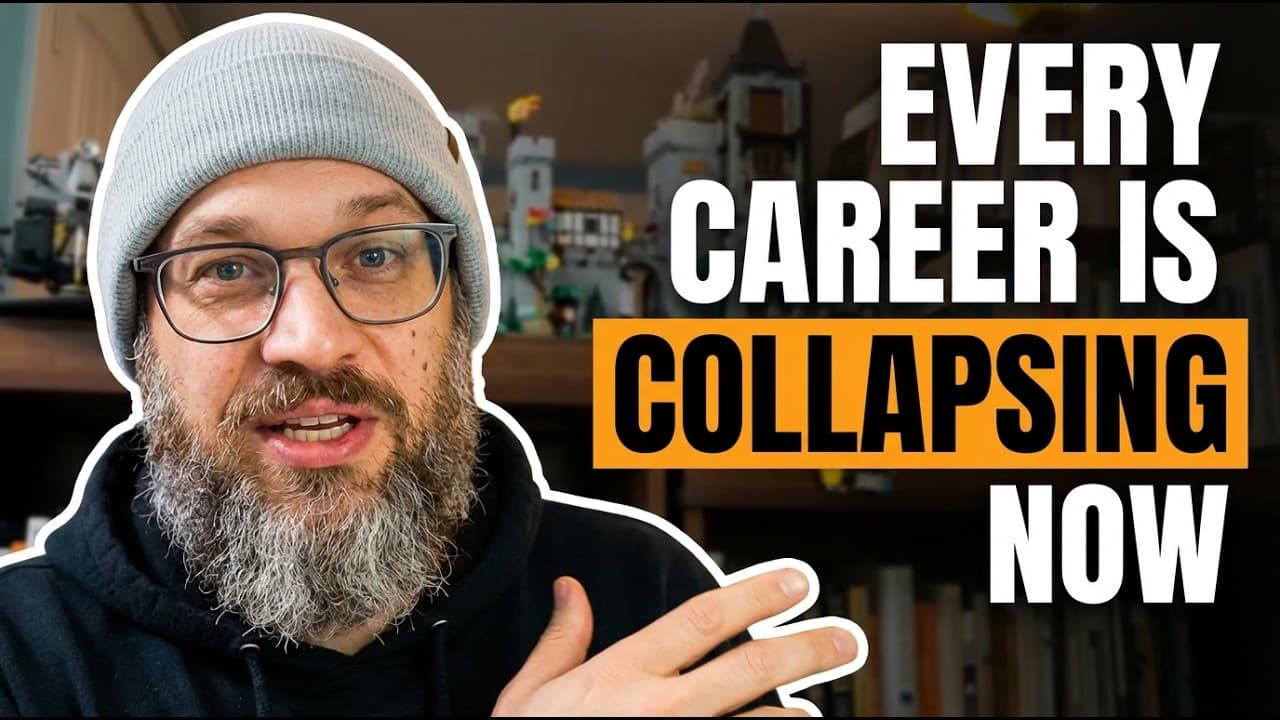
Future-proof your career by practicing how to direct AI agents, not by relying on domain expertise alone or waiting for AI to stabilize. Knowledge-work roles are converging around agent orchestration, while career timelines that once unfolded over years are compressing into months. Domain knowledge still provides essential judgment, but it must be translated into effective AI-assisted workflows. Read on to understand the skills and practice needed to adapt.
Transcript
AI is collapsing futures and most of us are missing what that really means. We think collapsing as in destroying. That's not what what I mean here. Collapsing as in compressing is what people are missing because AI is collapsing multiple different dimensions of our work lives into a single thread pointing to the future. And we're we're missing the ... Read More
Key Insights
- Knowledge-work roles are converging around the meta-competency of orchestrating AI agents. Engineering, product management, marketing, analysis, design, and operations still require distinct knowledge, but each increasingly depends on directing AI systems to complete tasks and produce useful outcomes.
- Domain expertise is becoming foundational rather than independently differentiating. Experienced professionals retain valuable judgment and context, but the transcript argues that their advantage depends on applying that knowledge through AI-assisted workflows instead of relying on years of experience alone.
- Software-shaped intent is the ability to frame work according to an agent's technical environment. Effective direction considers the agent's tools, memory, workflow, interfaces, and capacity to read and write data, even when the person directing it does not work in engineering.
- AI is compressing work that previously required days or weeks. The examples include legal contract review, financial projections, customer-support inquiries, product specifications, customer-data analysis, ticket updates, and production building, all of which can increasingly be assisted or performed by AI systems.
- Career timelines are compressing from years into months. Traditional ladders assumed that workers could learn stable skills, apply them for long periods, and wait two or three years between promotions, but accelerating AI capabilities make that assumption increasingly unreliable.
- Practical engagement is the primary way to develop AI capability. The transcript compares learning AI with swimming, riding a horse, and riding a bicycle because observation and reading cannot replace direct experimentation with models, agents, tools, and real workflows.
- Continuous learning is more durable than mastery of a specific AI technique. Individual pieces of AI knowledge have a short and shrinking half-life, while the habit of repeatedly testing new capabilities and adapting workflows retains value as the technology changes.
- Large capital commitments indicate that major technology companies expect AI to define the next computing era. The transcript cites close to half a trillion dollars of combined AI capital expenditure in 2025 and at least $2 trillion in planned AI-related assets over four years.
Install to Summarize YouTube Videos and Get Transcripts
Explore YouTube Video Summarizer or Get YouTube Transcript Extractor
Questions & Answers
Q: How can knowledge workers future-proof their careers with AI agents?
Start using AI agents on real work now and learn through repeated experimentation. Practice directing agents toward useful outcomes, evaluating their work, and applying your domain knowledge through AI-assisted workflows instead of waiting for the technology to stabilize.
Q: What does orchestrating AI agents mean for a career?
It means directing AI agents with strong domain knowledge and software-shaped intent to achieve a useful outcome. The transcript presents this as a shared meta-competency emerging across engineering, product management, marketing, analysis, design, and operations.
Q: Why is domain expertise no longer enough by itself?
Domain expertise still supplies the knowledge needed to direct AI effectively, but it becomes foundational rather than independently differentiating. When everyone can access similar AI tools, professionals must also know how to leverage their expertise through agents and AI-assisted workflows.
Q: What is software-shaped intent when directing AI agents?
Software-shaped intent means framing work around what an agent can deliver within its technical environment. This requires considering its tools, memory, workflow, interfaces, and ability to read and write data in ways that solve the problem.
Q: How is AI changing product management work?
Product managers traditionally synthesized customer feedback, wrote specifications, coordinated with engineering, and managed stakeholders. Increasingly, they can prompt models to draft specifications, use AI to analyze customer data, direct agents to update tickets, and use agents to build directly in production.
Q: How quickly are AI agents entering enterprise applications?
The transcript says close to half of enterprise applications are predicted to integrate task-specific AI agents by the end of 2026, up from less than 5% in 2025. It describes that change as an eight-fold increase in just over a year.
Q: How is AI compressing career timelines?
Career progress was traditionally imagined as steady steps, including waiting two or three years for the next promotion and building leverage over five years. The transcript argues that these timelines are compressing into months as AI capabilities improve, making present engagement more important than an eventual plan to catch up.
Q: Why should workers learn AI through direct practice?
AI is described as an experiential technology and an art learned by doing. Reading or observing cannot replace testing agents and workflows on real tasks, just as reading cannot teach someone to ride a horse or watching the ocean cannot teach someone to swim.
Summary & Key Takeaways
-
Knowledge-work roles such as engineering, product management, marketing, design, analysis, and operations are converging around a shared capability: directing AI agents toward useful outcomes. Domain expertise remains foundational because it guides judgment and intent, but expertise alone becomes less differentiating when workers have access to similar AI tools.
-
Career development is accelerating as AI capabilities improve and task-specific agents enter more enterprise applications. Traditional plans based on learning a skill, applying it for years, and advancing gradually are becoming less dependable. The transcript argues that present engagement matters because early users accumulate practical knowledge while others wait for stability.
-
Effective AI adoption requires continuous experimentation rather than one-time training. Workers need to understand an agent's tools, memory, workflows, and ability to read or write data. This software-shaped perspective helps people translate expertise into executable outcomes, while an ongoing learning habit remains durable even as specific AI techniques quickly lose relevance.
Read in Other Languages (beta)
Share This Summary 📚
Summarize YouTube Videos and Get Video Transcripts with 1-Click
Try YouTube Summary with ChatGPT & Claude or YouTube Transcript Generator
Explore More Summaries from AI News & Strategy Daily | Nate B Jones 📚






Summarize YouTube Videos and Get Video Transcripts with 1-Click
Try YouTube Summary with ChatGPT & Claude or YouTube Transcript Generator