What Are Intramolecular SN2 Reactions and Their Examples?
TL;DR
Intramolecular SN2 reactions occur when both the nucleophile and the leaving group are part of the same molecule, resulting in the formation of cyclic compounds such as cyclic ethers and epoxides. These reactions are distinguished from intermolecular SN2 reactions, which happen between different molecules, and involve specific orientation to avoid repulsion from the leaving group.
Transcript
in this video we're going to focus on sn2 intramolecular reactions now first let's talk about the difference between an inter molecular reaction and an intra molecular reaction so in an intermolecular reaction the reaction is between two different molecules for instance let's say if we have hydroxide reacting with methyl bromide this is an inter mo... Read More
Key Insights
- ❓ Intermolecular SN2 reactions involve reactions between different molecules, while intramolecular SN2 reactions occur within the same substrate.
- 🤲 Intramolecular SN2 reactions form cyclic compounds, such as cyclic ethers and epoxides.
- 👥 The nucleophile in an intramolecular SN2 reaction must approach the substrate from the back to avoid repulsion from the partial negative charge of the leaving group.
- 😋 The size of the ring formed in an intramolecular SN2 reaction is determined by the number of carbon and oxygen atoms.
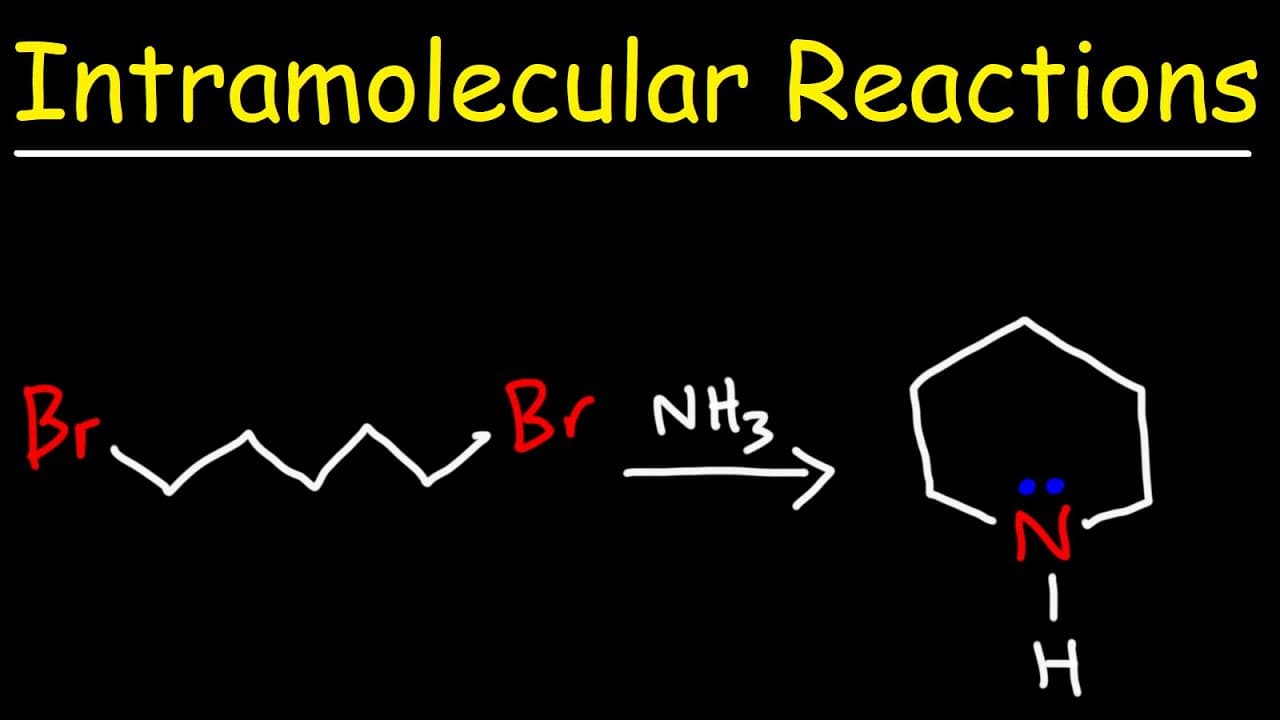
- 💁 In the reaction of 1,5-bromo pentane with ammonia, a cyclic amine can be formed through an intramolecular SN2 reaction.
- 💁 Multiple products can be formed in a reaction, and the specific product formed depends on factors such as the nucleophile and the leaving group.
- 🥺 Intramolecular SN2 reactions can lead to the formation of various cyclic compounds with different sizes and functional groups.
Install to Summarize YouTube Videos and Get Transcripts
Explore YouTube Video Summarizer or Get YouTube Transcript Extractor
Questions & Answers
Q: What is the difference between an intermolecular and intramolecular reaction in SN2 reactions?
In an intermolecular reaction, the reaction occurs between two different molecules, while in an intramolecular reaction, the nucleophile and the leaving group are in the same substrate.
Q: How is a ring formed in intramolecular SN2 reactions?
In intramolecular SN2 reactions, the nucleophile attacks the carbon, leading to the formation of a ring. The number of carbon atoms and oxygen atoms determines the size of the ring.
Q: Why can't a nucleophile perform a frontside attack in an intramolecular SN2 reaction?
In an intramolecular SN2 reaction, the nucleophile must approach the substrate from the back. A frontside attack is not possible because the nucleophile would be repelled by the partially negatively charged leaving group.
Q: What is the product formed in the reaction of 1,5-bromo pentane with ammonia?
The reaction between 1,5-bromo pentane and ammonia can result in the formation of a cyclic amine. The ammonia acts as a weak base and nucleophile, attacking the carbon atom and closing the ring.
Summary & Key Takeaways
-
An intramolecular reaction involves both the nucleophile and the leaving group in the same substrate, while an intermolecular reaction occurs between two different molecules.
-
In intramolecular SN2 reactions, a ring is formed when the nucleophile attacks the carbon, resulting in the formation of cyclic compounds.
-
Examples of intramolecular SN2 reactions include the formation of a cyclic ether and an epoxide.
Read in Other Languages (beta)
Share This Summary 📚
Summarize YouTube Videos and Get Video Transcripts with 1-Click
Try YouTube Summary with ChatGPT & Claude or YouTube Transcript Generator
Explore More Summaries from The Organic Chemistry Tutor 📚



Summarize YouTube Videos and Get Video Transcripts with 1-Click
Try YouTube Summary with ChatGPT & Claude or YouTube Transcript Generator