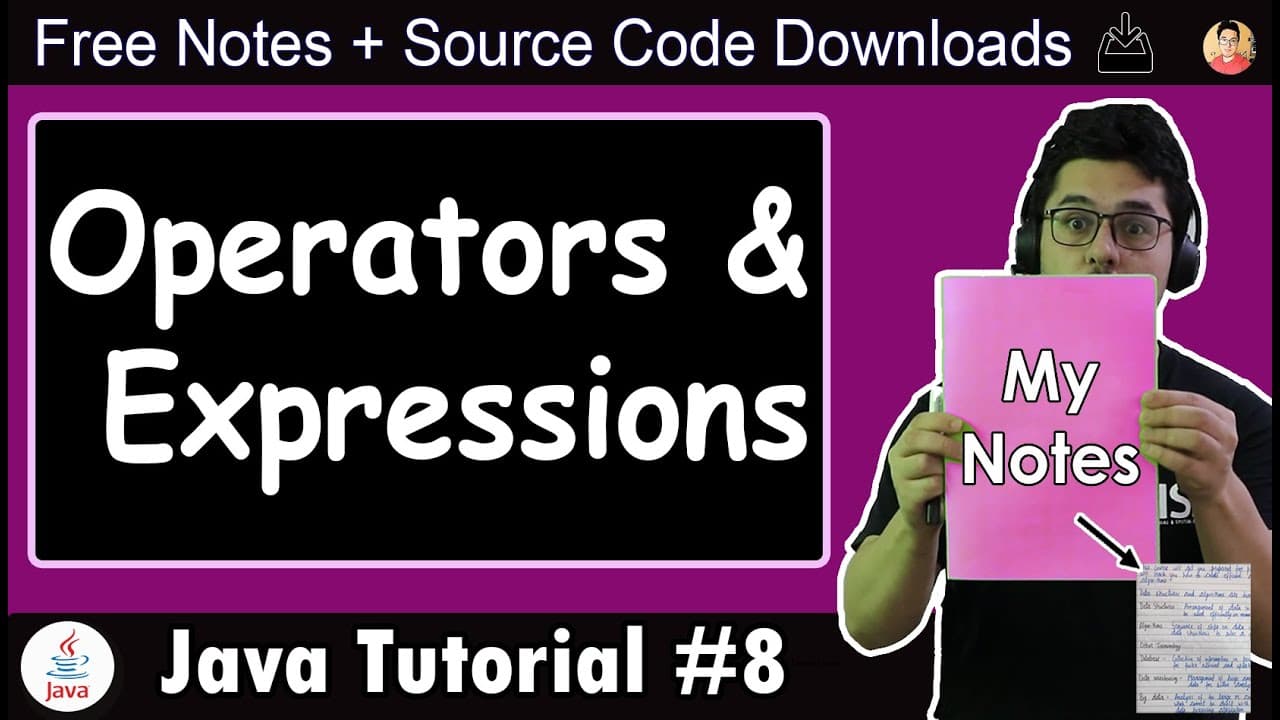
Java Tutorial: How Do Operators, Operator Types, and Expressions Work?
TL;DR
Java operators perform arithmetic, assignment, comparison, logical, or bitwise operations on values and variables within expressions. In 5 + 2, the plus sign is the operator, the numbers are operands, and the expression evaluates to 7. Examples include 6 % 4 returning 2 and b += 3 changing b from 9 to 12. Read on to understand each operator type through concrete Java examples.
Transcript
Guys, today's video is about Operators You must be thinking, what is an Operator? When we have 5 plus 2 is equal to 7 then 5 and 2 are Operands and this plus is an Operator Similarly, we have many Operators in Java Programming Now you must be knowing how to add, subtract and multiply But in this video, there are some important things which I will d... Read More
Key Insights
- An operator is a symbol that performs an operation on operands. In the expression 5 + 2, the values 5 and 2 are operands, the plus sign is the operator, and the complete expression evaluates to 7.
- Java operators can process both literal values and variables. If x contains 8, an expression such as x + 2 uses the stored variable value, while an assignment such as b = x - 2 stores the calculated result in b.
- Arithmetic operators include addition, subtraction, multiplication, division, and modulo. The lesson states that arithmetic operators do not work with Boolean values, and it demonstrates ordinary numerical calculations such as 6 + 4, 6 - 4, and 6 multiplied by 4.
- The modulo operator returns the remainder from division. The expression 6 % 4 evaluates to 2 because 4 fits into 6 once and leaves 2, making modulo useful when the remainder matters rather than only the division result.
- An assignment operator stores a value or expression result in a variable. A single equals sign in int b = 6 * a means that the calculated value of 6 multiplied by a is assigned to the variable b.
- Compound assignment operators update a variable using its current value. If b is 9, b += 3 means b = b + 3 and produces 12, while b *= 3 follows the same pattern by multiplying the existing value by 3.
- Comparison operators return true or false after checking relationships. Double equals checks equality, while greater than, less than, greater than or equal to, and less than or equal to compare values and can later support conditional program behavior.
- Logical and bitwise operators work at different levels. Logical AND requires all connected conditions to be true, logical OR requires at least one true condition, and bitwise AND operates on corresponding binary bits, with 2 & 3 producing 2 in the demonstration.
Install to Summarize YouTube Videos and Get Transcripts
Explore YouTube Video Summarizer or Get YouTube Transcript Extractor
Questions & Answers
Q: What are operators, operands, and expressions in Java?
An operator is a symbol that performs an operation on values or variables, while operands are the values or variables involved. In 5 + 2, the plus sign is the operator, 5 and 2 are operands, and the complete expression evaluates to 7.
Q: What types of operators are covered in this Java tutorial?
The tutorial primarily covers arithmetic, assignment, comparison, logical, and bitwise operators. These operators calculate results, store or update values, compare values, combine conditions, or operate on binary bits.
Q: How do arithmetic operators work in Java expressions?
Arithmetic operators calculate results from numerical values or variables. The examples show 6 + 4 producing 10, 6 - 4 producing 2, and 6 multiplied by 4 producing 24; the tutorial also states that arithmetic operators do not work with Boolean values.
Q: What does the modulo operator do in Java?
The modulo operator, written as %, returns the remainder after division. The expression 6 % 4 evaluates to 2 because dividing 6 by 4 leaves a remainder of 2.
Q: What is the difference between = and == in Java?
A single equals sign assigns a value or expression result to a variable, as when the result of 6 multiplied by a is stored in b. A double equals sign compares two values and returns true or false, so 6 == 8 is false while 6 == 6 is true.
Q: How do compound assignment operators work in Java?
A compound assignment operator updates a variable using its existing value. If b starts at 9, b += 3 means b = b + 3 and changes b to 12; similarly, b *= 3 means b = b * 3 and produces 27 when b starts at 9.
Q: What do comparison operators return in Java?
Comparison operators evaluate relationships between values and return true or false. The tutorial shows that 64 > 6 evaluates to true, while 64 < 6 evaluates to false.
Q: How does bitwise AND work in Java?
Bitwise AND operates on corresponding bits in the binary representations of numbers. In the demonstrated example, 2 is represented as 10 and 3 as 11, so 2 & 3 produces 10 in binary, which equals 2.
Summary & Key Takeaways
-
Java expressions combine operators with operands such as values and variables. Basic arithmetic examples demonstrate addition, subtraction, multiplication, and modulo. The modulo operator returns the remainder after division, so evaluating 6 % 4 produces 2 because dividing 6 by 4 leaves a remainder of 2.
-
Assignment operators store values in variables. A single equals sign assigns an expression's result, while compound forms update an existing value. For example, if b starts at 9, b += 3 changes it to 12. Similarly, b *= 3 represents assigning the result of b multiplied by 3.
-
Comparison operators evaluate relationships and produce true or false. Logical AND requires every connected condition to be true, while logical OR produces true when at least one condition is true. Bitwise operators instead operate bit by bit on binary representations, as demonstrated by applying bitwise AND to 2 and 3.
Read in Other Languages (beta)
Share This Summary 📚
Summarize YouTube Videos and Get Video Transcripts with 1-Click
Try YouTube Summary with ChatGPT & Claude or YouTube Transcript Generator
Explore More Summaries from CodeWithHarry 📚




Summarize YouTube Videos and Get Video Transcripts with 1-Click
Try YouTube Summary with ChatGPT & Claude or YouTube Transcript Generator