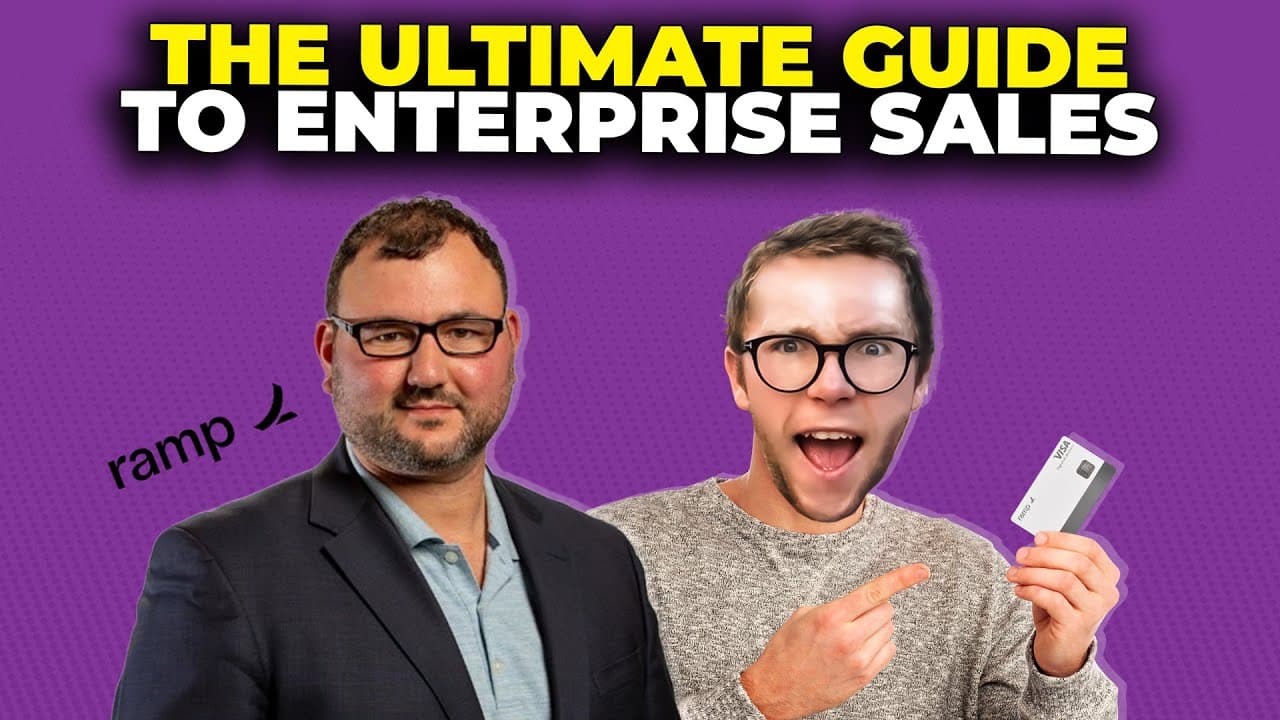
Mark Goldberger on Enterprise Sales and Hiring Reps
TL;DR
Early enterprise sellers do not need product-market fit. They need product-customer fit: focus on the accounts whose required capabilities match your core competencies. Mark Goldberger, Head of Enterprise Sales at Ramp, used this approach as the first enterprise rep at TripActions (now Navan). He prioritized 87 open opportunities and closed about $13 million in revenue in his first year.
Transcript
there's a great quote from John McMahon who was a tremendous sales leader the difference between winners and losers is that losers practice until they get it right winners practice until they never get it wrong Mark I am so excited for this I had so many great things from so many former colleagues of yours and current colleagues of yours so thank y... Read More
Key Insights
- Product-customer fit is what an early enterprise seller needs, not product-market fit. It means finding accounts whose required capabilities match the company's core competencies and the vision it is building toward, then focusing effort on those accounts.
- The 80/20 rule applies to enterprise pipeline. Mark Goldberger had 87 opportunities in his first six to nine months at TripActions. By focusing on the 20 percent that would drive 80 percent of the outcome, he closed about $13 million in his first year.
- Lean, pivot, walk is a qualification method Goldberger built. Lean in when the prospect's needs match what you do well. Walk away when what they need is not on your roadmap for years. Pivot when you meet only some of their requirements.
- Happy ears are a common failure among sales reps. A prospect agreeing to a meeting does not mean there is a real opportunity, so reps need to be honest with themselves and qualify deals out when the fit is not there.
- The sales playbook should come from the salesperson, while product-market fit is driven by the founder talking to customers and prospects. Goldberger advises against hiring a VP of Sales before the company has a seller, because a leader arrives with preconceived processes that may not fit.
- Logos are the currency of a startup's first sales, not revenue. Early customers provide credibility, feedback, case studies and references, and these matter more than the revenue from those deals.
- The first sales hire should come as soon as a founder has a product to test in the market. Goldberger thinks this is much sooner than the often-cited $1 million ARR mark.
- Early sales hiring should target people who can deliver 10x growth, not 1x or 1.5x. Such people are rare, so hiring two at once mostly makes sense at scale, for example when growing from 20 to 30 to 40 reps.
Install to Summarize YouTube Videos and Get Transcripts
Explore YouTube Video Summarizer or Get YouTube Transcript Extractor
Questions & Answers
Q: What is product-customer fit in enterprise sales?
Product-customer fit means finding the specific customers whose required capabilities match your product's core competencies and the vision you are building toward. Mark Goldberger argues that an early enterprise seller does not need full product-market fit to close deals. Instead, the seller should prioritize the accounts where the fit is strongest. Focusing on the 20 percent of accounts that will drive 80 percent of the outcome leads to far better results.
Q: How does the lean, pivot, walk qualification method work?
Lean, pivot, walk is a qualification method Mark Goldberger built. If the boxes a prospect wants checked are ones your product checks well, lean in and pursue the deal fully. If what they need is not on your roadmap for the next five years, walk away and qualify the deal out. If you check some boxes but not others, look for ways to pivot. One example is the buyer using one solution for North America and another for the rest of the world.
Q: How did Mark Goldberger close $13 million in his first year at TripActions?
As the first enterprise account executive at TripActions, now Navan, Mark Goldberger built a very large pipeline: 87 opportunities in his first six to nine months, which he admits is far too many for enterprise sales. He began closing deals around month six. By prioritizing the accounts with the strongest product-customer fit, he closed about $13 million in revenue that first year.
Q: Should a startup hire a VP of Sales before its first salesperson?
Mark Goldberger says no. A VP of Sales usually arrives with a set playbook, processes and tools in mind, and these may not fit the product being sold or the people in the organization. Forcing a square peg into a round hole creates thrash and wastes an early startup's time. He recommends that the founder act as the first seller, or that the company hire a junior salesperson to figure things out, before bringing in a sales leader.
Q: When should a founder hire the first sales rep?
Mark Goldberger believes founders should hire their first sales rep as soon as they have a product they want to test in the market. That is much sooner than the commonly cited $1 million ARR mark. In these first sales, revenue is not what matters most. The rep's job is to win recognizable logos, gather customer feedback, and build case studies and references that give the company credibility for later revenue-focused sales.
Q: Why are customer logos more important than revenue for early-stage startups?
According to Mark Goldberger, logos are the currency that matters in a startup's first sales. Being able to say that a well-known company works with you builds credibility for future deals. Early customers also provide product feedback, case studies and references. Together, these assets help the company make later sales that do bring meaningful revenue, which is why they matter far more than the revenue from the first deals.
Q: Should startups hire two sales reps at the same time?
Mark Goldberger only hires salespeople who can deliver 10x growth, not 1x or 1.5x. People like that are rare, so finding and recruiting two of them at the same moment is unusual. If you do find two, hire them both quickly. Hiring in pairs or classes makes more sense at scale, such as when growing from 20 to 30 to 40 reps. In the early days, he says, you should grab the best talent whenever it appears.
Q: Why did Mark Goldberger struggle to get his first SaaS sales job?
Mark Goldberger had founded a bootstrapped SaaS company for the wine industry and had always been a top sales performer. Even so, about 100 resumes sent to Silicon Valley companies produced no interviews. He sees fault on both sides. Software companies and sales leaders searched too narrowly for one candidate profile, and his own approach did not fit a world that was new to him. A recruiter eventually helped him land a role at Highfive.
Summary & Key Takeaways
-
Mark Goldberger came to enterprise sales from wine. He sold for a wine distributor while in business school, then bootstrapped a cloud SaaS company for the wine industry that had paying customers. After winding it down and moving to Silicon Valley, he sent his resume to about 100 companies and got no interviews.
-
A recruiter helped him land at Highfive, a video conferencing company competing with Zoom, where he spent two years. He then became the first enterprise account executive at TripActions, now Navan. Over four and a half years he helped bring in more than $100 million of ARR as an individual contributor and as a sales leader.
-
His main lesson is to sell on product-customer fit: prioritize accounts that match your strengths and qualify out the rest with his lean, pivot, walk method. On hiring, he advises bringing in a junior seller early, valuing early logos over revenue, and hiring only reps capable of 10x growth.
Read in Other Languages (beta)
Share This Summary 📚
Summarize YouTube Videos and Get Video Transcripts with 1-Click
Try YouTube Summary with ChatGPT & Claude or YouTube Transcript Generator
Explore More Summaries from 20VC with Harry Stebbings 📚





Summarize YouTube Videos and Get Video Transcripts with 1-Click
Try YouTube Summary with ChatGPT & Claude or YouTube Transcript Generator