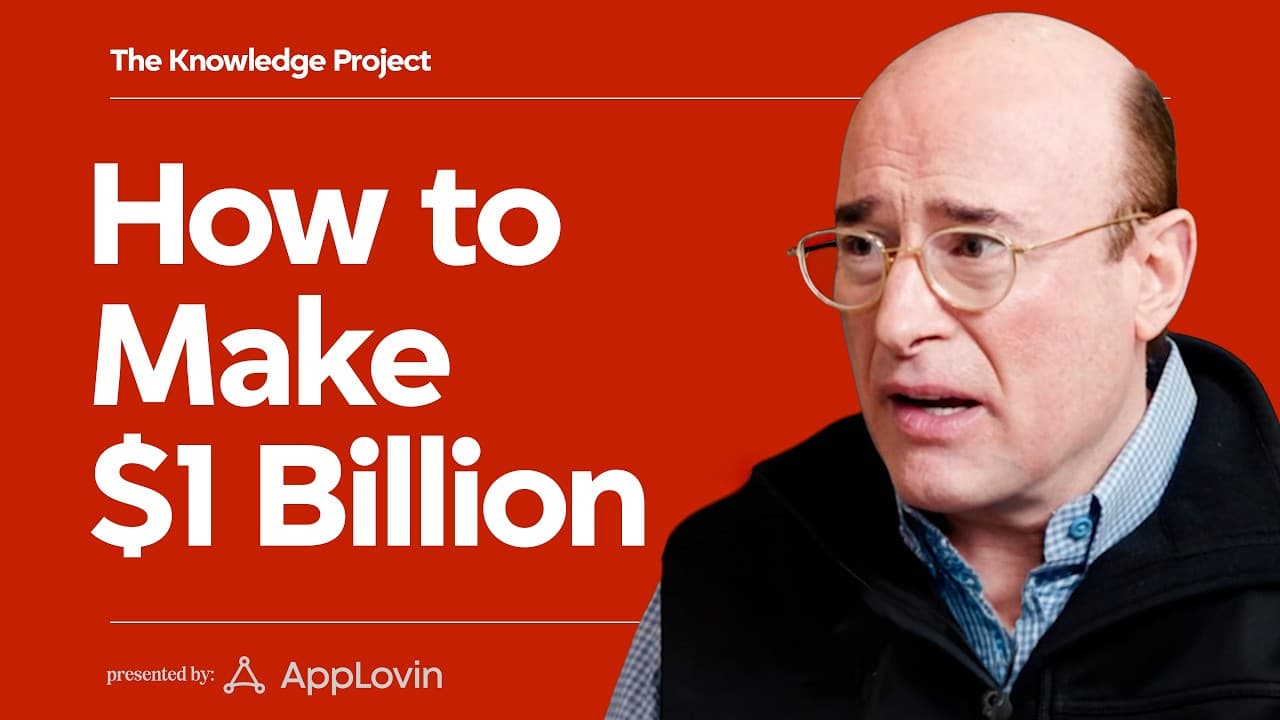
How to spot major business trends and grow wealth
TL;DR
Get the core idea that big wealth comes from capitalizing on major trends, not following rigid plans. The interview emphasizes staying curious, doing deep research, and using acquisitions to compound value. It also highlights psychology, therapy, and AI as drivers of smarter decision making. Don’t miss practical questions to uncover opportunities.
Transcript
So, I looked at that org chart and said, "This is a messed up org chart." Which is great for making money. If you can find something that's messed up and easy to unsess, booyah, there's your money. There's your opportunity to make a lot of money. You've made a few billion dollars. What lessons have you learned about money and spending money and liv... Read More
Key Insights
- The key to scaling wealth is identifying a major trend and aligning actions to advantage, rather than following a fixed plan.
- The growth engine most effective for Jacobs is M&A and selective acquisitions across hundreds of deals, which compounds value over time.
- Rigidity in business planning often fails when markets and technologies change, so adaptable strategies outperform rigid roadmaps.
- A systematic trend spotting process combines context, origin, present conditions, and plausible future paths to reveal opportunities.
- Questioning is a core skill; Jacobs uses a relentless curiosity driven by therapy and structured thinking to uncover rational, actionable insights.
- The research approach blends team support with hands on involvement, ensuring both breadth and depth in evaluating potential deals.
- Artificial intelligence is seen as a primary driver of the future, with expectations that computing power will outpace human limitations.
- Personal development, including therapy and mindfulness, is presented as essential to sustaining calm, rational leadership and better decision making in business.
Install to Summarize YouTube Videos and Get Transcripts
Explore YouTube Video Summarizer or Get YouTube Transcript Extractor
Questions & Answers
Q: What is the main driver behind Brad Jacobs’s wealth growth, according to the interview?
The main driver behind wealth growth is leveraging major trends through acquisitions, not adhering to a rigid long term plan. Jacobs emphasizes that misalignments in a static plan are acceptable if the big trend is right, and that acquisitions multiply opportunities by integrating and scaling multiple businesses under a common growth engine.
Q: How does Jacobs view rigidity in business planning?
Jacobs argues that rigidity is a liability because markets, economies, and technologies change. He believes that adapting to evolving conditions and capitalizing on emerging opportunities is more reliable for shareholder value than sticking to an inflexible blueprint, as long as the major trend remains favorable.
Q: What role does M&A play in Jacobs’s strategy?
M&A is the growth engine. Jacobs has been involved in hundreds of acquisitions and believes acquiring the right companies accelerates growth, distribution of resources, and economies of scale. He also notes that evaluating thousands of potential targets to find a few successful fits is central to the approach.
Q: Why is trend spotting emphasized as a skill, and how does he do it?
Trend spotting is essential because getting the major trend right can compensate for other missteps. Jacobs studies context, origin, and future catalysts, and spends substantial time thinking about where things are headed, using a structured method to map possible outcomes and identify opportunities before they become obvious.
Q: How important is psychology in Jacobs’s framework?
Psychology is crucial because it affects decision making under pressure. Jacobs discusses therapy, mindfulness, and emotional awareness as tools to reduce cognitive distortions and biases, enabling calmer, more rational choices in high stakes situations, which in turn improves leadership and investment outcomes.
Q: What is Jacobs’s research style?
Jacobs combines hands on analysis with team based research. He values getting into the details of potential targets while also leveraging a research team. He prefers asking many questions and learning from others, treating himself as a student of life and business rather than a guru.
Q: What is the expected impact of AI, according to the interview?
AI is described as the number one trend with the potential to vastly outperform human cognitive limits in processing information. Jacobs anticipates AI enabling deeper insights, faster decision making, and eventually systems with more advanced capabilities, including emotion and theory of mind, transforming how value is created.
Q: How does Jacobs think about personal development and decision making?
Personal development is integrated into business strategy. Jacobs references therapy and meditation as ways to sharpen thinking, manage emotions, and improve rationality. This approach supports better management, clearer decision making, and a steadier approach to capital allocation and leadership.
Summary & Key Takeaways
-
The conversation centers on Brad Jacobs’s approach to identifying and exploiting major trends, emphasizing flexibility over rigid long term plans and using acquisitions to accelerate growth. It also stresses the importance of psychology, self reflection, and continuous learning as a competitive advantage.
-
Jacobs explains how market shifts and trend recognition enable outsized returns, with a focus on M&A and asymmetric opportunities that leverage existing platforms for scale and efficiency. The mindset combines curiosity, disciplined questioning, and a willingness to adapt to changing conditions.
-
The discussion weaves in personal development tools like therapy and meditation to improve decision making, calm under pressure, and rational thinking, linking these to better leadership and investment outcomes in a rapidly evolving tech driven world.
Read in Other Languages (beta)
Share This Summary 📚
Summarize YouTube Videos and Get Video Transcripts with 1-Click
Try YouTube Summary with ChatGPT & Claude or YouTube Transcript Generator
Explore More Summaries from The Knowledge Project Podcast 📚





Summarize YouTube Videos and Get Video Transcripts with 1-Click
Try YouTube Summary with ChatGPT & Claude or YouTube Transcript Generator