How Does Process Creation Work in Operating Systems?
TL;DR
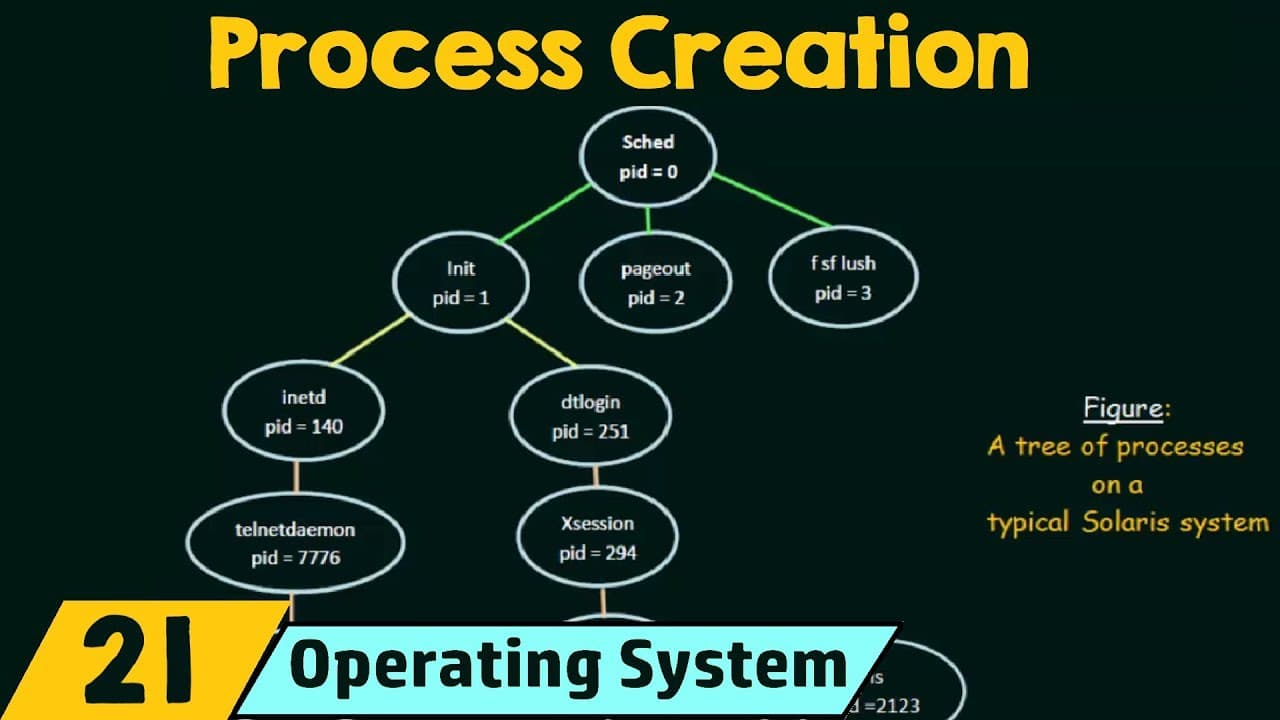
Process creation enables a parent process to generate multiple child processes through a system call, establishing a hierarchical process tree. Each child can create further children, leading to a complex structure where processes manage resources and execution sequentially or concurrently.
Transcript
in this lecture we'll be studying about operations on processes and this lecture particularly will be about process creation so let us see what is this process creation so it says here a process may create several new processes via a create process system called during the course of execution so when we have been studying about processes from the l... Read More
Key Insights
- 🤙 Process creation involves the creation of multiple new processes through a system call called create process.
- 👪 The parent process is responsible for creating child processes, forming a hierarchical structure known as the process tree.
- 👶 Child processes can further create their own children, leading to the formation of a tree-like structure.
- 👪 The parent process can continue executing concurrently with its children or wait for them to complete before resuming execution.
- 👶 Child processes can either be duplicates of the parent process or have a new program loaded into them.
- 👪 Resource allocation can be inherited from the parent process or selectively allocated to child processes.
- 🌲 The process tree represents the hierarchy and relationship between processes in an operating system.
Install to Summarize YouTube Videos and Get Transcripts
Explore YouTube Video Summarizer or Get YouTube Transcript Extractor
Questions & Answers
Q: What is process creation in operating systems?
Process creation refers to the ability of a process to create multiple new processes through a system call, forming a hierarchy of processes.
Q: What are the roles of parent and child processes in process creation?
The process that creates new processes is known as the parent process, while the newly created processes are called the child processes.
Q: What is the significance of the process tree in operating systems?
The process tree represents the hierarchical relationship between parent and child processes, with each child being created by its parent and potentially creating its own children.
Q: Can a process continue executing concurrently with its children?
Yes, in some cases, the parent process can continue executing concurrently with its children, even after creating them.
Q: When does a parent process wait for its children to terminate?
In certain scenarios, the parent process waits for its children to complete their execution before resuming its own execution. This can be useful for synchronizing processes or ensuring correct resource allocation.
Q: Are child processes duplicates of the parent process?
It depends. In some cases, child processes are exact duplicates of the parent process, with the same program and data. However, child processes can also have a new program loaded into them, different from the parent's program.
Q: What are the possibilities in terms of resource allocation for child processes?
Child processes can either inherit all of the parent's resources or have a subset of the parent's resources allocated to them, depending on the specific requirements.
Q: What is the relationship between process creation and address space in the new process?
The new process can either have the same program and data as the parent process or have a new program loaded into it, depending on the needs of the parent process.
Key Insights:
- Process creation involves the creation of multiple new processes through a system call called create process.
- The parent process is responsible for creating child processes, forming a hierarchical structure known as the process tree.
- Child processes can further create their own children, leading to the formation of a tree-like structure.
- The parent process can continue executing concurrently with its children or wait for them to complete before resuming execution.
- Child processes can either be duplicates of the parent process or have a new program loaded into them.
- Resource allocation can be inherited from the parent process or selectively allocated to child processes.
- The process tree represents the hierarchy and relationship between processes in an operating system.
- Process creation plays a crucial role in managing and coordinating processes within an operating system.
Summary & Key Takeaways
-
A process can create multiple new processes under it through a create process system call, forming a tree-like structure.
-
The creating process is called the parent process, and the new processes are called the children.
-
Each child process may in turn create its own children, creating a hierarchy or tree of processes.
Read in Other Languages (beta)
Share This Summary 📚
Summarize YouTube Videos and Get Video Transcripts with 1-Click
Try YouTube Summary with ChatGPT & Claude or YouTube Transcript Generator
Explore More Summaries from Neso Academy 📚



Summarize YouTube Videos and Get Video Transcripts with 1-Click
Try YouTube Summary with ChatGPT & Claude or YouTube Transcript Generator