How Does Time Shape Consciousness and Identity?
TL;DR
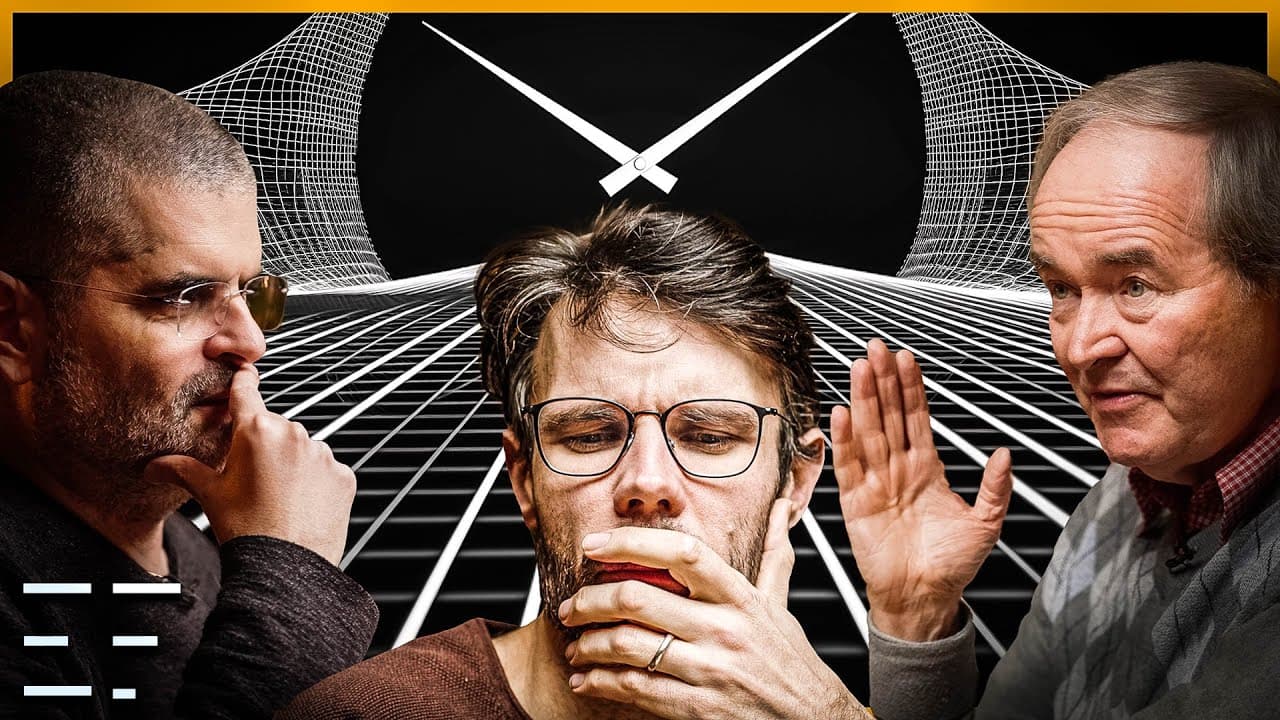
Consciousness may require more than the single time dimension used in ordinary physical descriptions, because one-dimensional time cannot readily explain how distinct identities could belong to a larger consciousness. Carr proposes extra time dimensions with broader specious presents, while Kastrup emphasizes that clocks measure perceived change and that both time and observation remain forms of experience within an idealist perspective.
Transcript
Mozart. His symphonies would come into his head. But if you believe in precognition, you should be able to see your future work, be it a poem or a piece of music. You think you're creating this, but actually, you're hearing yourself, you're plagiarizing yourself in the future. So the question is, is that telling you something subtle about the natur... Read More
Key Insights
- The mystery of consciousness substantially overlaps with the mystery of time because clock ticks, perceived change, and the observer’s awareness are all discussed as contents of experience rather than as wholly separate categories.
- Clock measurement is based on perception because the ticking of a clock is experienced mentally, even when its ticks are counted and assigned a number that gives the measurement a degree of objectivity.
- The block universe represents spacetime as a single landscape containing the past, present, and at least possible futures, allowing a hypothetical higher perspective to survey a life as an extended structure rather than a sequence of disappearing moments.
- The human specious present lasts about one-tenth of a second, while a higher time dimension could possess a much broader present, potentially spanning 14 billion years without its corresponding clock completing a single tick since the Big Bang.
- One-dimensional time cannot explain separate identity within a larger consciousness, according to Carr and Kastrup, because it lacks the extra degrees of freedom needed for one consciousness to be both differentiated and unified at the same time.
- Carr’s model adds an extra temporal dimension because he considers consciousness, especially anomalous and transpersonal experiences, incompatible with a strictly four-dimensional Einsteinian block universe rather than naturally explained by it.
- Psychical research provides a proposed bridge between science and mysticism because scientists may reject it as too mystical, while mystics may regard it as too scientific, leaving it in an uncomfortable position between the two communities.
- Interdisciplinary progress depends on connecting fields that normally remain separate, including physics, philosophy, psychology, neuroscience, cosmology, and psychical research, especially when the central problem concerns the relationship between time and mind.
Install to Summarize YouTube Videos and Get Transcripts
Explore YouTube Video Summarizer or Get YouTube Transcript Extractor
Questions & Answers
Q: How could multiple time dimensions explain consciousness?
Multiple time dimensions could provide the extra degrees of freedom needed to describe how a larger consciousness differentiates into separate individual consciousnesses. In one-dimensional time, Carr argues, it is difficult to explain how one person could remain distinct from another while both participate in a deeper identity. A multidimensional model allows separation and unity to operate across different temporal scales.
Q: What is the relationship between time and consciousness?
Time and consciousness overlap because the passage of time, clock ticks, and changes in an observer are all encountered through experience. Kastrup notes that even an apparently objective clock reading begins with perceived ticking that is counted and quantified. The discussion therefore treats the nature of time and the nature of mind as connected mysteries rather than fully independent problems.
Q: What is the specious present in the discussion of time?
The specious present is the experienced interval treated as now rather than a dimensionless instant. The discussion states that the human specious present lasts about one-tenth of a second. Carr proposes that a higher time dimension could have a much larger present, so questions about what exists now require clarification about the temporal scale and kind of present being considered.
Q: How does the block universe describe a person’s life?
The block universe describes spacetime as an extended landscape in which the past, present, and at least possible futures belong to one structure. From a hypothetical higher perspective, an entire personal timeline could be surveyed together. Birth, school, death, and other events would not simply vanish, but would remain locations or parts of that larger spacetime landscape.
Q: Why does Carr reject the block universe as an explanation of consciousness?
Carr says consciousness cannot be accommodated within Einstein’s four-dimensional spacetime and therefore cannot be explained by the block universe alone. Although some people regard anomalous phenomena as compatible with a fixed spacetime structure, Carr proposes an extra dimension. His aim is to provide additional temporal freedom for consciousness, identity, and experiences that exceed ordinary descriptions.
Q: How can clocks measure time if ticking is an experience?
A clock gains a degree of objectivity because its ticks can be counted and expressed numerically, but the ticking itself remains a content of perception in Kastrup’s account. Measurement therefore does not remove experience from the picture. It standardizes an experienced pattern of change, allowing observers to attach a shared quantity to what is still encountered mentally.
Q: Why is psychical research important to Bernard Carr?
Psychical research is important to Carr because he sees it as a bridge between science and mysticism. Scientists may dismiss the subject because it appears too mystical or because they doubt the phenomena, while mystics may reject its scientific treatment. Carr considers this uncomfortable position valuable because bridging separated disciplines may contribute to a more unified view of reality.
Q: Could creativity involve information from the future?
The discussion raises the possibility that precognition could change how creativity is understood. If future information were accessible, a composer or poet might appear to create something while actually receiving information connected to their own future work. This idea is presented as a question about genius, creativity, and whether information from the future could be compatible with physics.
Summary & Key Takeaways
-
Bernard Carr and Bernardo Kastrup connect questions about consciousness to questions about time. They examine whether physical descriptions of time can accommodate ordinary awareness, separate personal identities, and anomalous mental phenomena. Their discussion brings cosmology, philosophy, psychology, neuroscience, psychical research, and idealism into a shared inquiry about mind and reality.
-
Kastrup argues that clock ticks and the passage they quantify are contents of perception. A changing observer moves with surrounding change, complicating claims that time simply flows past a fixed self. The discussion compares this experiential view with the block universe, where an entire spacetime landscape can be treated as existing together.
-
Carr proposes that additional time dimensions could provide extra degrees of freedom needed to discuss consciousness and identity. A higher temporal perspective might possess a vastly broader specious present than the roughly one-tenth-second human present. Within that framework, birth, death, and other moments could remain accessible parts of a larger temporal landscape.
Read in Other Languages (beta)
Share This Summary 📚
Summarize YouTube Videos and Get Video Transcripts with 1-Click
Try YouTube Summary with ChatGPT & Claude or YouTube Transcript Generator
Explore More Summaries from Essentia Foundation 📚

Summarize YouTube Videos and Get Video Transcripts with 1-Click
Try YouTube Summary with ChatGPT & Claude or YouTube Transcript Generator